 look news india

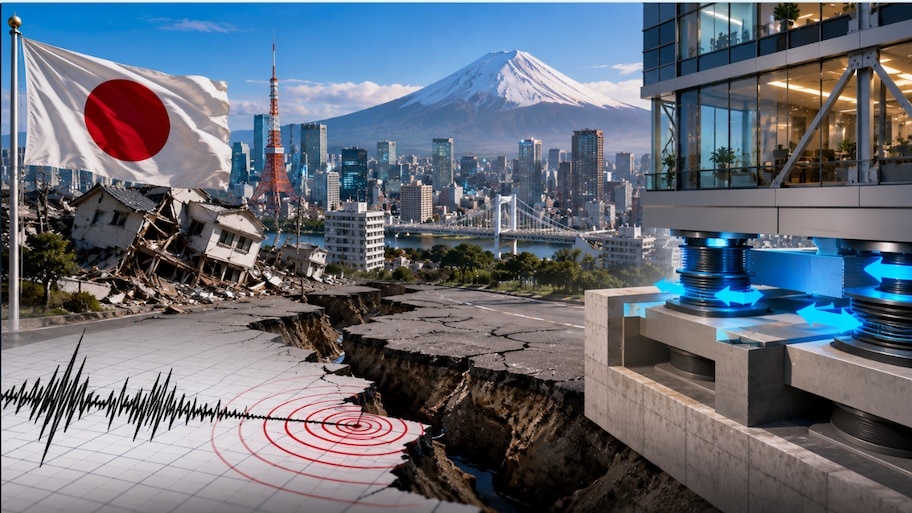
Imagine if the earth shakes more than 1500 times every year in a country, then what will be the view there? If such a big natural disaster occurs in any other corner of the world, then the luxurious cities will turn into piles of debris in a moment. But Japan is such a unique country that faces this terrible challenge with a smile every day and still stands proudly in front of the whole world. Despite being situated at the junction of the four most dangerous tectonic plates, the skyscrapers here do not fall apart like a deck of cards. There is no natural miracle behind this, but decades of rigorous research by Japanese scientists, excellent anti-earthquake engineering and their amazing preparation to fight the disaster.
The deadly web of four tectonic plates that surrounded Japan
Japan’s geographical location is its biggest enemy. This country is located directly above four large and very active tectonic plates named Pacific, Philippine Sea, Eurasian and North American. These plates continuously collide with each other inside the ground and keep sliding under each other. Due to this geological upheaval, about 20 percent of the total dangerous earthquakes occurring around the world are recorded in Japan and its surrounding sea areas alone. Being located on the ‘Ring of Fire’ of the Pacific Ocean makes it the most sensitive danger zone in the world.
The buildings here do not fight earthquakes, but shake like water
Japan has learned to live in harmony with nature instead of fighting it. ‘Base Isolation Technology’ technology is used in the modern skyscrapers here. In this technique, very thick and flexible bearings made of rubber, lead and steel are installed between the main foundation and upper structure of the building. Whenever a strong earthquake occurs, these bearings absorb the dangerous shock of the ground, due to which the foundation shakes but the upper building remains completely stable and safe. Apart from this, just as there are shock absorbers in cars, similarly heavy dampers (Tuned Mass Dampers) are installed in buildings, which dissipate the energy of earthquake vibrations in the air.
Insistence on strict law: Test on the world’s largest simulator ‘E-Defense’
Japan has suffered many such wounds in its history which devastated the entire country, such as the ‘Great Kanto Earthquake’ of 1923 and the ‘Kobe Earthquake’ of 1995. Learning from these mega-accidents, Japan has made its ‘Building Safety Laws’ the strictest and strictest in the world. Here it is mandatory by law to build such buildings which can easily withstand even severe shocks of intensity 8 or 9 on the Richter scale without collapsing. Japanese scientists conduct live tests of real multi-storey buildings on the world’s largest shaking table (earthquake simulator) called ‘E-Defense’ so that even the smallest construction defects can be rectified in time.
Alert in the blink of an eye: Automatic emergency brakes are applied in bullet trains
Japan has the world’s fastest and most accurate ‘Earthquake Early Warning System’ (EEW). As soon as primary waves (P-waves) arise hundreds of kilometers underground, sensors spread across the country capture them within milliseconds. A few seconds before the destructive waves (S-waves) reach the ground, a special emergency alarm and alert is sent to the mobile phones of citizens across the country. In such a short time, the machines of big factories of the country stop automatically, the lifts of buildings stop on the nearest safe floor and open and people get a precious chance to recover.
Not only this, Japan’s famous ‘Shinkansen Bullet Train’ is directly connected to this national earthquake detection network. As soon as the sensors detect even the slightest shock, emergency brakes are automatically activated in bullet trains running at speeds of up to 300 km/h. Trains stop safely on the tracks before the destructive waves arrive, which is why despite so many earthquakes over the decades, there has been no major bullet train accident in Japan till date.
Modern technology stolen from centuries old wooden towers (Pagodas)
The interesting thing is that this Japanese understanding of earthquake prevention is not just a contribution of modern science. Japanese pagodas made of centuries-old wood have always stood safe even in the biggest earthquakes. Ancient engineers placed a main and heavy wooden pillar in the middle, which is called ‘Shinbashira’. During an earthquake, this pillar gives flexibility to the entire tower like a snake, due to which different parts of the building balance the energy by moving in opposite directions. Today’s modern Japanese engineers are creating the world’s safest skyscrapers by deeply studying this ancient art and architecture.