 look news india

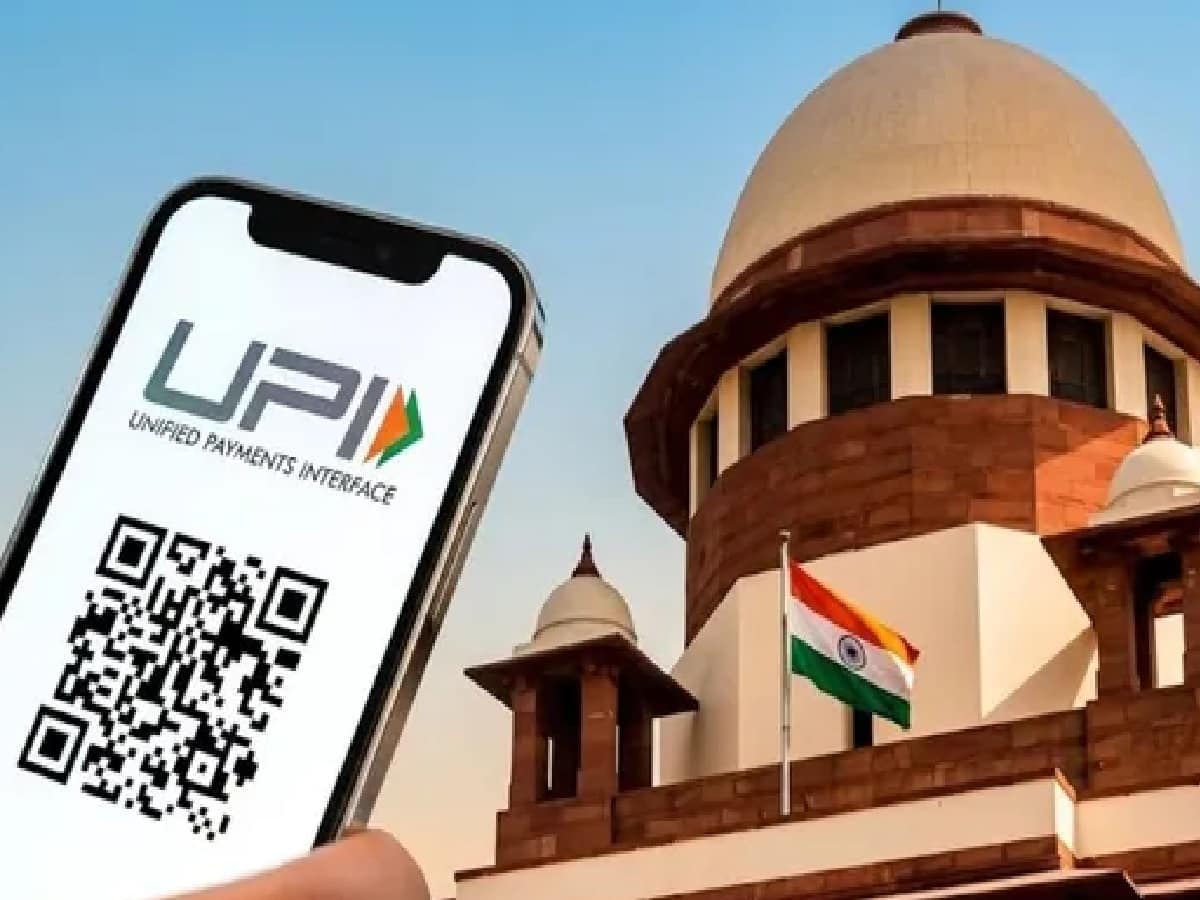
A major legal and policy dispute regarding the Unified Payments Interface (UPI), which has become an important part of the daily lifestyle of crores of citizens and businessmen across the country, has reached the doorstep of the Supreme Court of the country. The Supreme Court, hearing a PIL challenging the Central Government’s recent decision to impose Merchant Discount Rate (MDR) on merchant UPI transactions amounting above ₹2000, has issued a formal notice to the Central Government, the Reserve Bank of India (RBI), National Payments Corporation of India (NPCI) and the UPI and Services Steering Committee. The court has sought responses from all concerned parties by filing detailed affidavits within four weeks.
A three-member special bench of Justice Surya Kant, Justice Joymalya Bagchi and Justice V. Mohana heard the case in depth. Although a strong demand was made by the petitioner for an interim stay on the implementation of this new proposed fee structure with immediate effect, the apex court clearly refused to give any kind of stay order at this initial stage. This simply means that the policy process decided by the government and the concerned financial institutions will be able to proceed smoothly for the time being.
This petition has been filed in the Supreme Court by petitioner lawyer Anjan Dutta through advocate Ashutosh Dubey. In this petition, the official gazette notification issued by the Central Government on 14 September 2026 under Section 10A of the Payment and Settlement Systems Act, 2007 has been mainly challenged, calling it unconstitutional and arbitrary. Along with this, the petition has also sought to repeal the detailed policy framework announced on September 15, through which a provision has been made to impose Merchant Discount Rate (MDR) up to 0.4 percent on select Person-to-Merchant (P2M) UPI transactions worth more than ₹ 2000.
Under the proposed rules, the maximum fee (cap) for large commercial transactions amounting to ₹75,000 and above has been fixed at ₹300, while different concessional rates have been set for different business sectors and essential services. The petitioner’s lawyer gave a strong argument in the court saying that if such indirect charges are imposed on digital payments, it will cause a deep blow to the Digital India Mission, will encourage cash transactions again and may increase the possibilities of tax evasion and corruption in the market.
Additional Solicitor General (ASG) N. representing the Central Government in the Supreme Court. Venkataraman strongly defended this policy move of the government. The ASG made clear and factual arguments before the court and said that this is not an extortion or a government tax. He explained to the Bench that this proposed fee is essentially a very nominal settlement fee fixed for maintaining the technical infrastructure between banks, technical service providers and payment aggregators, of which not a single rupee goes into the treasury of the Government of India.
The law officer of the central government also underlined that more than 96 percent of the total UPI transactions in the country will remain completely out of the scope of this new rule. He said that for milk, medicine, ration and other extremely essential civil services, the upper limit of this fee has been fixed at only ₹ 5. ASG stressed that banks have to continuously spend on huge server capacity, cloud space and technical resources to process millions of digital transactions. MDR is already applicable on credit card and debit card transactions, while UPI was till now operated at completely zero charges, thereby continuously increasing the financial pressure on the banking system.
Amidst this entire legal dispute and court process, the Union Finance Ministry has clarified the situation, completely removing the concerns of the common citizens and small shopkeepers of the country. The government has reiterated that UPI payments for common consumers will remain completely free as before. Whether customers pay ₹10 or ₹50,000, they will not be charged any extra money or surcharge. Additionally, all person-to-person (P2P) financial transfers, no matter the amount, will remain completely free as always.
Giving details of protecting the interests of small traders and street vendors, the Finance Ministry said that the rule of zero fee will be applicable on small traders doing digital business up to ₹ 1 lakh in a month through UPI QR code. Additionally, more than 95 percent of daily merchant payments worth less than ₹2000 will remain completely free. This new fee structure will be applicable only to large corporate merchants, organized retail chains and high value commercial transactions.
The Reserve Bank of India (RBI) has also strongly supported this policy initiative. The central bank believes that the need of the hour is to impose nominal MDR on high-value transactions to ensure long-term sustainability of the digital payments ecosystem, advance cyber security standards and strengthen digital financial inclusion in Tier-III to Tier-VI cities and rural India.
Taking on record the preliminary arguments of the Central Government and the ASG, the Supreme Court has directed that the Central Government and the Reserve Bank should present a comprehensive affidavit detailing all the technical, economic and security aspects of this system before the court. The next detailed hearing of the case has now been fixed after four weeks. Till then there will be no restrictions on this new financial framework which will come into effect from 15 October 2026, which will give financial institutions the opportunity to prepare their technical systems smoothly.