 look news india

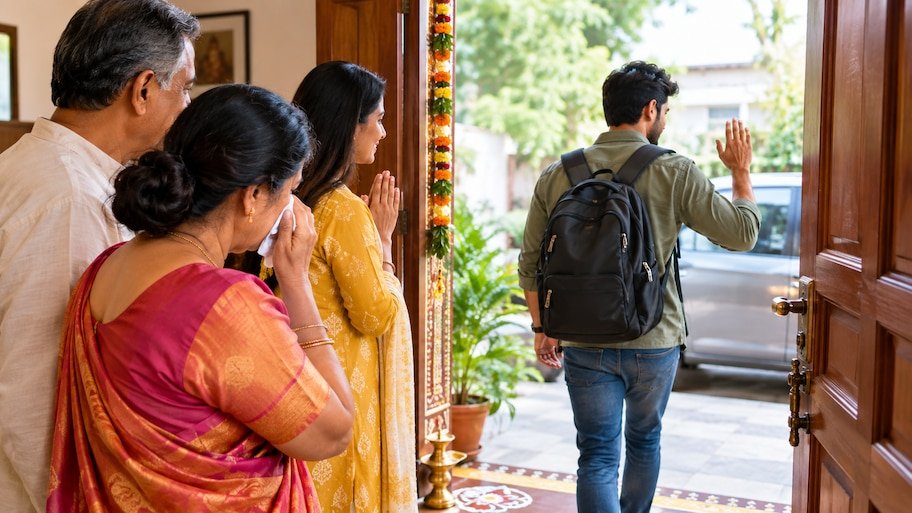
In Indian Sanatan culture, the main door of the house and its threshold (Dehri) are not just a frame of brick, stone or wood, but it is considered to be the main center of dignity, energy balance and happiness and prosperity of the family. Often the elders in our house scold us that we should not wail, cry or stand with our feet crossed while standing at the doorstep. Today’s modern generation often ignores it considering it to be just superstition or old thinking, but if investigated deeply, there are very logical Vastu rules, mythological beliefs and psychological reasons behind this rule.
According to religious and mythological beliefs, the main door of the house is the first place from where positive divine powers and Goddess Lakshmi, the goddess of wealth, enter the house. The threshold of the main gate is considered to be the area of respect for Goddess Lakshmi and Kuldevi. In the ancient tradition, the first thing women wake up every morning is to clean the door frame, sprinkle water and make Swastika or Rangoli there.
When a person stands at the doorstep and cries, screams or expresses grief, an immediate circle of negative energy is created there. Tears and lamentation are considered indicators of bad luck. According to the scriptures, instead of entering the house where there is an atmosphere of mourning and crying, Goddess Lakshmi returns from the door itself. As a result, financial constraints, unnecessary expenses and poverty gradually start spreading in that family.
From the point of view of Vastu Shastra and astrology, the threshold of the house is considered to be directly related to the shadow planet Rahu. The doorframe is the meeting point of two different energy fields—the open, playful energy outside and the protected, private energy inside the house. This junction is considered a highly sensitive energy area.
When a person stands at the doorstep and cries or expresses distress, the inauspicious influence of Rahu suddenly becomes stronger at that place. The heavy and sad waves generated by crying break the protective circle of positive energy in the house. This not only creates an atmosphere of tension and depression inside the house, but also creates a rift in the coordination between family members and fights start happening every day without any apparent reason.
According to Vastu Shastra, ‘Vastu Purush’ resides in every constructed building. The main gate is considered as respectable as the head or energetic mouth of Vastu Purusha. Apart from this, there is a Sanatan belief that the invisible powers of the gatekeeper and the family deity are stationed at the doorstep of the house, who protect the house from the evil eye, tantra-mantra and inauspicious elements from outside.
When a person sheds tears while standing at the threshold, it is considered an insult to the protective energy and the family deity. Garuda Purana and other Smriti texts also state that only auspicious, peaceful and joyful thoughts should be expressed at auspicious places and main gates. Crying or moaning causes Vaastu defects, which can affect the mental health of the head of the household and the children in the long run.
The importance of the door frame in mythological history is also linked to the appearance of Lord Narasimha. Demon king Hiranyakashyap had a boon that he would neither die during the day nor at night, neither inside nor outside the house, nor by any weapon. Lord Vishnu chose the evening time to kill Hiranyakashyap and chose the door frame of the house as the place.
This mythological incident is proof that there is a boundary line between the outer world and the inner world. This place symbolizes justice, balance and divine presence. Mourning or mourning at such a highly sensitive and spiritually important place is considered to be against spiritual propriety. That is why elders always advise to keep this place quiet and revered.
Deep practical and social rules also lie behind this religious tradition. In ancient times, household matters were confined to the four walls of the house. The door frame is the place from where passers-by, neighbors and outsiders can easily see and hear you. If someone cries at the doorstep, then the private problems, sorrows and weaknesses of the house become public.
Apart from this, seeing a crying face of any person while leaving the house or going for some auspicious work is mentally discouraging. Psychologically, it weakens a person’s self-confidence and makes him fear failure in travel or work. Even while returning home, if someone is found crying at the door, then the mental peace of the day gets disturbed. This advice of the elders is actually a timeless system to protect the respect, internal energy and pleasant environment of the family.