 look news india

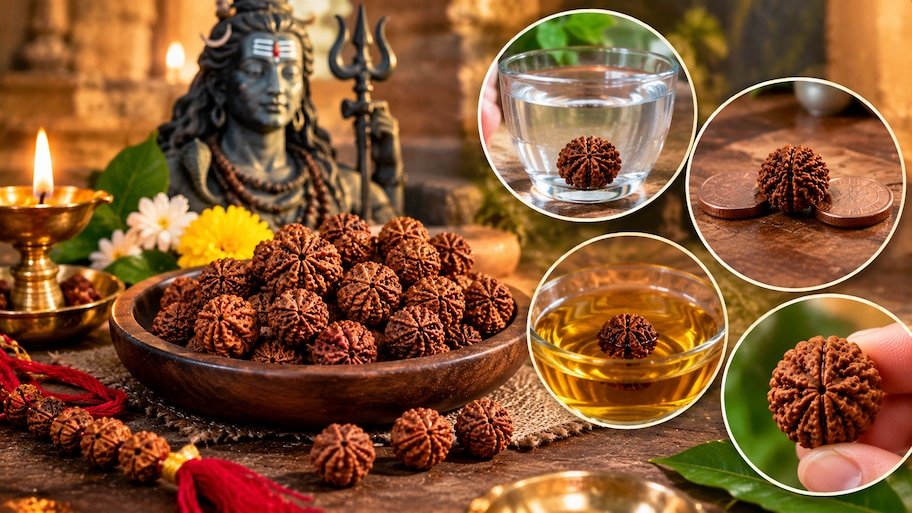
Real vs fake rudraksha test: In Sanatan tradition, Rudraksh is considered to be the physical form of Lord Shiva and is considered extremely sacred and beneficial. There is a religious belief that wearing Rudraksha brings peace to the mind, controls stress and blood pressure and transmits positive energy. However, due to increasing demand and limited supply of Rudraksha in the market, illegal trade of fake and man-made beads has also spread on a large scale. Plastic, wooden sawdust, plum kernels or common seeds are carved and colored with chemical colors and are sold at high prices by declaring them as rare one-mukhi or fourteen-mukhi Rudraksha. In such a situation, before wearing or buying any Rudraksh, it is very important to check its purity and genuineness. Through some easy scientific and traditional tests, you can identify the exact difference between real and fake Rudraksha right at home.
Real Rudraksha is the dried natural seed of a tree called ‘Elaeocarpus ganitrus’. Being created by nature, no real Rudraksh is perfectly round or smooth. The surface of a genuine Rudraksha has natural bulges, roughness and tubercles of uneven depth. At the same time, fake Rudraksha is often made by molding it, due to which its surface appears unnaturally smooth, shiny and uniform. If you look carefully, genuine Rudraksha has a naturally formed hole through it (natural hole), whereas in fake beads, the hole is forcibly drilled with a drill machine, whose edges appear ragged and rough.
Water test is the most ancient and popular home method of identifying genuine Rudraksha. For this, fill a transparent glass with clean water and gently put the Rudraksh in it. If the Rudraksha is a real, heavy and fully ripe natural seed, it will sink immediately to the bottom of the water due to its high density. If the Rudraksha is an imitation bead made of a hollow wooden shell, plastic or fibrous lightweight material, it will float on the surface of water. However, there is a caveat to this test—if the Rudraksha is very old, dried or has been hollowed out from inside by insects, it may float even if it is genuine. Therefore, it is safer to take the help of other methods along with water testing.
The boiling water test is considered to be the most accurate test for identifying serious adulteration and chemical glue. Fake Rudraksha makers often paste the pieces of two ordinary Rudrakshas with synthetic fevicol or chemical wax and give the form of rare ‘Gauri-Shankar’ or ‘Ekmukhi’ Rudraksha. For this test, boil water in a vessel and put Rudraksh in it and let it boil on low flame for about 20 to 30 minutes. If the Rudraksha is pure and natural, then boiling water will not affect its colour, shape or texture nor will it lose its natural color. If the Rudraksha is fake or glued, the heat of boiling water will melt the glue, the joints will separate and the chemical color will dissolve in the water and separate.
Facets of Rudraksha are the natural lines that run from the apex to its bottom. Observe these lines carefully with the help of a magnifying glass. In genuine Rudraksha, these lines are naturally deep, slightly curved and as natural as the bark of a tree trunk. In fake Rudraksha, artisans carve the ordinary Panchmukhi Rudraksha with a knife or blade and create artificial lines. Such sculpted lines appear straight, sharp and unnaturally cut, lacking any natural relief. If scratch marks are seen on the edges of the lines, then understand that the Rudraksha has been tampered with.
This test is a popular traditional method based on the bio-electromagnetic properties of Rudraksha. For this take two clean copper coins. Place a coin on a flat surface and balance the Rudraksha on it. After this, lightly touch the second copper coin on the upper end of the Rudraksha. Natural Electromagnetic Energy (Electromagnetic Properties) flows in the real Rudraksha, due to which when slight pressure is applied, the Rudraksha starts rotating or moving slowly in the clockwise direction. Although this test is not a substitute for a completely scientific lab test, this activity is usually clearly visible in naturally germinated seeds.
A hot needle can be used to capture any type of plastic, synthetic resin or wax adulteration within the Rudraksha. Hold an ordinary sewing needle with tongs and heat it thoroughly over a candle or gas flame. After this, lightly press the tip of the needle inside any small corner or line of the Rudraksha. If the Rudraksha is of natural wood or seeds, the needle will not penetrate and only a slight natural smell of dry wood burning will be emitted. If the Rudraksha is made of plastic, fiber or chemical wax, the hot needle will immediately sink into it and a pungent smell of burning plastic or chemical will start emanating.
If you are buying a precious or rare Rudraksha (like 1 Mukhi, 14 Mukhi, 21 Mukhi or Gauri-Shankar), the safest route is to get it scientifically certified rather than relying on home remedies alone. Get its digital X-Ray or CT scan done from any reputed gemological or Rudraksha testing lab. The internal compartments of Rudraksha and the number of seeds are clearly visible in the X-ray image. A genuine Rudraksha has exactly the same number of internal chambers and natural seeds as it has external lines. If five lines are visible outside but only four or six chambers inside, then it is definitely a man-made or carved fake Rudraksha. Always buy Rudraksha from a trusted institute with a government recognized lab certificate (ISO Certified Lab Certificate).