 look news india

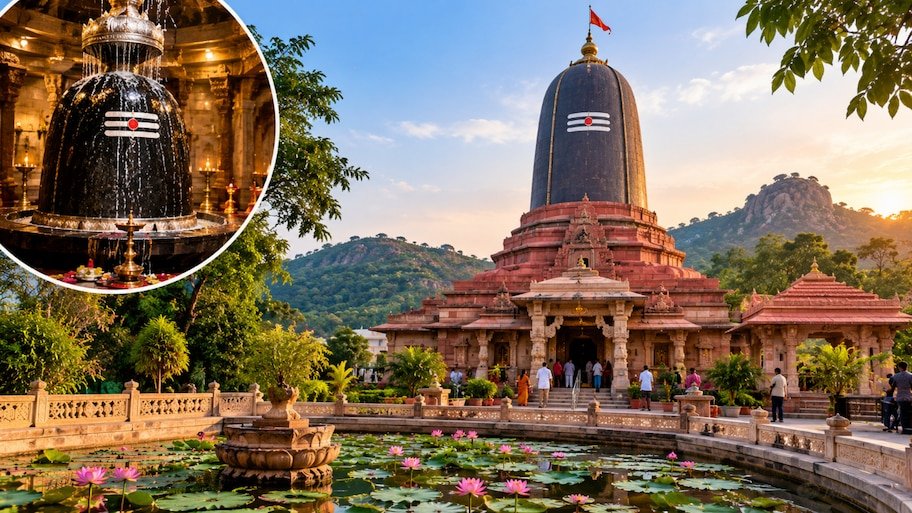
Shankar Math shivling shaped temple : Indian temple architecture is known worldwide for its grandeur, carvings and spiritual mysteries. Be it the tall peaks of Nagara style of North India or the huge Gopurams of Dravidian style of South India, the temples located in every corner of the country leave everyone forgotten with their unique design. But have you ever imagined such a temple, which does not have any traditional dome, minaret or urn on top, but the entire temple building, when seen from outside, appears in the form of a huge, living Shivalinga? This astonishing confluence of religious and architectural art is known as ‘Shankar Math’. When seen from a distance, it appears as if a huge linga form of Devadhidev Mahadev is established on the chest of the earth. The architecture, internal energy and mysteries associated with this temple attract both devotees and researchers alike.
Usually, at the top of Hindu temples, hemispherical domes, umbrellas or triangular peaks touching the sky are built, on which the flag and Kalash are installed. But the architectural plan of Shankar Math is based on a unique scientific and tantric philosophy completely beyond the traditional rules. The outer walls of the temple have been given such a curved and shapely form that they rise from the ground in the same proportion as the shape of a natural Shivalinga. Its upper part is molded with the exact same roundness and slope, which shows the balance of Jalhari and Pindi. The entrance of the temple is planned in such a way that when the devotees stand outside, they see a grand temple as well as a giant Shivalinga, which in itself is counted among the rare architectural works of the world.
As soon as they step inside Shankar Math, devotees feel a different kind of vibration and immense peace. According to experts and architects, the reason for this is the elliptical and Shivalinga-shaped internal roof of the temple. According to the rules of modern acoustics, when ‘Om Namah Shivay’ or ‘Mahamrityunjaya Mantra’ is chanted in the sanctum sanctorum of the temple, the sound waves continuously rotate on the curved walls of the Shivalinga instead of hitting a flat wall. This reflection creates a subtle and continuous resonance, which instantly calms the mind of the meditators who meditate there. From the point of view of meditation and yoga, this structure is seen as a center that absorbs cosmic energy.
Not only has geometrical precision been maintained in the construction of this unique temple, but the construction material used is also very special. It has been carved with a mixture of special natural stones and traditional lime-mortar in such a way that even during the scorching summer days, the temperature inside the temple remains much cooler and more pleasant than outside. As the sun’s movement changes throughout the day, the scene of sunlight and shade created on the outer surface of this Shivalinga-shaped temple mesmerizes the spectators. In the morning, when the first rays of the sun touch the top part of this temple, it seems as if the golden consecration of Shivalinga is taking place.
According to religious beliefs, Shivalinga is not just a symbol but is the integrated form of formless and corporeal Brahma. Shankar Math was conceived to realize the idea that devotees could realize Shivatva even before entering the walls of the temple. Local devotees believe that just circumambulating this temple gives many times more virtuous results than worshiping and circumambulating the normal Shivling, because here the devotees do not circumambulate any small Pindi but the Maha-Shivling in the form of the entire temple. During Mahashivratri, Holy Monday of Sawan and Pradosh Vrat, there is an influx of devotees coming from far and wide, who bow before this unique creation and wish for spiritual peace.