 look news india

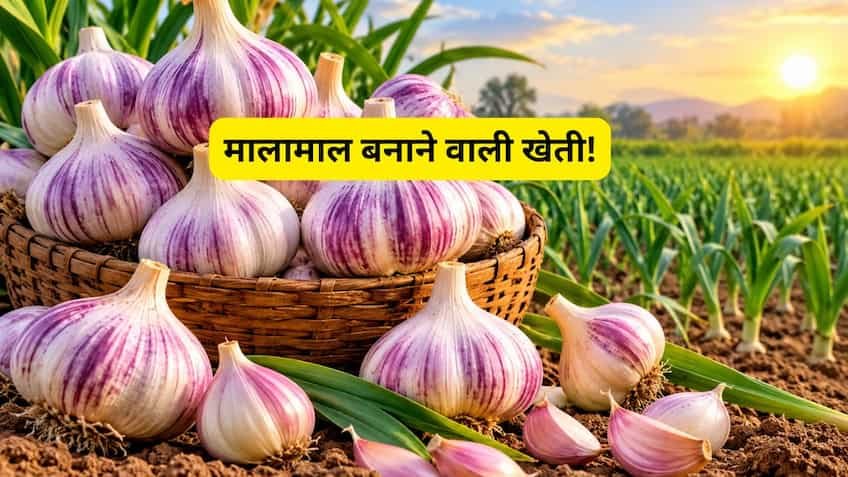
Garlic has always been a highly profitable option for farmers cultivating cash crops in the Rabi season. Amidst the continuously strong prices and increasing demand of garlic in the market, the improved varieties developed by the Indian Council of Agricultural Research (ICAR) and the National Horticultural Research and Development Establishment (NHRDF) are proving to be a milestone in increasing the income of farmers manifold. Such improved and high yielding varieties of garlic (like Bhima Omkar, Yamuna Safed-3/G-282 and Agrifound Parvati) have attracted the attention of farmers. This crop becomes fully ripe within just 130 to 135 days and with proper management has the potential to give bumper yield of 35 to 40 quintals per acre (about 80 to 100 quintals per hectare).
These improved varieties of garlic are becoming increasingly popular in the major agricultural zones of Uttar Pradesh, Madhya Pradesh (especially Mandsaur and Neemuch Mandi areas), Rajasthan (Kota and Baran belt), Gujarat, Haryana and Bihar. Bulbs of this variety are of medium to large size, attractive bright white in color and very hard. Due to the pungency found in it and the high quantity of medicinal element called Allicin, it is widely purchased in domestic kitchens as well as in spice and pharmaceutical industries.
The biggest feature of this variety is its uniform buds and excellent storage capacity. Often a problem is seen in traditional local garlic that after a few months of harvesting, the tubers start drying up or become hollow from inside, due to which farmers have to sell the crop at throwaway prices. In contrast, the tubers of this improved variety have a thick and hard skin, due to which it can be easily stored for 6 to 8 months without any loss of weight or luster even in ventilated warehouses at normal temperature.
This variety is also far ahead in terms of disease resistance. It is more tolerant to major garlic diseases like ‘Purple Blotch’, Downy Mildew and stem blight than the normal varieties. Its strong stems and broad leaves accelerate the process of photosynthesis, which leads to rapid and abundant growth of nodes under the ground.
Garlic is a cold climate crop, for which the ideal temperature for vegetative growth is 15 to 20 degrees Celsius and at the time of tuber ripening, the temperature is 25 to 30 degrees Celsius. For its sowing in the plains of North India and Central India. From the first week of October to mid November The time is most favorable.
Well drained loam or sandy loam soil is most suitable for field preparation, whose pH value should be between 6.5 to 7.5. Make the soil friable by deep plowing the field 2 to 3 times. At the time of last ploughing, 8 to 10 tonnes of well decomposed cowdung manure or 2 tonnes of vermicompost (earthworm manure) per acre should be mixed thoroughly in the soil. For balanced nutrition, it is mandatory to use sulfur at the rate of 10 to 12 kg per acre along with nitrogen, phosphorus, potash on the basis of soil test, because sulfur plays a direct role in increasing the pungency, aroma and sharpness of garlic tubers.
About 1.5 to 2 quintals (150-200 kg) of cloves from healthy and thick tubers are required for sowing in one acre field. It is very important to treat buds before sowing. For this, treat the buds with the solution of Carbendazim or Trichoderma Viridi (5 grams per kilogram of seeds) for 15-20 minutes and dry them in the shade. This completely eliminates the risk of seed-borne and soil-borne fungal diseases.
While sowing, row to row distance should be kept at 15 cm and plant to plant distance should be kept at 8 to 10 cm. The buds should be buried in the ground at a depth of 2 to 3 cm with the pointed end of the bud facing upwards. Give a light irrigation immediately after sowing. In modern times, by sowing garlic on drip irrigation and raised beds, up to 40% water is saved and the size of tubers is 25 to 30% larger.
The total cost of scientifically cultivating this advanced variety of garlic in one acre, including seeds, ploughing, manure-fertilizer, irrigation and labor, is around Rs 45,000 to 55,000. If the farmer gets an average yield of 35 to 40 quintals per acre and the normal wholesale price in the market also averages ₹6,000 to ₹8,000 per quintal (or ₹10,000 to ₹15,000 per quintal in off-season), then a gross revenue of Rs 2.4 lakh to 3.2 lakh per acre can easily be achieved.
Even after deducting all the input expenses, farmers can earn approx. Net profit ranging from Rs 1.8 to 2.5 lakh Can earn. If instead of selling the crop immediately after harvesting, farmers keep it in proper storage for 3-4 months and sell it in the off-season, then this profit increases even more. By selecting advanced seeds and adopting modern agricultural techniques, farmers can make garlic farming a solid profit machine in the real sense.