 look news india

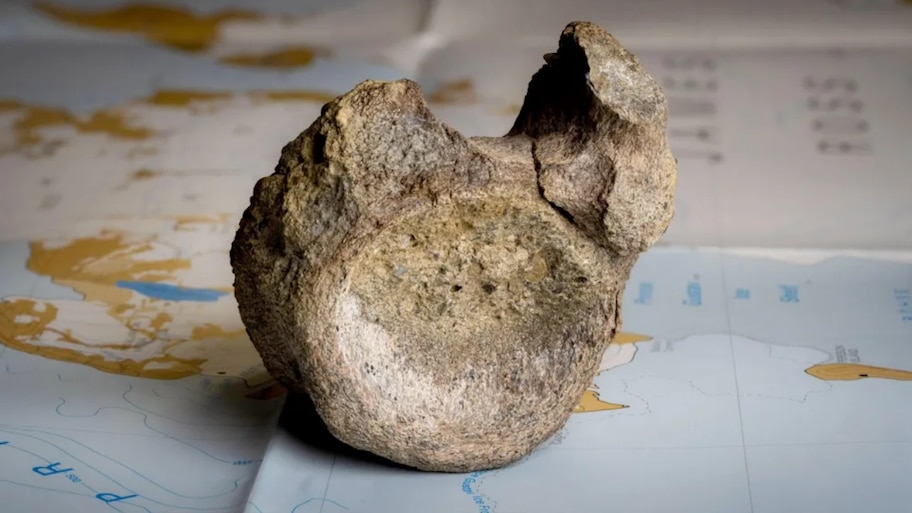
First Dinosaur Fossil of Antarctica Found in Drawer : Imagine that one of the most surprising and first discoveries in the history of science remained gathering dust in an old drawer like some junk for 40 years! Yes, this is not a film story or science fiction but 100 percent reality. In the year 1985, a strange fossil was discovered from the icy area of Antarctica, but the scientists of that time could not understand its reality and kept it in a drawer in Cambridge and forgot it. Now, after four decades, scientists have lifted the veil of mystery and confirmed that this is the first dinosaur fossil in history found on the continent of Antarctica. This bone is of the tail of ‘Titanosaur’, one of the largest creatures in the world, which has now created a stir in the world of science.
Millions of years old history suddenly came to light while cleaning the drawer
This unique and exciting story dates back to the year 1985, when a mysterious fossil was collected by British scientists from James Ross Island in Antarctica. Dr. Mike Thomson, a famous geologist of that time, had also made a small sketch of it in his field notebook and recorded it as “Reptile Vertebrae”. But the then team did not have any accurate information or modern technology, due to which it was kept safe in an old drawer in the Cambridge office of the British Antarctic Survey (BAS).
Recently, when Collection Manager Dr. Mark Evans was cleaning the drawers and regularly examining thousands of old specimens, suddenly his eyes fell on this brown and heavy bone. He looked carefully at the shape of this strange bone and immediately recognized that its structure was completely different from the common ancient sea creatures and like that of a dinosaur.
Member of the world’s largest dinosaur family: ‘Ball-and-socket’ becomes big evidence
Professor Paul Barrett of the Natural History Museum, London was invited for final confirmation and scientific analysis of this rare discovery. As soon as he took this fossil in his hands, he understood its historical importance. The physical structure of this bone was like a ‘Ball-and-Socket Joint’, which is found only in the ‘Titanosaur’ species in the entire history of dinosaurs.
Titanosaurs were the largest herbivorous creatures ever to walk on this earth, reaching a length of up to 115 feet and weighing up to 60 tons. However, the dinosaur to which this tail bone, found in a drawer in Antarctica, belonged, would have had a total length of about 23 feet (7 meters). Scientists estimate that it was either a juvenile of the titanosaur species or a small adult dinosaur of its own class.
80 million years ago, Antarctica was not an ice desert but a ‘living paradise’.
Today we all know Antarctica only as miles of ice sheets, extremely cold winds and a desolate place where it is impossible for humans to live normally. But this fossil is about 82 million years old, which is called ‘Late Cretaceous Period’ in geological language.
This discovery proves that the climate of Antarctica was not at all like this millions of years ago. During that period, this entire continent was extremely warm, favourable, covered with lush green and dense rainforests. This was the reason that these giant herbivorous dinosaurs easily got abundant food and an ideal environment to live.
Why is this bone found in the drawer very special and historical?
Finding the ancient history hidden under the several feet thick ice of Antarctica has always been the biggest and most dangerous challenge for paleontologists around the world. Although in the years after 1985, some more dinosaur remains were found there, but their number is very less.
Professor Paul Barrett explains that the revival of this old discovery is helping us understand that in a place which today is completely uninhabitable with minus degree temperatures, a very large and rich world of prehistoric creatures once flourished. This small bone found in a drawer in Cambridge has become a great means of recreating the ancient ecosystem of this coldest part of the world.