 look news india

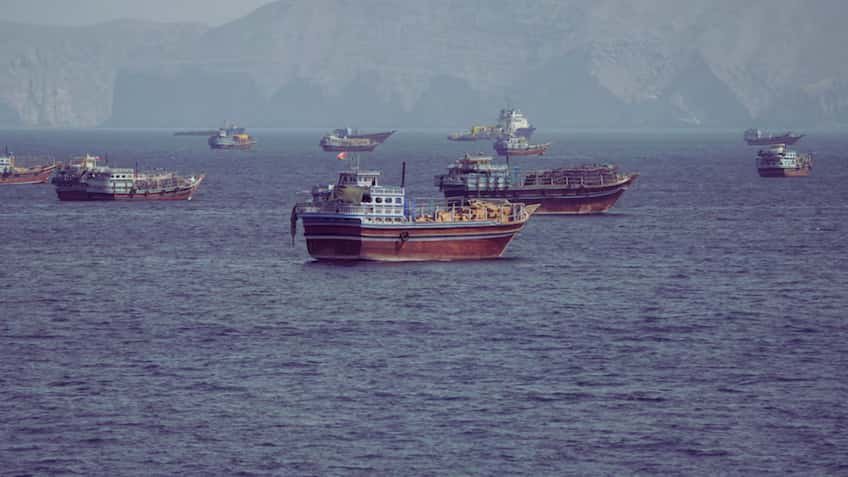
The ongoing geopolitical conflict over the world’s most sensitive maritime trade corridor, the Strait of Hormuz, has now reached a dangerous point. Iran has outright rejected the diplomatic response sent by Washington to reduce tensions and restore safe movement of ships through the strait. Describing the US proposal as completely ‘vague and inadequate’, Tehran has clearly declared that it is no longer in the mood for any formal or informal talks with the US on this issue. After this aggressive and tough stance of Iran, there has been a stir in the international diplomatic circles. This sea route, which has been closed or under heavy military surveillance for the past several weeks, was expected to find a middle path through the behind-the-scenes talks between the two countries, but Iran’s latest announcement has dashed all hopes of peace.
The Strait of Hormuz is not just a narrow passage of water, but it is considered the main lifeline (Choke Point) of the entire world’s economy. Located between Oman and Iran, this waterway connects the Persian Gulf with the Gulf of Oman and the Arabian Sea.
-
Center of global oil supply: About 20 to 21 percent of the total seaborne petroleum trade across the world passes through this narrow passage. Major oil and natural gas exporting countries like Saudi Arabia, Iraq, UAE, Kuwait and Qatar are completely dependent on this route to send their ships to international markets.
-
Strategic Advantage: Iran has direct geographical and military control over the northern part of this waterway. The navy of Iran’s Islamic Revolutionary Guard Corps (IRGC) keeps an eye on this entire area through speed boats, submarines, anti-ship missiles and sea-mines.
-
Impact of trade deadlock: As soon as there is even the slightest tension on this waterway, the prices of Brent Crude start skyrocketing in the international market and the freight rates and insurance costs of ships increase manifold at the global level.
According to diplomatic sources, the US sent a proposal to Tehran through a third party that called for reducing military tensions along the waterway, guaranteeing the safety of merchant tankers in return for easing some non-critical sanctions. But Iran’s stance has been very clear from the beginning:
-
Demand for concrete guarantee on sanctions: Iran says there can be no deal on maritime security until the US formally lifts all stringent economic sanctions imposed on its energy sector, banking network and oil exports. Tehran has termed America’s ‘conditional relaxation’ proposal as a diplomatic trick.
-
Objection to military presence: Iran considers the US Fifth Fleet and the massive gathering of Western warships in the Persian Gulf and Arabian Sea as a direct threat to its sovereignty. Iran argues that the security of this area is solely the responsibility of the regional Gulf countries and that Western powers must immediately vacate the area.
-
Severe lack of trust: Iran’s top leadership believes that America is using diplomatic talks only to buy time and strengthen its military deployment. For this reason, the Iranian Foreign Ministry made it clear that the era of sitting at the table on the basis of empty promises is now over.
The immediate impact of Iran’s announcement of closing the talks is visible on global financial and commodity markets:
-
Sharp rise in crude oil: There has been an upward trend in the prices of crude oil in the international market. Analysts believe that if this standoff prolongs or there is an attack on a tanker in the Persian Gulf, oil prices could cross the level of $ 100 per barrel.
-
Threat to LNG supply: A large consignment of liquefied natural gas from Qatar to Asian and European countries travels through this route. The shortage of LNG can lead to power crisis amid winter season or increasing power demand.
-
Direct pressure on India’s energy security: India imports more than 85% of its domestic crude oil needs, a major portion of which comes from the Gulf countries. If the Hormuz route is completely blocked, then both the time and cost of oil transportation for India will increase, which can have a direct impact on petrol-diesel prices and inflation in the country.
After this tough stance of Iran, the ball is now in the court of America and its western allies. Washington is under pressure from its Gulf allies to intensify naval escort missions to protect merchant ships. However, experts are of the opinion that any small military lapse or misunderstanding in this narrow waterway can lead to a full-scale war, which the global economy is simply not in a position to withstand at this time. On the other hand, China and other major importing countries that are linked to both Iran and the Gulf countries have been making behind-the-scenes efforts to control tensions. At present, Tehran’s stubborn stance has made it clear that unless America takes some big and concrete steps on sanctions and its military policies, it seems very difficult to open this strategic lock of the Strait of Hormuz.