 look news india

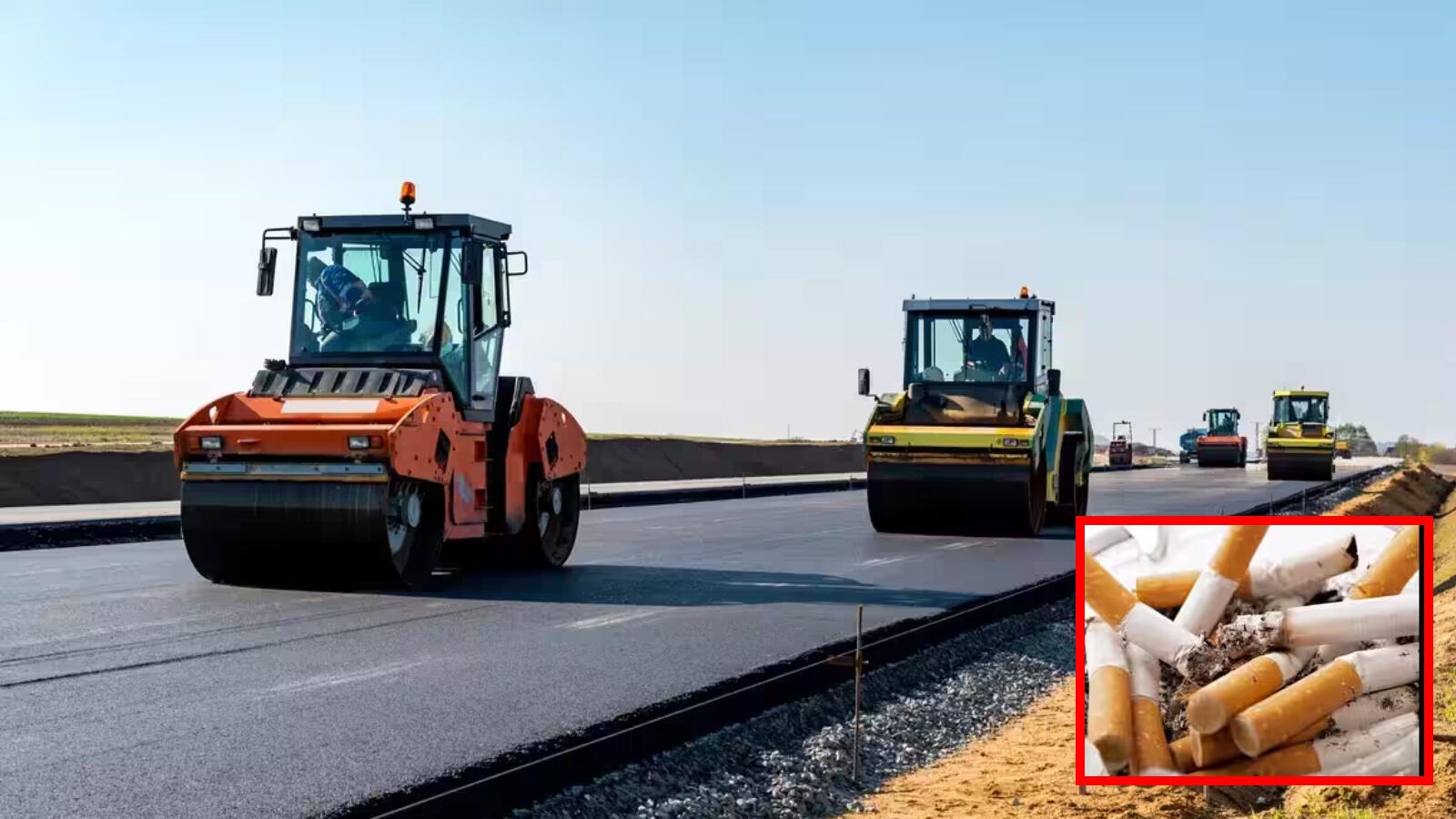
Waste management and environmental pollution is becoming a big challenge all over the world, in which discarded cigarette butts are counted among the most dangerous and non-decomposing waste. Every year, trillions of these small pieces are thrown on roads and public places, not only spoil the beauty of the city, but also poison the soil and water. Now scientists and civil engineers have found a very innovative and revolutionary way to deal with this serious problem. Recent research and technical tests have revealed that extremely strong and durable roads can be created by recycling these waste and poisonous cigarette butts. The special thing is that with this technology, not only will there be proper disposal of waste, but our cities will also be able to get relief from the scorching heat.
Cigarette filters are mainly made of cellulose acetate, which, being a synthetic fiber, does not decompose naturally for hundreds of years. When environmentalists and engineers thought deeply about this problem, they found a unique technical way to recycle it. In laboratory tests it was found that these cigarette butts could be mixed into asphalt and concrete mixtures by treating them under special chemical processes and high temperatures. When these are mixed with road construction materials in a certain proportion, the mixture becomes much stronger, more flexible and more load bearing than ordinary asphalt. In this way, this dangerous substance which was thrown as waste is now becoming an excellent resource to strengthen the infrastructure of the country.
Generally, asphalt roads suffer from heavy traffic, weight of heavy vehicles and the problem of melting or crumbling during summer season. But the load-bearing capacity of roads made with this new technology developed by engineers has been found to be much better than traditional roads. The fibrous properties of cigarette butts form a fine and strong mesh within the concrete, which evenly distributes the pressure exerted on the road by passing heavy vehicles. This drastically reduces the problem of cracking and formation of potholes on the roads. The use of this technology not only increases the life of the roads manifold, but also saves crores of rupees of government budget spent on road maintenance and repairs.
In today’s modern cities, concrete jungles and black asphalt roads absorb solar energy, due to which the temperature of the cities increases much more than the surrounding rural areas, which is called ‘Urban Heat Island Effect’. The thermal conductivity of roads built with this new technology is much different and better than traditional roads. Surfaces made from a mixture of cigarette butts absorb less heat from the sun and prevent the asphalt from overheating. As a result, the city’s street temperatures remain lower than normal, which unexpectedly helps mitigate the local effects of global warming.
This unique invention is not only a miracle in the field of engineering and technology, but it is also proving to be a milestone towards achieving the goals of environmental protection and sustainable development. The biggest challenge faced by municipal bodies and cleanliness drives is to clean the cigarette butts scattered on the roadside, which if thrown directly into the landfill, contaminate the soil. Now when these pieces will be directly used in construction work, there will be a huge success in reducing the burden of municipal waste. In the coming time, if this technology is implemented commercially on a large scale, it will become a great example of making Kanchan from city waste, which will also give a new and green direction to the smart city projects of the country.