 look news india

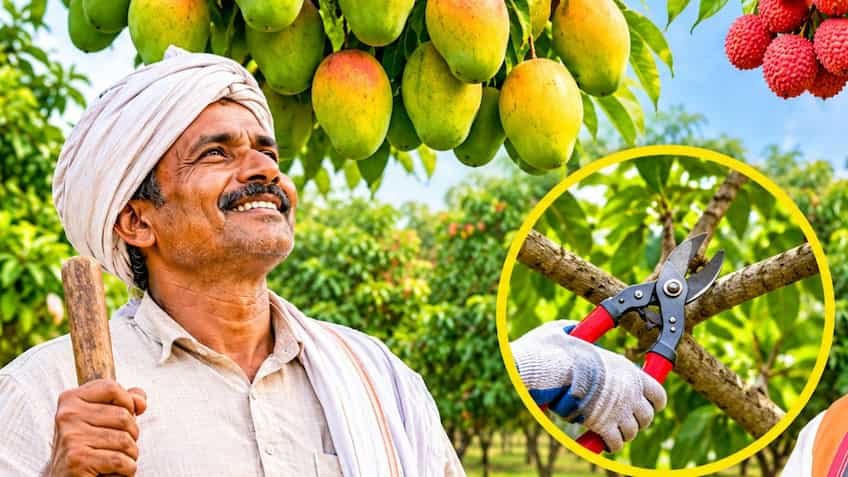
Decades old mango and litchi plantations were once the mainstay of farmers’ prosperity in the traditional fruit producing states of the country. But now the effect of age is clearly visible in these trees which are 30 to 40 years old or more. Due to hollowing of stems, entanglement of branches, sunlight not reaching the ground and increasing incidence of insect diseases, the fruit production capacity of these trees has reduced by 50 to 70 percent. Troubled by declining production and deteriorating quality, many farmers were forced to cut down the historic orchards of their ancestors or convert them into concrete plots. To solve this serious problem of gardeners and to take fruit production back to record level, the Ministry of Agriculture and Farmers Welfare in collaboration with Mission for Integrated Horticulture Development (MIDH) and State Horticulture Departments has decided to provide direct financial assistance (subsidy) of 40 to 50 percent under ‘Orchard Rejuvenation Scheme’.
Often farmers think that the only solution is to cut down the old tree which has become unproductive and plant a new one in its place. But the new plant has to wait at least 8 to 10 years for it to become a fruit-bearing tree. In contrast, with the ‘Canopy Rejuvenation’ technique developed by the scientists of Indian Council of Agricultural Research (ICAR) and Central Institute of Subtropical Horticulture (CISH, Lucknow), the old tree is made capable of bearing abundant fruits again in just 2 years without uprooting it. In this scientific process, systematic pruning or pollarding of the main branches is done at a height of 2.5 to 3 meters from the main trunk of the old tree. Protection from fungus is provided by immediately applying a paste of Bordeaux paste or copper oxychloride on the cut parts. Within a few months, strong and new branches sprout from the stem, which are trained to form a balanced canopy (umbrella-like shape). This allows ample sunlight and fresh air to reach the interior of the tree, making the size, sweetness and color of the fruits better than ever before.
As per the guidelines of the National Horticulture Mission, a standard scale of cost per hectare has been fixed for restoration of fruit trees. Back-ended Direct Benefit Transfer (DBT) grant of up to 40% is given to general category farmers and 50% to small, marginal, women and Scheduled Caste/Tribe farmers on the total expenditure on revival of old orchards (cutting-pruning, organic fertilizers, medicines, micro-irrigation and drip lines).
-
Unit Cost: The standard cost of restoration per hectare has been set by the government at approximately ₹40,000 to ₹50,000.
-
Subsidy Amount: Under this, eligible gardeners are given direct financial assistance ranging from ₹ 16,000 to ₹ 20,000 per hectare directly into their Aadhaar linked bank account.
-
Additional input support: Along with subsidy, the Horticulture Department also provides improved grafted plants, Trichoderma, vermicompost and pesticide spraying equipment to selected farmers for intensive plantation (Gap Filling) at concessional rates.
After deep pruning of old trees, for the first one and a half to two years when new branches are developing, there is open sunlight available on the ground inside the orchard. To make good use of this vacant land, agricultural scientists are encouraging farmers to plant intercropping. Immediately after pruning the trees, farmers can grow turmeric, ginger, taro, peas, French beans, cucurbits or medicinal plants between the rows of the garden. According to scientific studies, by intercropping turmeric or ginger in reclaimed orchards of mango and litchi, farmers get additional net income of Rs 80,000 to Rs 1.20 lakh per hectare in the first year. By the time the trees start producing bumper blooms and fruits again, the farmer’s regular household expenses and orchard maintenance costs are easily covered by intercropping.
The major fruit producing areas of the country will get the biggest benefit of this revival campaign.
-
Mango producing belt: The famous Malihabad (Dussehri), Saharanpur, Bulandshahr, Barabanki belt of Uttar Pradesh; Bhagalpur (Jardalu) of Bihar, Darbhanga; Malda (Himsagar, Langra) of West Bengal; And lakhs of farmers of Banganpalli and Totapari gardens of Andhra Pradesh and Telangana will get direct support from this scheme.
-
Litchi producing areas: With this technology, up to 60% reduction in fruit cracking and insect problems has been recorded in the old litchi orchards of Muzaffarpur, Samastipur, Vaishali (Shahi Litchi) of Bihar and the world famous litchi orchards of Dehradun and Ramnagar of Uttarakhand.
To avail horticulture renovation subsidy, farmers have to register online on the official portal of their state’s horticulture department (like dbt.uphorticulture.in in UP or horticulture.bihar.gov.in in Bihar). Apart from this, farmers can also submit offline applications by visiting the office of Deputy Director / District Horticulture Officer (DHO) located at their block or district level. For the application, farmer’s Khatauni/Jamabandhi (land records), Aadhaar card, copy of bank passbook, passport size photograph and on-site description of the current condition of old trees in the orchard are required. Technical officers of the Horticulture Department do physical verification (Geotagging Survey) of the garden, after which the approval letter is issued. After completion of the work, after verification, the subsidy amount is sent directly to the farmer’s bank account. By improving these gardens, which are the heritage of their ancestors, with modern science and government assistance, farmers can sustainably increase their annual income by 2 to 3 times.