 look news india

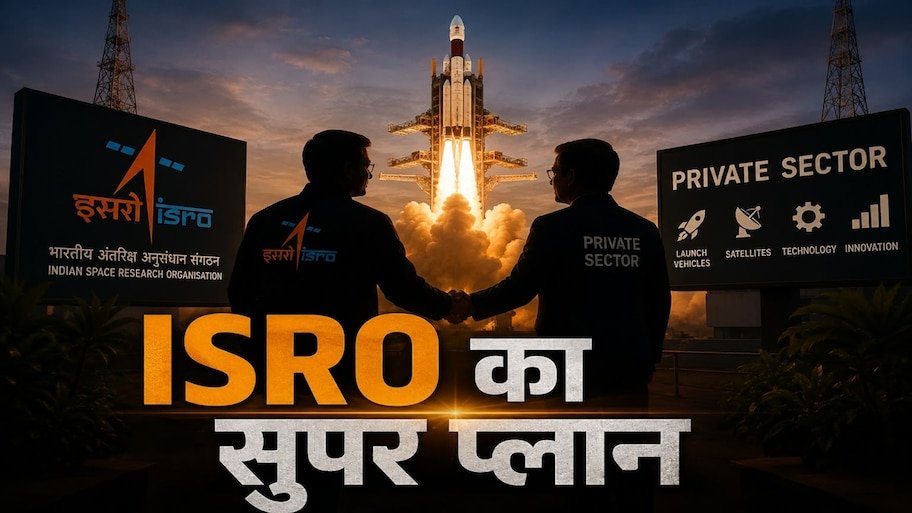
India’s space sector is standing on the cusp of a historic change. Just as the American space agency NASA had opened its doors to private companies like SpaceX and Boeing, on the same lines, the Indian Space Research Organization (ISRO) has also made a strategy to take the country’s private space startups and companies along. The direct impact of this new model is visible on the country’s economy, employment and India’s share in the global space market. Experts believe that space can prove to be a big ‘economic engine’ for India in the coming few years.
Coordination of NASA model and ISRO’s new strategy
NASA had realized decades ago that if routine tasks like rocket manufacturing and regular satellite launching were handed over to private hands, the agency could focus its entire attention on complex scientific research like deep space exploration, Moon and Mars missions. In India too, this framework has now been strengthened through IN-SPACE (IN-SPACe) and Newspace India Limited (NSIL). ISRO is transferring the technology of its heavy rockets, satellites and launch pads to private companies. With this, private players are not only getting ready-made infrastructure, but the youth of India are also getting an open platform to launch their innovative ideas in space.
Statistics speak: Global space market worth $447 billion
Currently the total space economy of the world is estimated to be more than $447 billion, in which India’s current share is between 2 to 3 percent. The goal of the Central Government and NITI Aayog is to increase this share to 8 to 10 percent by 2030-2033. This simply means that India’s space market can reach 40 to 50 billion dollars in the coming time and 100 billion dollars in the long run. There are currently more than 200 space-tech startups active in the country, working on satellite manufacturing, Earth observation, 3D printed rocket engines and propulsion systems.
Indian space startups taking off and increasing investment
Domestic companies like Agnikul Cosmos, Skyroot Aerospace, Pixxel and Dhruva Space have proven that Indian talent can deliver world-class solutions at low cost. Skyroot’s Vikram-S and Agnikul’s Agnibaan sub-orbital launches are a clear testament to the capability of the Indian private sector. Apart from this, Pixel is building the world’s most advanced hyperspectral earth-imaging satellite network. Global and domestic venture capitalists are now investing heavily in the Indian space sector, leading to the creation of new patents and high-skilled technology jobs.
Low Cost, High Accuracy: India’s Biggest Global Advantage
India’s biggest strength has always been ‘Frugal Engineering’ i.e. accurate and reliable technology at low cost. While the cost of launching a satellite is quite high in western countries, India’s PSLV and SSLV remain the first choice for countries around the world. With the entry of private companies, the demand for commercial small satellites will be met faster. The demand for space-based data has increased manifold in sectors like communications, agriculture, weather forecasting, disaster management, defense and logistics, making this sector a huge revenue earner.
Geo-strategic and local impact: India will become a space hub
This change is not limited only to the Central Government or ISRO Headquarters, rather aerospace corridors are being developed in many states of the country. The new spaceport at Kulasekharapattinam in Tamil Nadu is being strategically designed for the launch of small satellites, leading to huge industrial investment and employment opportunities in the southern states. Along with this, cities like Bengaluru, Hyderabad and Chennai are strengthening their identity as global space-tech hubs.
Future prospects: New source of economic growth
When a country’s space infrastructure is strong, it directly impacts 5G/6G connectivity, smart farming, maritime security and green energy mapping. This new PPP (Public-Private Partnership) model of ISRO is not only making the country technologically self-reliant, but is also working towards making India the main center of the global space supply chain. If this momentum continues, space will indeed prove to be a major source of economic prosperity and global influence for India.