 look news india

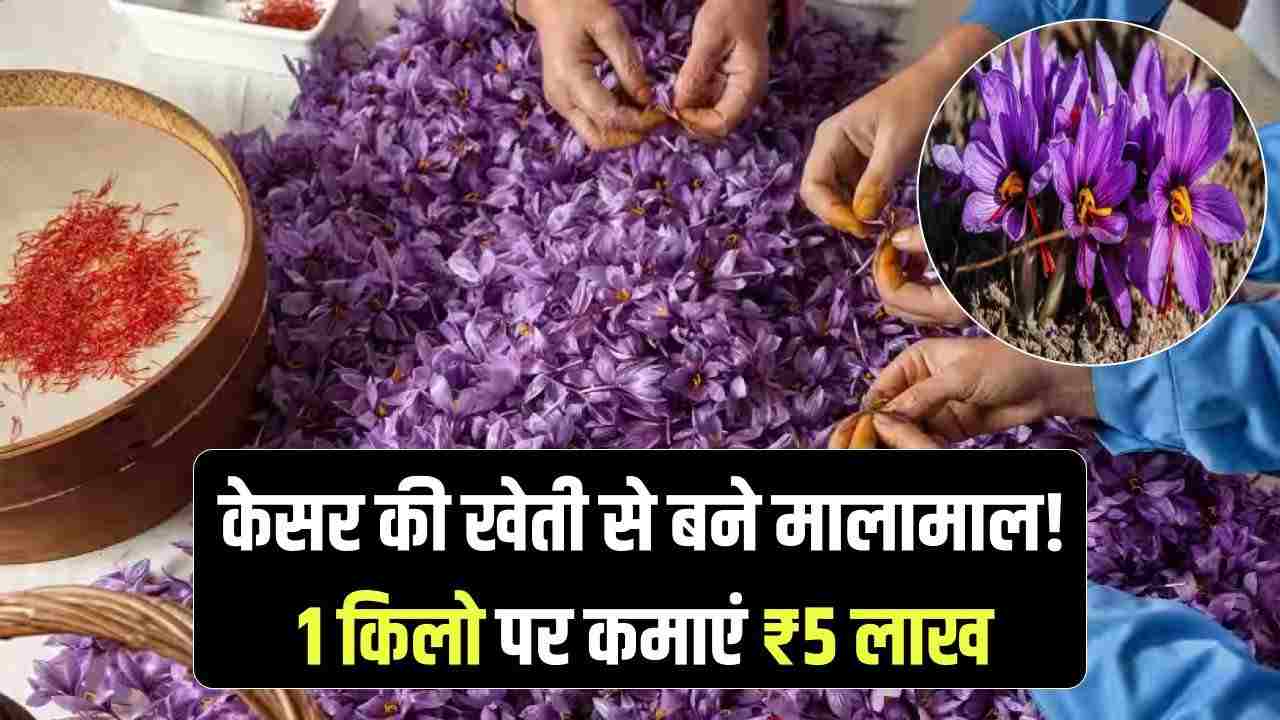
Saffron (Crocus sativus) is called ‘Red Gold’ in the agricultural world. It is the world’s most expensive food product and spice by weight. High quality pure Mongra saffron is easily available in the market at a price ranging from ₹ 3 lakh to ₹ 5 lakh per kg (and up to ₹ 6 lakh/kg in retail/export). The main reason why saffron is so expensive is its rarity and hard work. Only 3 red fibers (stigmas) emerge from a saffron flower. To prepare just 1 kilogram of dry saffron, about 1.5 lakh to 1.7 lakh flowers have to be plucked by hand. While India produces 5 to 6 tonnes of saffron annually, the domestic and global demand is many times more.
Traditionally, saffron cultivation was considered possible only in the cold climate and clay soil of Kashmir (Pampore). But the modern agricultural revolution and ‘Aeroponic & Climate-Controlled Indoor Cultivation’ has completely changed this geography. Now farmers and young entrepreneurs in any state like Uttar Pradesh, Delhi, Maharashtra, Rajasthan, Bihar or Madhya Pradesh are getting bumper yield of saffron by creating artificial environment (temperature, humidity and light) like Kashmir in a simple room of 10×10 or 20×20 feet.
Indoor saffron cultivation does not require soil or field, rather it is grown in air and vertical trays:
-
Thermally insulated room: PUF panels or insulation are installed in rooms of 200 to 500 square feet so that the outside temperature is not affected inside.
-
Temperature and Humidity Control (HVAC System): For the growth of saffron, the temperature has to be kept constant at 10°C to 20°C and at the time of flowering, it has to be kept at 15°C to 17°C. For this, inverter AC, chiller and automatic humidifier (to maintain 65% to 80% humidity) are installed.
-
Vertical Multi-Tier Rex: Plastic or wooden trays are placed in 4 to 6 layer stands of iron or aluminum, so that 5 times more plants can be accommodated in less space.
-
Full Spectrum Photo-Period LED Lights: Special grow-lights are installed to make the plants realize the photoperiod of day and night.
1. Procurement of good quality corms/bulbs:
Saffron does not have seeds, rather it is cultivated from corms. Healthy and fungus-free tubers are procured from Kashmir (Pampor/Pulwama), which should weigh at least 8 to 10 grams or more.
2. Pruning and anti-fungal treatment of tubers:
Before planting in the room, the tubers are treated with fungicide solution like Trichoderma or Carbendazim so that they do not rot.
3. Decoration of tubers in vertical trays (July-August):
The treated tubers are arranged side by side in trays without soil. During this period the room temperature is kept at 18°C to 22°C.
4. Flowering and Temperature Trigger (September-October):
By the end of September the temperature is reduced to 15°C and humidity is increased. This process makes the tubers feel like the autumn of Kashmir, due to which the tubers sprout and start blooming purple flowers in 15 to 20 days.
5. Plucking flowers and drying saffron (October-November):
As soon as the flowers bloom in the morning, three red fibers (saffron) are taken out from inside them with the help of tweezers. After this, they are dried in an electric dryer or vacuum oven at 40°C to 45°C and packed in an airtight glass jar.
6. Multiplication and Cycle of Corbs (December-May):
After harvesting, these tubers are planted in an earthen shed or nursery, where 2 to 3 new baby tubers are prepared from one tuber. These tubers are reused in the next season.
-
Initial Investment: 300 to 500 square feet indoor room setup, AC, lights, trays and purchasing 500 to 800 kg tubers takes approximately ₹4 lakh to ₹7 lakh There is a lump sum expense of Rs.
-
Production of Saffron: 500kg of premium tubers in the first year approx. 1 to 1.5 kg dry saffron is received.
-
Annual Earnings: Selling 1.5 kg of pure Grade-1 saffron gives direct revenue of ₹4.5 lakh to ₹6 lakh. With this, as the number of tubers doubles, the cost of purchasing tubers next year becomes zero.
-
Government Schemes: Subsidy ranging from 30% to 50% and easy bank loans are available on vertical farming, cold room and high-value spices cultivation under ‘Rashtriya Krishi Vikas Yojana’ (RKVY) and various state horticulture missions.