 look news india

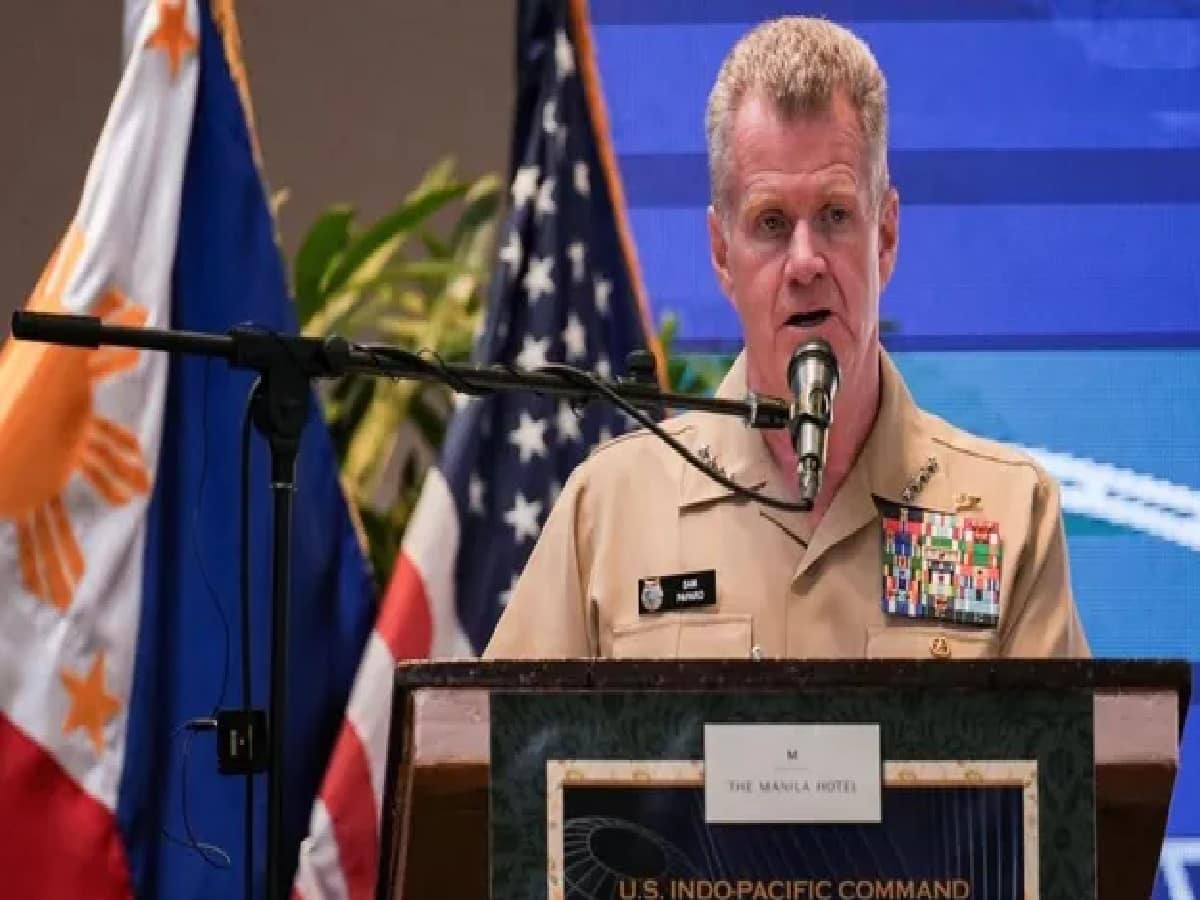
In the modern history of global geopolitics and military balance, such a period is rarely seen when the future of half the world depends on the decisions of a single military commander. Admiral Samuel Paparo, the head of the US Indo-Pacific Command (USINDOPACOM), the largest, strategic and powerful military branch of the United States, is currently standing at the same center point of the world. When hoisting the victory flag on the battlefield is considered the biggest achievement of the Army at the international level, then the philosophy of this top four-star American commander is completely different and practical. Admiral Paparo believes that the greatest historical victory of a true and dedicated soldier lies not in fighting the war, but in preventing the war from happening through his infallible power and preparation.
Today, when the scope of tension is continuously expanding from the Pacific Ocean to the Indian Ocean, the most sensitive responsibility rests on the shoulders of Paparo. The biggest challenge before them is to contain China’s increasing aggression and clear the dark clouds of the Third World War looming in the Taiwan Strait. Known for his strict working style, strategic discipline and ground realism, Paparo is today recognized as a strong and trusted strategist among defense strategists from Washington to Tokyo, Canberra and New Delhi.
Samuel Paparo’s personality and leadership style have their roots in his student days. This happened in the year 1986, when he was studying in a college in Pennsylvania. One evening he went to the cinema with his fiancée (now wife) Maureen to watch the blockbuster Hollywood film of that era ‘Top Gun’. At that time, the carefree, aggressive and rule-breaking character of ‘Maverick’ played by Tom Cruise had become a role model for every youth. But surprisingly, instead of Maverick, young Paparo was most impressed by his rival character ‘Iceman’ (Tom Kaczynski).
Paparo realized that while Maverick’s style might be exciting, in actual combat his air-headed self-confidence and uncontrolled anger would lead to disaster. In contrast, the Iceman believed in discipline, hard work, systematic preparation and remaining calm in times of crisis and taking accurate decisions. This ‘Iceman Philosophy’ later became the backbone of Paparo’s four decade long military journey. They still believe that in modern electronic and missile warfare, only that commander wins whose mind remains as cold and stable as ice under pressure.
Admiral Paparo inherited the culture of uniform and sea waves, although his family environment was full of extreme simplicity and struggles. His grandfather served in the US Navy Construction Squadron (Seabees) during World War II. His father, Samuel Sr., served in the U.S. Marine Corps and later commanded the USS John F. Played an important role in the maintenance and technical maintenance of giant aircraft carriers like Kennedy and Kitty Hawk. To make ends meet, his mother worked at a modest hair salon in South Philadelphia, washing hair and at the makeup counter in a store.
Paparo was the first generation member of his entire family to pursue higher education. After graduating from Villanova Catholic University, he received rigorous training as a fighter pilot at the US Navy’s prestigious TOPGUN (Naval Fighter Weapons School). Flying lethal fighter aircraft like the F/A-18 Hornet, he flew thousands of hours and made hundreds of dangerous landings on carriers. On the basis of his extraordinary abilities, he gradually rose to the top of the US Navy’s chain of command.
The US Indo-Pacific Command, which Admiral Paparo leads today, extends from the west coast of the United States to the western maritime border of India. This vast region contains more than 60 percent of the world’s population and the busiest maritime trade routes of the global economy. Under his direct command, about 4 lakh military and civilian soldiers, 5 giant nuclear powered aircraft carrier strike groups, about 200 modern destroyers and warships and more than 1,000 state-of-the-art fifth generation stealth fighter aircraft are deployed.
America’s naval dominance in the Pacific has been undisputed since World War II, but now China, led by President Xi Jinping, is directly challenging this dominance. According to intelligence reports, the Chinese President has given a clear time-bound target for his People’s Liberation Army (PLA) to be able to control Taiwan by military force by 2027. In such a situation, the responsibility of Paparo is not just to patrol, but to instill psychological fear in the minds of Beijing’s planners that the cost of any military adventurism on Taiwan would be completely unbearable for China’s economy and military.
In military circles, Admiral Paparo is known as a calm and professional officer who stays away from political rhetoric and TV headlines. Even during the Middle East and Iran crises, when military options were being debated in Washington, Paparo expressed his independent, clear and practical military opinion without any political pressure regarding the deployment of aircraft carriers and guided missile destroyers in the Red Sea and the Persian Gulf. He presented an unbiased assessment of the ground reality before top policy-makers and leadership.
Admiral Paparo often tells his officers that he has no ambition to become a great hero in the history books by winning any battle. Their sole and supreme goal is to maintain the balance of power and safeguard peace in the Pacific region. Paparo believes that the best army is the one whose firepower is such that the enemy can never muster the courage to attack. His biggest hope is that humanity will never have to fight the terrible war for which he and his soldiers are preparing day and night.