 look news india

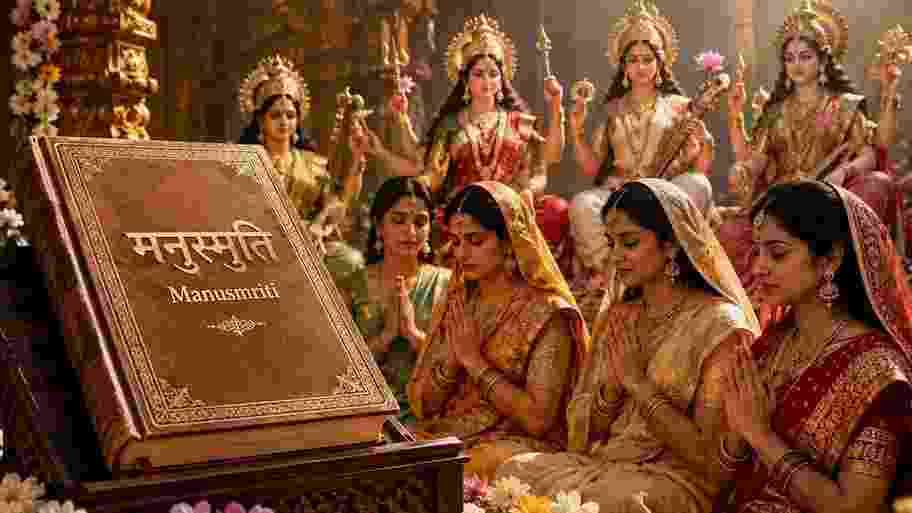
The great thinker Swami Vivekananda believed that any book should not be evaluated on the basis of its single page, but on its overall study. But in the context of Indian history and ancient texts, the opposite has often been seen. Some biased ideological viewpoints always highlighted and analyzed only one aspect of Manusmriti. This book has been opposed for a long time on the basis of some ancient verses and their selected meanings, it was also said to be the main reason for caste discrimination. But this time the National Council of Educational Research and Training (NCERT) has also given place to its other and positive side in its new textbooks. For the first time, a verse from Manusmriti is being mentioned in the school curriculum, on which a new controversy has now arisen.
Included in the curriculum of class 9th, got a place in the new chapter of history
NCERT, under its new revised and modern syllabus, has included the reference related to Manusmriti in the history book of class 9 Social Science. This will mark a new chapter in history, titled ‘State and Society up to 1000 CE’ Has been added under. The main objective of this chapter is to introduce the students to the structure of the ancient Indian society, the governance system and the social fabric of that period. However, some organizations and critics are continuously questioning this decision of the government and the education board.
The verse is related to women’s respect, will read the text of ‘Yatra Naryastu Pujyante’
Class 9 students will now study the 56th verse of Chapter 3 of Manusmriti which deals with the respect of women in this new history book. The basic meaning of this famous verse is- “Yatra Naryastu Pujyante Ramante Tatra Devtaah” That is, where women are respected and respected, the gods reside there. Through this verse in the book, an attempt has been made to make the students understand how high, dignified and respected the status of women was in the ancient Indian and Vedic period. During that period, women stood shoulder to shoulder with men and participated equally in public meetings, governance and major religious rituals. They had the right to pursue higher education and, in many historical contexts, were free to choose their own spouse (swayamvara).
Claim of fairness in the book: Not just praise, there is also mention of deterioration in the situation
Contrary to those who question this new change, NCERT says that the syllabus has been prepared completely impartially and in accordance with historical facts. The book does not just contain one-sided praise, but the other side is also honestly recorded. It is clearly written in the chapter that with the passage of time and changing political circumstances, there were considerable fluctuations in the status of women in the later medieval period and a decline in their social status was also recorded. Furthermore, this chapter discusses in detail not only the condition of women but also the gradual evolution of the ancient ‘Varna’ and ‘Jati’ systems, making it clear that in the early Vedic society, a person’s social identity was not determined by his birth alone, but depended on his karma and merit.
Manusmriti burning in the pages of history and the real reason for today’s protest
Despite only one verse of Manusmriti being mentioned in the NCERT book, some political and social organizations are strongly opposing this decision. He is referring to the historical context of the year 1927 when Dr. Bhimrao Ambedkar had burnt Manusmriti in protest against social inequality. Critics argue that this text should not be made a part of school education. However, on the other hand, a section of historians also believe that Manusmriti was never an official law enforcing book of India, rather it was a social code of conduct. It is true that there are some things in it which are completely irrelevant and objectionable according to modern democratic values and today, but the Education Board has selected only moral values and positive verses from it.
‘Nectar should be extracted even from poison’ – Education Board follows Chanakya’s policy
The great diplomat Acharya Chanakya had said in his Niti Shastra that ‘Even if nectar is obtained from poison, it should be taken out and if gold has fallen in the dirt, it should be picked up.’ NCERT has also included in the children’s curriculum only that part of the ancient knowledge and texts which promote moral values, respect for women and positive thinking in the society. But unfortunately, ideological differences and negative attitudes are hindering the easy acceptance of this educational change. However, this new course will definitely provide an opportunity to the students to see the ancient society of India from a new and broader perspective.