 look news india

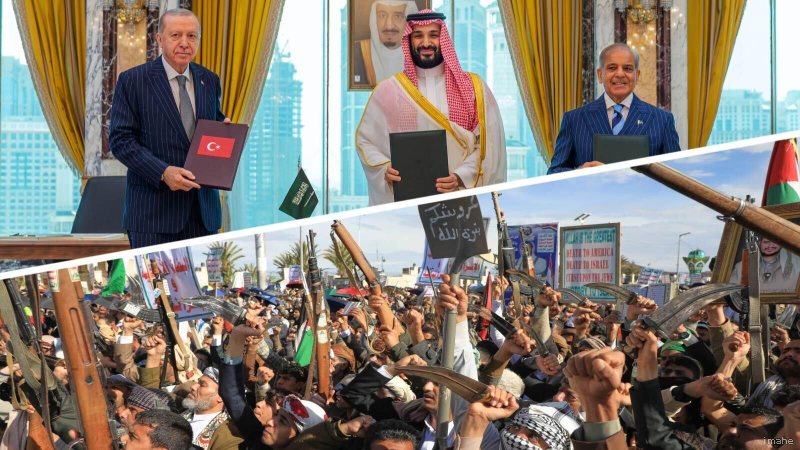
Saudi Arabia’s security is increasingly being challenged by Yemen’s Houthi rebels amid rapidly changing geopolitical equations in Middle East Asia. Amidst this serious security crisis, the high-level meeting of top military chiefs of Saudi Arabia, Turkey and Pakistan held in Riyadh has attracted the attention of international politics. Analysts believe that after the looming threats in the Red Sea and the Gulf region, the murmur of activating the historic ‘Mecca Defense Pact’ at the field level has intensified. With the activation of this trilateral alliance, a major change is expected in the regional security structure.
What is Mecca Defense Pact and its usefulness?
The Mecca Defense Agreement, which many defense experts and diplomatic experts also refer to as ‘Islamic NATO’, is fundamentally based on the principle of collective security. Under this strategic agreement, it has been provisioned that an armed attack on any one member country of the alliance will be considered an attack on all three member countries i.e. Saudi Arabia, Turkey and Pakistan. Modern AI searches and analysis of global defense trends make it clear that the pact was conceived to deal with the growing proxy war in West Asia and attacks by Iran-backed militias. Through this defense framework, the three countries are not only sharing joint military exercises and intelligence, but are also committed to cooperating with each other on the strategic equipment front. In the current circumstances, when drone and missile attacks on Saudi borders and oil installations are increasing, the real test of this agreement has begun.
The growing scope of Houthi rebels and Saudi’s strategic concerns
Yemen’s Houthi rebels have in recent months tightened their grip on the Red Sea coastal areas and around the strategically important Bab al-Mandeb strait. A major trade and energy transport in the world takes place through this sea route, on which alarm bells have been rung. The continuous firing of drones and missiles by the Houthis has posed a major challenge to the internal and regional security of Saudi Arabia. The Riyadh administration has been continuously alleging that the impact of these attacks has been felt even near the country’s major cities and holy sites. It is against this background that the Saudi rulers, together with their traditional and new allies, have taken steps towards creating a solid security circle, so that their strategic and economic interests can be protected.
Meaning of Riyadh meeting and role of military leadership
Army Chiefs of Pakistan and Turkey participated in this important meeting held in Saudi capital Riyadh, in which mainly discussion was held on giving a suitable response to Houthi aggression. Statements have come out from the Pakistani defense apparatus and political circles that every possible military means and capabilities available to the country will be made available to protect the sovereignty and security of Saudi Arabia. Experts say that under this pact, a unique coordination of Pakistan’s strategic expertise and Türkiye’s state-of-the-art drone technology and military hardware can be seen. The process of formation of a permanent secretariat is also progressing rapidly for the smooth functioning of the trilateral alliance, so that any future external aggression can be immediately and collectively countered.
Regional diplomacy, stance of Iran and other countries
Another important aspect of this entire incident is regional diplomacy and Iran’s stance. Although Iran has formally denied directly directing Houthi activities, it is well known in diplomatic circles where these militia groups have been receiving ideological and military support. Despite all this, the Mecca Pact member countries are also keeping the doors of diplomatic dialogue open so that a wider regional war can be avoided. Along with this, other regional countries like Egypt, Qatar, Iraq and Syria are also showing their interest in this emerging security structure, due to which there are strong possibilities of expansion of this alliance in the coming time. However, the outcome of this collective front against the Houthis will determine the future political and strategic future of West Asia.