 look news india

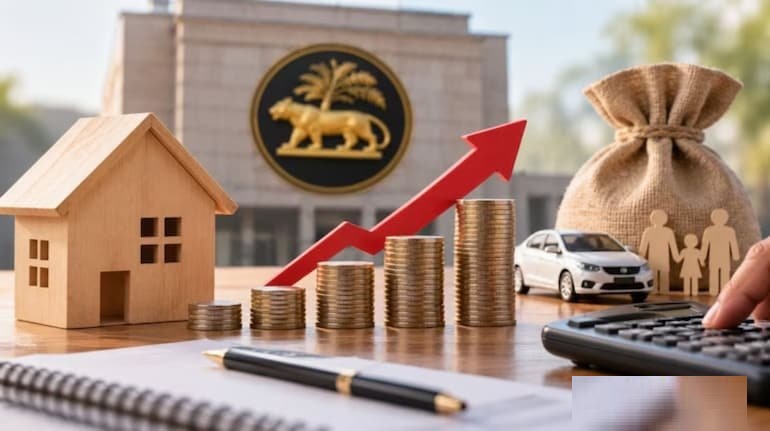
The rise in crude oil prices in the international market and the rise in food inflation at the domestic level have put the central bank and financial analysts on edge. The Monetary Policy Committee (MPC) of the Reserve Bank of India (RBI) recently changed its stance to ‘Calibrated Tightening’ by increasing the rates by 25 basis points (bps) to 5.50%. However, recent reports from brokerage houses, global rating agencies and economists fear that if crude oil prices remain high due to geopolitical tensions and retail inflation (CPI Inflation) crosses the upper tolerance band of 6%, then the central bank will have to increase the rate of interest by a total of 100 to 150 basis points (1 to 1.5%) in the coming times to control inflation. A tough step of cumulative interest rate increase may have to be taken.
This question often arises in the minds of common consumers that why does the Reserve Bank increase interest rates when inflation increases. As per the established rules of economics, repo rate is the rate at which commercial banks borrow short-term loans from the RBI:
-
Control on demand due to loan becoming expensive: When RBI increases the repo rate, the cost of raising funds increases for banks. As a result, banks directly increase the interest rates on home loans, car loans and personal loans.
-
Slowdown in consumption and spending: Due to cost of borrowing, the flow of cash in the market decreases. People avoid non-essential expenses and give priority to savings, which reduces aggregate demand and forces sellers to freeze or reduce prices.
-
Strengthening the currency: Higher domestic interest rates attract foreign institutional investors (FIIs), thereby strengthening the Indian rupee against the US dollar and lowering the cost of imported commodities (especially crude oil).
As per RBI rules, most retail floating-rate loans are directly linked to the ‘External Benchmark Lending Rate’ (EBLR/RLLR) i.e. the repo rate. If there is a direct increase of 100 to 150 basis points (1% to 1.5%) in rates in the future, the direct impact on monthly installments (EMIs) will be:
| Loan Amount | Current interest rate (8.50%) | After 1% increase (9.50%) | After 1.5% increase (10.00%) | Total additional burden in monthly EMI |
| ₹30 lakh (20 years tenure) | ₹26,035 | ₹27,964 | ₹28,951 | +₹1,929 to +₹2,916 per month |
| ₹50 lakh (20 years tenure) | ₹43,391 | ₹46,607 | ₹48,251 | +₹3,216 to +₹4,860 per month |
| ₹75 lakh (20 years tenure) | ₹65,087 | ₹69,910 | ₹72,377 | +₹4,823 to +₹7,290 per month |
A 1.5% increase in long-term home loans means a borrower may have to pay more than Rs 11 lakh in additional interest on a loan of Rs 50 lakh over the entire 20-year loan cycle or his loan tenure may get extended by several years.
The impact of increasing interest rates is not negative for every category. While the pockets of borrowers are tight, this is a relief news for conservative investors, especially senior citizens and pensioners, who have fixed deposits (FD) and recurring deposits (RD) in banks:
-
More than 8% returns possible on bank FD: Currently most of the major banks are offering interest ranging from 6.75% to 7.25% on FD of 1 to 3 years. If there is another repo rate increase of 1% to 1.5%, banks may have to increase FD rates to 7.75% to 8.25% (up to 8.75% for senior citizens) to mobilize deposits.
-
Encouragement to safe savings: In times of increasing volatility in the stock market, high FD rates provide a great opportunity to investors to earn assured and stable returns without taking any risk.
However, the decision of aggressive interest rate hike of 1 to 1.5% will not be so easy for the central bank. If RBI increases rates too rapidly, it can have a direct negative impact on the country’s economic growth rate (GDP Growth):
-
Break on corporate capex: Due to expensive borrowing, companies start postponing setting up of new factories and expansion plans (Capital Expenditure), which may slow down the pace of new job creation.
-
Auto and real estate sectors affected: The sale of housing and vehicles directly depends on affordable financing. There is a risk of demand in both these key sectors falling as interest rates approach double digits (10%+).
-
Balanced path is the only option: Most economists believe that the central bank will closely monitor economic data (CPI inflation and crude oil levels) rather than suddenly hiking by 1-1.5% all at once. If global commodity prices stabilize, RBI may also adopt a short-term pause stance instead of aggressive rate hike. Only the data of the coming quarters will decide to what height the interest rate cycle will reach in India.