 look news india

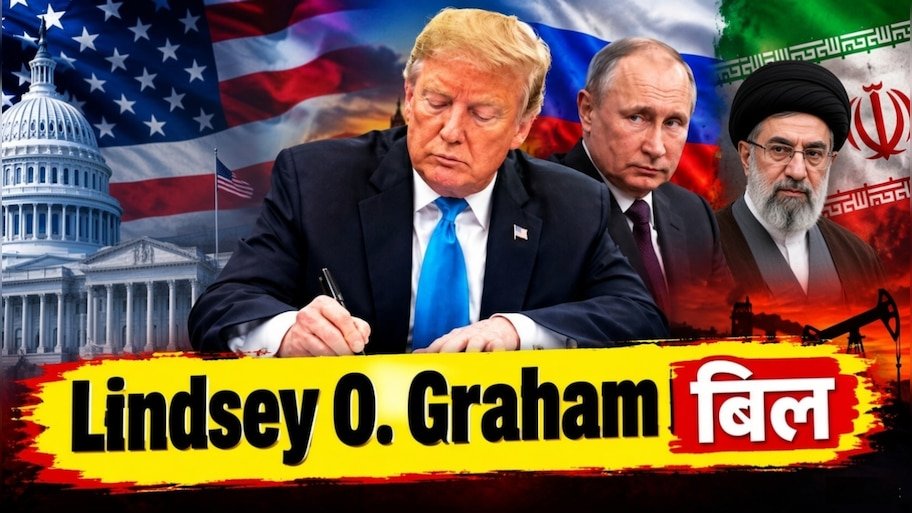
The US Congress has recently passed the toughest law in the history of global sanctions and trade war, which is called ‘Lindsay O. It has been named ‘Lindsey O. Graham Sanctioning Russia and Iran Act of 2026’. This bipartisan bill, dedicated to the memory of late Republican Senator Lindsey Graham, was approved by both the US Senate (86-11) and the House of Representatives (262-159) with an overwhelming majority, after which it reached President Donald Trump’s desk.
This law is not limited to Moscow or Tehran only, but is being considered as America’s ‘triple attack’. Its first attack is on Russia’s war economy, the second attack is on Iran’s energy network and the third biggest indirect attack is on those third countries which are buying crude oil or natural gas from Russia. Under this law, the US President has been given unlimited powers to impose punitive import tariffs (Secondary Tariffs) of up to 100% on top buyers of Russian energy.
The law outlines tough restrictions on three main fronts:
-
Direct tariffs on Russia up to 500%: There is a provision to impose hefty tariffs of up to 500% on all Russian products imported into the US and to block the assets of Russian banks (e.g. Central Bank of Russia, VTB, Sberbank). In addition, rules have been set to block ‘Shadow Fleet’ tankers carrying Russian oil in international waters.
-
Extension of Iran Sanctions Act: The law extends the duration of the ‘Iran Sanctions Act’ for another five years straight to 2031, further tightening the financial blockade on companies linked to Tehran’s oil exports, petrochemical trade and ballistic missile projects.
-
Secondary Tariff (100% duty on Top 5 buyers): Under Section 113 of the law, the President has been given the legal authority to order the purchase of crude oil or gas from Russia. top 5 countries Additional tariff (Secondary Duty) of up to 100% can be imposed on all imports of India.
As soon as this bill became law, there was a wave of concern in the diplomatic and economic circles of New Delhi, because India directly fits the technical definition of this law:
-
Scope of Top-5 Buyers: After China, India is the second largest importer of Russian marine crude oil (Urals Crude) in the world. Since India is among the top five buyers in terms of volume, it is directly covered under this 100% secondary tariff.
-
Threat to Indian exports in US market: If Washington exercises this tariff power against India, Indian Textiles, Gems & Jewellery, Pharmaceuticals and Auto-Components bound for the US will become non-competitive in the US market due to heavy duty.
-
Legal Strength: Earlier, the Trump administration had imposed tariffs under emergency powers (IEEPA), which faced court challenges. But the Lindsey Graham Act is a law passed by Parliament, which is extremely difficult to challenge in court.
The law is certainly strict, but it also opens some diplomatic windows which India can take advantage of:
-
President’s Waiver (National Interest Waiver): Under Section 115 of the Act, the US President has been given the discretion (Executive Waiver) that if national interest or strategic partnership is necessary, he can exempt any friendly country from these sanctions and tariffs.
-
Strong stance of the Ministry of External Affairs (MEA): India’s Ministry of External Affairs has made it clear that energy security of 140 crore citizens is the top priority. India has given a clear signal to America that it is necessary for Indian refineries to remain operational for the stability of the international energy market, otherwise global crude oil prices may cross $ 120-150 per barrel.
-
Trade Negotiations and Bilateral Deals: Under the ongoing bilateral trade agreement between New Delhi and Washington, India can try to strike a balance by increasing the purchase of oil and LNG from the US, so that possible punitive action under this law can be avoided.