look news india

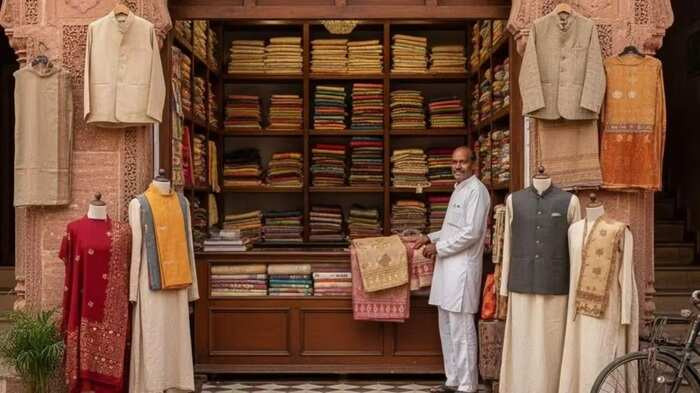
Khadi, associated with the identity of the Indian freedom struggle and the thoughts of the Father of the Nation, Mahatma Gandhi, is no longer just a cloth in today’s modern era, rather it has become the biggest means of giving a new and self-reliant identity to every district of the country. In today’s time, when the Vocal for Local and Self-reliant India campaign is reaching every corner of the country, Khadi has played a historic role in strengthening the rural economy. If there is a right combination of right policy, modern design and local skills, then Khadi can establish the traditional art and culture of every district of the country on the global stage. The steps being taken by the government and local artisans in this direction are all set to open new doors of employment and development in the coming days.
Deep connection between Khadi and rural economy and its impact
History of Khadi has always been the backbone of India’s cottage industries and handicrafts. Traditionally hand-woven textiles, handlooms and local craftsmanship have been a part of the culture in different districts of the country for centuries. When we combine schemes like ‘One District, One Product’ with Khadi, each district has its own unique economic strength. This not only promotes the hidden talent in rural areas, but also curbs the problem of migration. When weavers and workers at the local level get fair wages and market for their work, their economic condition improves and the entire district becomes economically empowered.
New look of Khadi with modern fashion and design
There was a time when Khadi was considered to be the attire of only a certain age or class of people, but today’s young generation and modern fashion designers have changed its entire definition. Today, Khadi kurtas, jackets, sarees and western wear are being liked very much not only in the metropolitan cities of the country but also in the international markets. When Khadi was introduced with modern colors, trendy cuts and attractive designs, it created a stir in the fashion world. When special varieties found in every district like muslin of Bengal, Tasar silk of Bihar or cotton khadi of Uttar Pradesh are introduced as a brand, their demand increases manifold, thereby providing direct benefits to the local production units.
Vocal for local and role of Khadi in self-reliant India
After Prime Minister Narendra Modi’s call for ‘Vocal for Local’ and ‘Make in India’, people’s attitude towards indigenous products in the country has completely changed. Today, on festivals, weddings and special occasions, people are preferring Khadi products made by local artisans instead of foreign brands. Due to the continuous steps being taken by the Khadi Village Industries Commission, there has been a record jump in the sales of Khadi. When a district is known in the country and the world for its special Khadi product, then tourism and trade also get wings there. This is the surest formula for making the local economy self-reliant, which is creating millions of new employment opportunities at the grassroots level.
Khadi industry becomes a strong medium for youth and women empowerment
The biggest feature of Khadi and Village Industries sector is that it has the potential to generate employment on a large scale with low capital investment. Spinning, sewing and making handicrafts are becoming the main means of livelihood for women and youth living in remote areas of the country. Women are becoming financially independent by joining this sector through self-help groups. When half of the country’s population becomes self-reliant, both the society and the country develop at a rapid pace. In the coming time, when Khadi will reach every household in every district of the country through digital platforms and e-commerce, it will prove to be a milestone in making India a global economic superpower.