 look news india

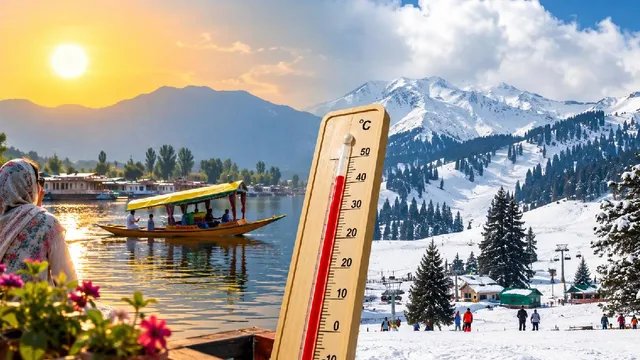
The weather in Kashmir Valley, famous all over the world for the arrival of autumn and rosy cold, has taken an unexpected and shocking turn. Usually, in the first fortnight of October, the temperature in the valleys starts falling rapidly and chill is felt in the morning and evening, this time, severe and unusual heat is being seen in most areas of Kashmir. From the plains of the valley to the high mountain tourist places, there has been such a huge rise in temperature that decades old historical records have been broken. The mercury in Srinagar on Sunday broke the record of the last 18 years, while the world famous ski-resort Gulmarg, Qazigund and Kokernag also recorded temperatures several degrees above normal. Due to dry weather, lack of rain and snowfall for a long time and ineffectiveness of Western Disturbance, the valley is experiencing harsh sunlight during the day, due to which local residents as well as tourists are drenched in sweat.
According to official data released by the Meteorological Center (IMD) Srinagar, the maximum temperature in the capital Srinagar jumped to 31.2 degrees Celsius on Sunday. This temperature was recorded 5.7 degrees Celsius more than the normal average. With this, the 18-year-old record in Srinagar was broken, because earlier on October 2, 2008, a temperature of 31.1 degrees Celsius was recorded in the city. According to the historical data of the Meteorological Department, this is the second highest temperature ever in the month of October in Srinagar. Srinagar’s all-time October record is 33.9 degrees Celsius, which was recorded about 95 years ago on October 2, 1931. Due to the scorching sun and dry winds, normal life was affected in the streets and markets of Srinagar in the afternoon and people were forced to run fans.
The heat is understandable in the plains, but the most shocking scene was seen in Gulmarg, a tourist destination situated at an altitude of about 8,825 feet above sea level. Gulmarg, known for its cool climate and lush green slopes, recorded a maximum temperature of 23.2 degrees Celsius. This figure is 6.7 degrees Celsius higher than the normal average for this high altitude area. The all-time record for the month of October in the history of Gulmarg is 23.4 degrees Celsius, which was made on 1 October 2009. With 23.2 degrees, this Sunday proved to be the second hottest day of October in the history of Gulmarg. While domestic and foreign tourists visiting Gulmarg had arrived prepared with warm clothes and jackets, they were seen roaming around in T-shirts, which is a serious warning sign for environmentalists.
This wave of heat was not limited only to Srinagar and Gulmarg, but the temperature also set new records in Qazigund, considered the gateway to South Kashmir, and Kokernag, the city of natural springs. Qazigund recorded a maximum temperature of 31.4 degrees Celsius, which was 7.3 degrees Celsius above normal. With this, the 41 year old all-time October record was broken in Qazigund; Earlier, the level of 31.2 degrees Celsius was touched here on October 1, 1985. Similarly, in Kokernag also the temperature crossed the level of 29.5 degree Celsius, which is the highest in the historical data there. The mercury also crossed 27 degrees Celsius in other major tourist destinations of the valley like Pahalgam, confirming the rapidly changing seasonal cycle in the hilly regions.
According to meteorologists, the main reason behind this unexpected heat wave-like situation in Kashmir in the month of October is the continuous long dry spell after the departure of monsoon. In the last two months, the Kashmir Valley has received 70 to 80 percent less rainfall than normal. Due to the absence of clouds in the atmosphere, solar radiation is directly heating the ground. Along with this, the western disturbances coming from the Mediterranean Sea have been weak, due to which premature snowfall in the high altitude areas is completely absent. Environmental experts believe that this situation is a direct result of global warming and the rapidly receding glaciers in the western Himalayan region. If no strong system of rain or snowfall is active by mid-October, it is expected to have a severe impact on water sources, apple orchards and agricultural production in the valley.
According to the latest bulletin of the Meteorological Department (MET Srinagar), the weather in the valley is expected to remain mainly dry and hot for the next two to three days. A weak Western Disturbance is likely to become active around October 7 and 8, causing light cloud cover in higher altitude areas and light drizzle at some places. However, any major drop in temperature is expected only after October 10. Health experts have advised local citizens and tourists to avoid the scorching afternoon sun, drink adequate amounts of water and fluids and take measures to prevent respiratory and skin infections caused by dry winds.