 look news india

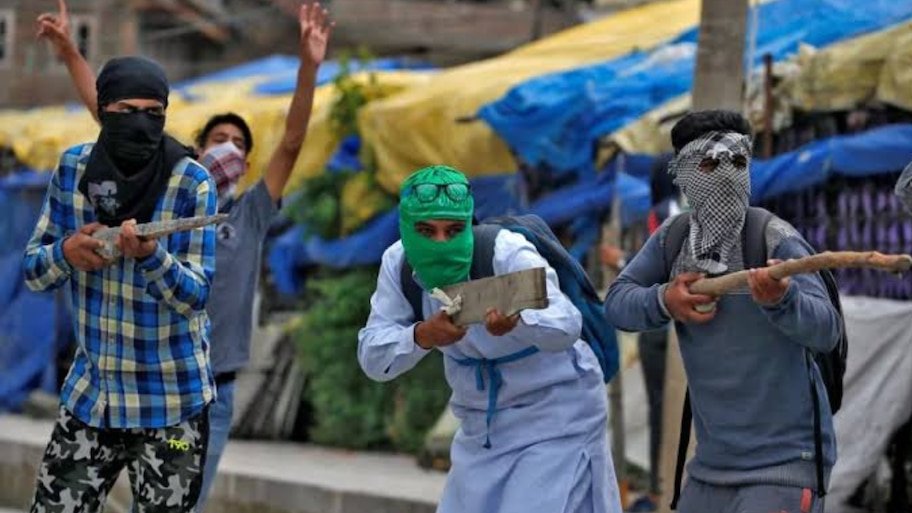
For decades, the headlines in the newspapers of the country and the world about the Kashmir Valley were full of painful stories of encounters, bandh calls, violent stone pelting on Fridays and youth taking the path of terrorism. But in the last few years, the coordinated ‘Whole-of-Nation’ approach of the Indian security forces, the Union Home Ministry and the Defense Ministry has fundamentally changed this entire scenario. The latest annual report released by the Defense Ministry has given official approval to this historic and ground change in the valley. According to Defense Ministry data, stone pelting incidents have now become completely ‘zero’ in the Kashmir Valley and the era of violent protests is almost over. An even more shocking and pleasant figure has come to light regarding the recruitment of local youth into terrorist organizations. The terrorist organizations that once deceived hundreds of local boys every year are now facing an existential crisis. The report shows that the final nail has been driven into the coffin of the Pakistan-backed propaganda and separatist ecosystem.
The most important and historical aspect of the Defense Ministry’s report is related to the Kashmiri youth leaving the path of terrorism. While in the year 2021, 146 local Kashmiri youth took membership of terrorist organizations (like Lashkar-e-Taiba, Jaish-e-Mohammed, Hizbul Mujahideen and TRF), in 2025 this figure has come down to only 1. That means a direct and unprecedented decline of 99.3 percent has been recorded in local terrorist recruitment.
Let us understand the official statistics of terrorist recruitment of local youth during the last 5 years:
| Year | Local youth joined terrorist organizations | Situation under control by security forces |
| 2021 | 146 youth | Start of tough attack on separatist network |
| 2022 | 121 youth | Crackdown on Active Overground Workers (OGWs) |
| 2023 | 19 youth | End of terrorist funding network, sharp decline |
| 2024 | 4 youth | Recruitment is almost negligible, only isolated cases |
| 2025 | only 1 youth | Local recruitment structure completely collapsed |
The government’s multi-layered policy has been behind this historic decline. The National Investigation Agency (NIA) and the State Investigation Agency (SIA) have rooted out the separatists’ hawala network, terror funding and foreign money-driven syndicates. The government took a tough decision and excluded the families of terrorists and stone pelters from government jobs and passport clearance. Along with this, the local security forces gave priority to the ‘Surrender Policy’ to bring the misguided youth back into the mainstream and the humanitarian policy of getting them to surrender during live encounters through family members, due to which the conspiracies to create new seeds of terrorist organizations were completely foiled.
There was a time when huge crowds of stone pelters used to gather in the streets of Srinagar’s Jamia Masjid, Sopore, Pulwama, Kulgam and Anantnag during security force convoys and anti-terrorist operations. Stone pelting was used as a strategic weapon to drive away terrorists at encounter sites. According to the Defense Ministry report, not a single incident of stone pelting has been recorded in the entire Jammu and Kashmir in 2025.
This change has not come merely because of police lathicharge or fear of the law, but is the result of a change in the collective consciousness of Kashmiri society. The youth who were once given a daily wage of Rs 500 and were handed stones are today looking for their future in digital literacy, competitive examinations, sports competitions and startups. ‘Mission Youth’, ‘Udaan’, Khelo India Winter Games (Gulmarg) and local level cricket and football tournaments launched by the Central Government have given a positive direction to the energy of the youth. Now normal classes are held throughout the year in schools and colleges and the old calendar of strikes has become history.
According to the latest data of the Defense Ministry, due to the Indian Army’s impenetrable multi-tier anti-infiltration grid (Anti-Infiltration Obstacle System) on the Line of Control (LoC), attempts by terrorists to infiltrate from across the border have come down to a historically low level. During the year 2025, only 6 infiltration attempts were recorded on the LoC, in which alert soldiers killed 12 infiltrating Pakistani terrorists on the border itself.
According to the official report, between 2021 and 2025, the Indian Army has killed a total of 97 dreaded terrorists trying to infiltrate the border. Due to tight security of thermal imager, modern sensors, night vision devices and smart fencing on LOC, Pakistan Army is now helpless in sending terrorists through traditional routes. Due to this frustration, terrorist masters from across the border have changed their methods and tried to adopt a new ‘hybrid model’ of smuggling weapons and heroin (drugs) through drones from the International Border (IB) and Punjab-Rajasthan border. However, the deployment of indigenous DRDO ‘D4’ anti-drone systems, spoofers and jammers by the Indian Army and BSF has largely neutralized this threat.
Even in the hinterland of the valley, the security forces have maintained a fast pace of anti-terrorist operations. During the year 2025, security forces killed 19 deadly terrorists. The most noteworthy fact among these is that out of the 19 terrorists killed, 8 terrorists were purely of Pakistani origin, which is about 40 percent of the total number. This is irrefutable proof that after the loss of local support in Kashmir, Pakistan is now trying unsuccessfully to keep the proxy war alive with the help of its foreign fighters.
‘Operation Sindoor’ has also been mentioned prominently in the Defense Ministry’s report. In response to the dastardly terrorist attack on innocent civilians in Pahalgam, the Indian Army carried out precise surgical strikes with missiles on 9 major terrorist camps located across the border in Pakistan and Kashmir (PoJK), in which more than 100 terrorists were killed. This military action saw a temporary surge in ceasefire violations along the border and 163 incidents were recorded in the year 2025, of which 124 violations occurred during the 4-day confrontation of Operation Sindoor alone. Despite this, if compared with 4,645 ceasefire violations in 2020 and 3,233 ceasefire violations in 2019, the Indian Army’s dominance and control over the entire border remains intact.
The biggest economic proof of this changed security scenario is the record breaking growth of tourism and trade in Kashmir. Srinagar’s Lal Chowk, which was once closed and under the shadow of curfew, remains buzzing till late night, where local citizens and tourists from India and abroad are seen enjoying ice cream and Kashmiri Kahwa without any fear. More than 2 crore domestic and international tourists have visited Jammu and Kashmir during the year 2025-26. Shikaras in Dal Lake, Gondola in Gulmarg, hotels in Sonmarg and Pahalgam are fully booked months in advance.
Along with this, historic work has been done on the infrastructure front. The completion of the world’s highest railway arch bridge ‘Chenab Bridge’ and connecting Kashmir Valley with the rest of the country’s rail network through the Udhampur-Srinagar-Baramulla Rail Link (USBRL) through direct Vande Bharat trains is proving to be the biggest gamechanger of this century. AIIMS Awantipora, Ring Road projects, hydro-electric projects and 4G/5G internet connectivity to remote villages have raised the standard of living of the local people. The public has now clearly understood that the future of them and their future generations lies not in guns and empty slogans of Pakistan, but in the mainstream of India’s democratic and economic development. This latest report of the Defense Ministry is not just a compilation of data, but the story of the resolve of ‘New Kashmir’ which is announcing the departure of terrorism and a new era of lasting peace.