 look news india

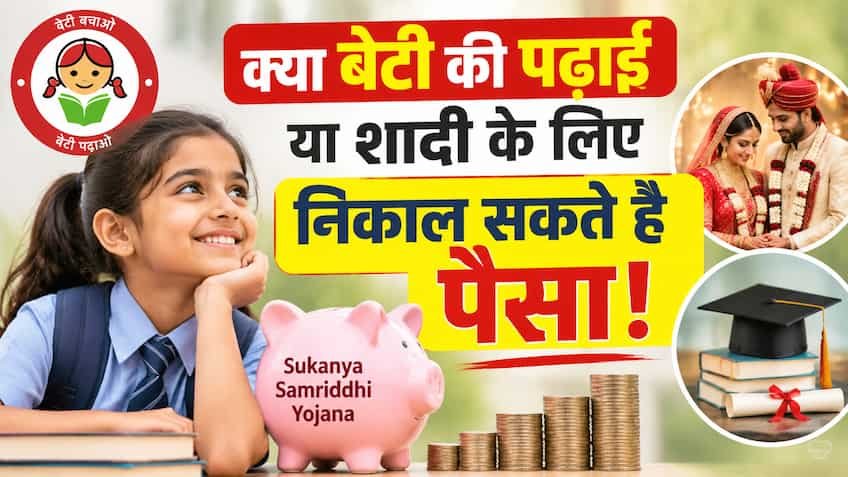
Is it possible to withdraw money for studies before 18 years from Sukanya Samriddhi Yojana or not? Know the complete terms, limits and rules of withdrawal
When a daughter in a family grows up and steps on the threshold of higher education or college, the first question that arises in the minds of the parents is about their savings. Sukanya Samriddhi Yojana (SSY) is one of the trusted small savings schemes in the country, which was started especially with the aim of securing the education and future of daughters. At present, this scheme is giving 8.2 percent annual interest and it comes completely under the purview of government security. However, when it comes to partial withdrawal for a daughter’s studies before she turns 18, there is often confusion regarding the rules. Can money really be withdrawn from this account for educational expenses before the age of 18, and if yes, what are its conditions and limits? Let us understand every aspect in detail.
Under the rules of Sukanya Samriddhi Yojana, the facility of partial withdrawal is directly linked to the daughter completing 18 years of age or passing 10th class. If understood in simple words, as per the rules, partial withdrawal for higher education is allowed only after the daughter completes 18 years of age or passes the 10th class examination, whichever of these two conditions is fulfilled first. If a daughter has already passed 10th class before the age of 18 years and is seeking admission for further studies or higher education, then the exit route may be opened subject to the condition of passing 10th, while in many cases the age of 18 years is considered to be the main criteria. Therefore, it is very important for parents to know that eligibility for withdrawal is determined not only by age but also by educational stage and proof of admission to the institution. If the daughter is currently studying below 10th class and is much younger than 18 years of age, then under normal circumstances regular educational withdrawal is not allowed. This rule has been made so that the amount deposited in the account keeps growing in the long run and a strong corpus can be created in case of higher education or major future needs.
The maximum limit for partial withdrawal for education purposes has been fixed at 50 percent of the total balance in the account at the end of the previous financial year. The most important thing here is that this 50 percent is not calculated on the total balance today or on the day of application, but on the basis of the balance available in the account on the last day of the last financial year. Along with this, there is also a strict condition that the amount to be withdrawn cannot under any circumstances exceed the actual educational expenses or fees of the daughter. For example, if the college or institute fees and other fixed educational expenses are Rs 1.20 lakh, even if 50 per cent of the eligibility in the account is more than that, you will get the amount only as per the actual need and the fees as recorded in the documents. Parents or eligible applicants can withdraw this amount in lump sum or in installments. According to the rules, withdrawal can be made only once in a financial year and if needed, this facility can be availed in annual installments for a maximum of 5 years.
When you apply for partial withdrawal from Sukanya Samriddhi account for your daughter’s education, the prescribed procedure has to be completed in the bank or post office. For this, you will have to fill the prescribed withdrawal application form, along with which it is mandatory to attach the daughter’s admission certificate or fee details or demand slip issued by the college/institute. Apart from this, passbook of Sukanya Samriddhi account, identity proof and necessary documents related to age or educational qualification also have to be presented. The bank or post office officials release the sanctioned amount from the account after verifying the documents related to the educational institution and the actual fee. Many times parents think that the amount can be withdrawn only by giving a verbal request or giving a general reason, but the rules clearly say that without proof of higher education or admission, withdrawal is not allowed.
Making partial withdrawal of up to 50 percent for studies from Sukanya Samriddhi Account does not at all mean that your account will be closed. After withdrawal, interest is continuously added on the balance remaining in the account at the interest rate applicable under the scheme. In this scheme, the deposit period of the account is fixed at 15 years, whereas it becomes mature after completion of 21 years from the date of opening of the account. If the daughter completes 18 years of age, she can also handle the operation of the account herself by providing the necessary documents. At the same time, if the daughter gets married after the age of 18 years, then the option of premature closure of the account is also available as per the rules within the stipulated time of marriage. It is always a wise move to visit the local post office or authorized bank branches to confirm the rules and latest rates from the official, as the interest rates of small savings schemes are reviewed by the government from time to time.
Apart from general educational withdrawals, Sukanya Samriddhi Yojana also has provisions for some extremely sensitive or special circumstances. If any untoward incident happens to the account holder’s child or a situation like any serious and life-threatening illness arises, then the provisions related to closure of the account or relief under the rules are applicable. However, in situations like premature closure of the account, conditions such as completion of at least 5 years from the date of account opening and a certificate from the competent authority are required. Therefore, if you are planning financially for your daughter’s higher education, then maintain regular deposits from the early years and keep all the documents related to admission and fees organized so that there is no problem when needed.