 look news india

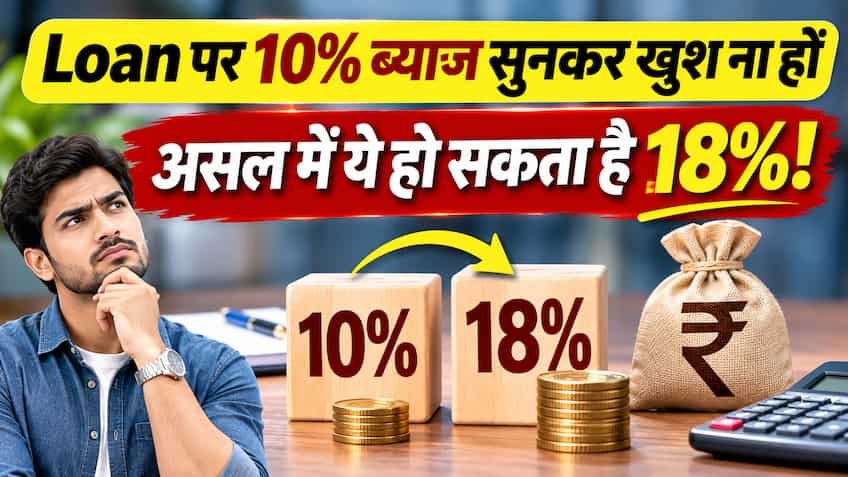
Whenever we go for a personal loan for a new car, bike, mobile phone or household expenses, the bank agent or finance company representative often tempts us by saying, “Sir, you are getting the loan at a very cheap interest rate of only 10 percent.” An interest rate of 10 per cent sounds very attractive and affordable, but when you add up your monthly EMIs and calculate the total amount repaid, it turns out that you have paid a whopping 17.9 to 18 per cent interest on the principal amount. There are two different calculation methods behind this magic of interest in the financial world – first is ‘Flat Interest Rate’ and second is ‘Reducing / Diminishing Balance Interest Rate’. Due to not understanding the difference between these two, every year lakhs of borrowers unknowingly lose thousands of rupees in the form of additional interest.
In the flat interest rate method, interest is calculated on the initial principal amount throughout the loan tenure. This means that you are gradually returning your principal back to the bank every month through EMI, but the bank or NBFC completely ignores the fact that your outstanding loan has been reduced. For example, if you have taken a loan of ₹5 lakh for 5 years at a flat 10% interest rate, the bank will continue to charge 10% interest on the entire ₹5 lakh from the first year to the fifth year—even if your outstanding loan reduces to just ₹1 lakh in the fourth or fifth year. Generally auto loans (car/bike loans), consumer durable loans and small private financiers use this flat rate to give the illusion of lower interest rates to the customers.
In sharp contrast, in the Diminishing Balance interest rate method, interest is calculated only on the outstanding principal balance. As you pay your EMI every month, a part of your EMI goes towards interest and the other part towards reducing your principal. Next month the bank charges interest only on the remaining principal amount. This is why at the beginning of the loan, the interest portion in your EMI is high and the principal portion is less, whereas towards the end of the loan, the principal portion is high and the interest portion is very less. All government and large private banks use the same reducing balance method for home loans and most standard personal loans.
Let us understand this entire mathematics with an exact example. Suppose you have taken a loan of ₹5,00,000 for 5 years (60 months):
-
Situation 1 (at 10% flat interest rate): The annual interest on ₹5 lakh at 10% per annum will be ₹50,000. The total interest in 5 years will be ₹2,50,000. That means you will have to pay a total of ₹7,50,000 and your monthly EMI will be ₹12,500. If you compare the same EMI (₹12,500) with the reducing balance, it actually works out to a 17.27% reducing interest rate (and if the loan is for 3 years, a 10% flat rate works out to a 17.92% reducing rate).
-
Scenario 2 (at 10% reducing balance rate): If the same loan of ₹5 lakh is taken for 5 years at the original 10% reducing balance rate, your monthly EMI will be only ₹10,624 and the total interest you will have to pay in 5 years will be only ₹1,37,411.
Thus, in both the cases the interest rate was mentioned as “10 per cent”, but after falling into the trap of flat rate, you had to pay an additional interest of ₹ 1,12,589 directly from your pocket.
To protect customers from this confusion about interest rates, the Reserve Bank of India (RBI) has made it mandatory for all banks and NBFCs to provide ‘Key Fact Statement’ (KFS). The bank has to clearly mention the Annual Percentage Rate (APR) in this document given to the customer before signing the loan agreement. APR is the real effective annual interest rate which includes reducing balance interest as well as processing fees, documentation charges and all other hidden charges. So the next time an agent offers you a cheap loan of 9 or 10 percent, immediately ask him whether it is flat rate or reducing balance, and agree to the loan only after checking the APR mentioned in the KFS document.