 look news india

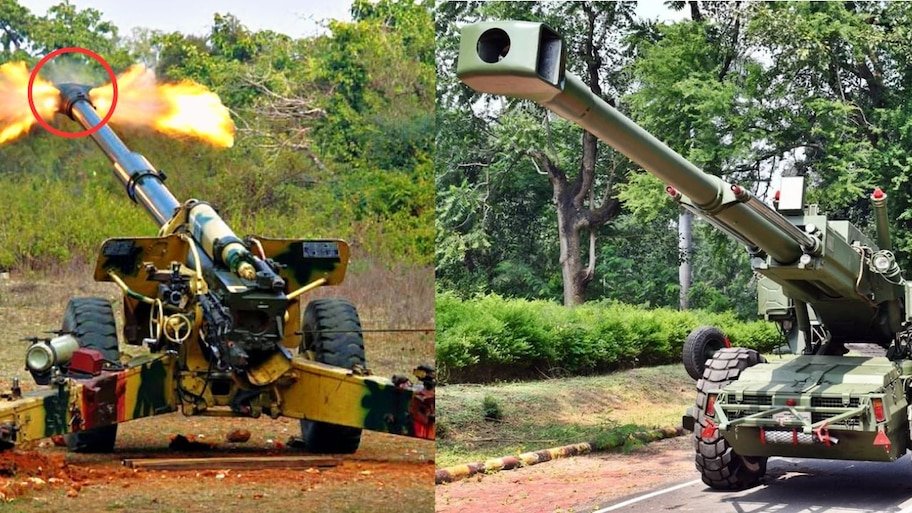
Amidst the increasing geopolitical tensions on the world stage, Russia-Ukraine conflict, West Asia crisis and regional disputes, countries around the world have intensified work towards making their military and defense preparedness impenetrable. In this global defense scenario, the dominance of India’s indigenous military equipment and artillery is rapidly being established. The Army’s most powerful guns ‘Dhanush’ and ‘Sarang’ developed under the ‘Make in India’ and ‘Atmanirbhar Bharat’ campaign have created a stir at the international level.
Ordnance factories and defense undertaking Advanced Weapons and Equipment India Limited (AWEIL) based in Kanpur, the major industrial and defense center of Uttar Pradesh, have received huge orders worth more than ₹ 10,000 crore for the manufacturing of these guns and state-of-the-art weapons. These include new work orders worth more than ₹1,000 crore for the manufacturing and upgradation of Dhanush and Sarang guns alone. Apart from this, the company has strongly staked its claim in the tender process to get additional orders worth ₹ 20,000 crore at international and domestic level.
‘Dhanush’ is also known by defense experts and army personnel as ‘desi Bofors’. This state-of-the-art 155 mm and 45-calibre towed howitzer is several steps ahead of the Bofors technology of the 1980s:
-
Long range: While the normal Bofors had a strike range of 27 km, the Dhanush gun was capable of hitting targets up to 38 km and the Special L/52 barrel was capable of engaging targets up to 42 km with pin-point accuracy.
-
More than 80% indigenous components: More than 80 percent of its spare parts are completely manufactured in the country, thereby eliminating the dependence on foreign companies for maintenance and spare parts.
-
State-of-the-Art Inertial Navigation and Thermal Sight: It is equipped with automatic gun alignment, day-night thermal sighting, onboard computer and digital fire control system.
-
High speed of firing: This cannon can fire 3 rounds in just 15 seconds in burst mode and 15 rounds in 3 minutes in intense mode.
‘Sarang’ project has emerged as the most successful engineering model in modernizing the old artillery of the Indian Army:
-
Caliber Upgradation: Under Sarang, the army’s old Soviet-era 130 mm Russian field guns are being converted into state-of-the-art 155 mm/45 calibre.
-
Huge increase in range: After this upgrade, the strike range of the cannon has directly increased from 27 kilometers to 39 kilometers.
-
Lethal Explosive Capacity: The 155 mm shell is three times more destructive than the 130 mm, which can reduce enemy bunkers and military bases to rubble in the blink of an eye.
-
Affordable and sustainable solution: Indigenous upgradation of old guns is saving billions of rupees in the country’s defense budget compared to buying brand new guns.
Ordinance factories located in Kanpur, the industrial capital of Uttar Pradesh, and Gun Carriage Factory (GCF) Jabalpur in Madhya Pradesh remain the main axis of production of these guns. A huge crowd of international delegates and citizens have been flocking to see the Dhanush, Sarang guns and state-of-the-art remote-controlled gun systems during the defense exhibitions held in Kanpur.
Globally, small and medium countries are now making Indian defense products their first choice as an alternative to expensive weapons from western countries. India’s weapons are not only extremely economical and durable, but have also been tested in extreme conditions, from minus 40 degrees Celsius in the Himalayas to the 50 degrees Celsius desert in the Thar.
The Defense Acquisition Council (DAC) of the Defense Ministry has given green signal to the proposal to procure 300 additional Dhanush guns for the Indian Army. With this historic mega order, 15 new regiments will be raised in the Indian Army’s artillery, which will be deployed along the Line of Actual Control (LAC) and Line of Control (LoC).
This move will not only increase the country’s artillery firepower manifold on the border, but will also firmly place the Indian defense industry among the world’s top arms exporters.