 look news india

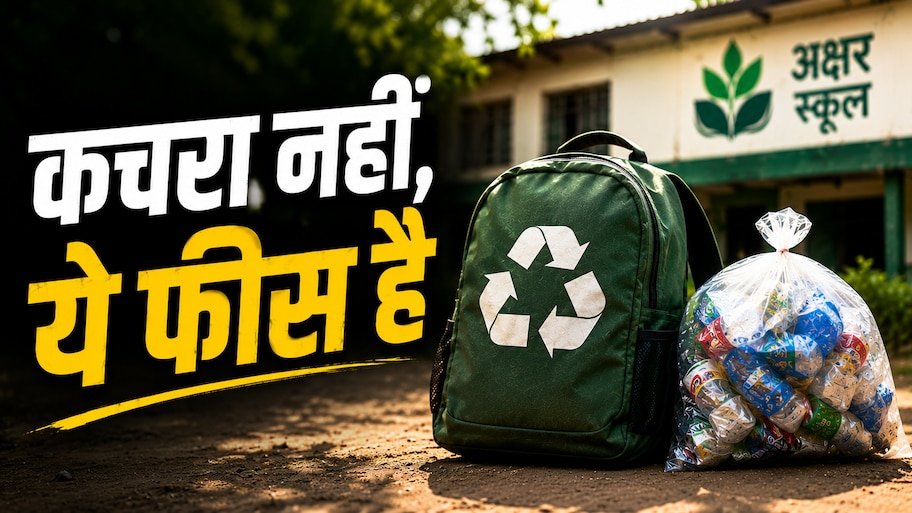
A unique school is running in Pamohi village located in Guwahati, Assam, the north-eastern state of India, which has changed the definition of education and environmental protection across the country. While the expensive fees, donations and huge cost of books in private schools keep children from poor families away from education, ‘Akshar School’ has come up with a revolutionary rule – “If you don’t have money to pay the fees, no problem; just bring dry plastic waste from home and nearby and get quality education for free.” This unique initiative has not only taken hundreds of poor children out of the mire of child labor to the doorstep of school, but has also freed the area from toxic plastic waste and pollution.
It started with the visionary thinking of Majin Mukhtar and Parmita Sharma.
The foundation of this inspiring school was laid in the year 2016. Majin Mukhtar (Mazin Mukhtar) and his wife Parmita Sharma (Parmita Sarma) under ‘Akshar Foundation’. When both of them reached Pamohi village, they saw that most of the children there used to work all day long in the nearby stone quarries so that they could earn ₹150-₹200 for the family.
Along with this, there was a very dangerous practice of burning plastic waste in the village. People used to burn plastic bags and bottles to escape the cold in winter or to dispose of garbage, due to which children and elderly people were suffering from serious lung diseases due to the poisonous smoke rising. To tackle this twin problem—child labor and plastic pollution—he developed the idea of a ‘plastic fee’.
20 to 25 pieces of plastic waste every week is the school’s ‘tuition fees’
The only mandatory rule for every student enrolled in Akshar School is that every week he has to walk at least from his home, neighborhood or streets. 20 to 25 dry plastic wrappers, packets or bottles Have to collect it and bring it to school.
-
Parents’ resolution: At the time of admission, a written promise is taken from the parents that they will never burn plastic waste at home and will send it to school through their children.
-
Stopping pollution: Due to this rule, hundreds of families in the village completely stopped burning plastic waste and the entire area started looking clean and green.
‘Eco-bricks’ and construction materials are made from plastic waste
The plastic waste collected in the school is not just thrown away, but children and teachers together do scientific recycling of it:
-
Eco-Bricks: Students tightly stuff polythene and single-use plastic wrappers into empty plastic bottles, creating strong and solid ‘eco-bricks’.
-
Construction work in school: Sitting platforms, boundary walls, plant pots and paved pathways have been made in the school premises using a mixture of these eco-bricks and cement.
-
Recycling Unit: The remaining plastic is further sent to recycling plants, which are made into toys and useful items.
‘Peer-to-peer’ learning and vocational earning model
Akshar School’s curriculum is not limited to traditional books (Maths, Science, English) but focuses on making children self-reliant:
-
Learn and Earn: In school, older and senior students teach younger children. In return, older students get toy currency or honorarium, which they can exchange for stationery, clothes, shoes or food items. Due to this, they do not need to work in stone quarries.
-
Practical Skills (Skill Training): The school provides practical training to students in solar panel installation, carpentry, organic farming, animal care, coding and tailoring so that they can choose a self-reliant career as they reach the age of 16-17 years.
This model, which started from Pamohi village in Assam, is being appreciated today in the United Nations (UN) and international forums. Akshar School has proved that if there is innovation in thinking and true devotion towards the society, then even waste can be transformed into the power of education to shape the future of a new generation.