 look news india

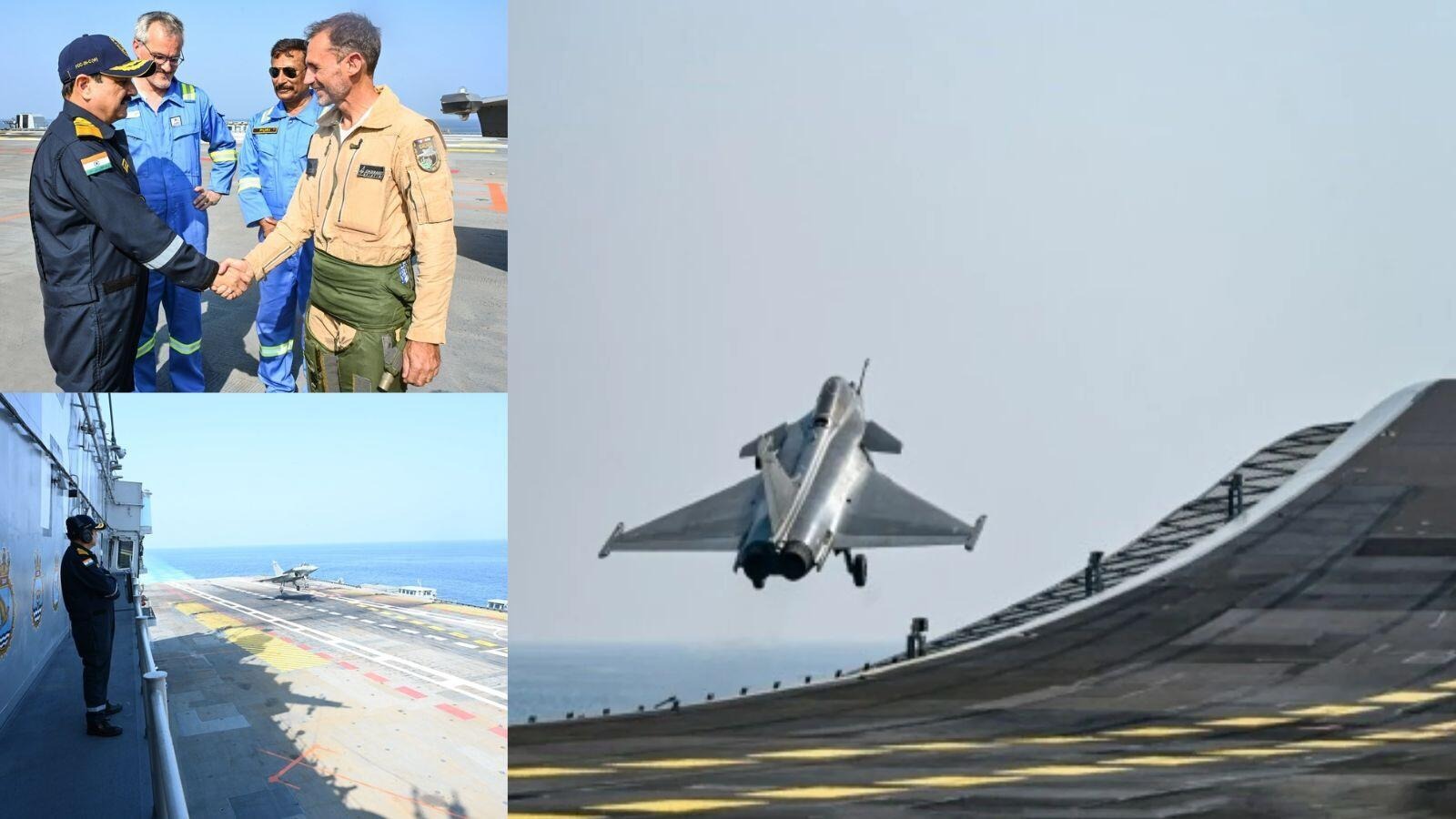
The Indian Navy has added a golden chapter to the history of its strategic strength and maritime security. French origin’s state-of-the-art fighter aircraft Rafale-Marine (Rafale-M) has created history by successfully landing and taking-off in its first attempt on the country’s first indigenous aircraft carrier INS Vikrant. This test not only reflects the strength of defense cooperation between India and France, but also paves the way for taking the Indian Navy’s supremacy in the Indo-Pacific region to a new and unassailable height. After this mega defense update, the biggest question has become that how will this deadly integration double the strike capability of the Indian Navy? Let us understand this entire technical and strategic development in detail.
Why is this successful trial of INS Vikrant and Rafale-M historic?
Landing a fighter jet on an aircraft carrier floating in the depths of the ocean is a very risky and technically complex task compared to landing at a normal airport. There are two main technologies used for operating aircraft on aircraft carriers around the world—CATOBAR and STOBAR. France’s Charles de Gaulle aircraft carrier uses CATOBAR technology, where the aircraft gets launched with the help of a catapult launch system. In contrast, India’s INS Vikrant works on ‘STOBAR – Short Take-Off But Arrested Recovery’ technology.
In this, the aircraft takes off from the raised ski-jump ramp built on the deck of the ship and stops during landing with the help of arrestor wire and tail hook. Rafael-Marine has demonstrated its coordination for the first time with this Stobar system of INS Vikrant. This successful trial has proved that in future, when these modern aircraft from France become part of the Indian fleet, there will be no technical hurdles in deploying them on Vikrant. At present, MiG-29K fighter jets are being operated on naval aircraft carriers, but with the arrival of Rafale-M, the entire profile of this air wing will change.
Deal and technical features of 26 Rafale-M aircraft which will increase strength
An agreement has been signed between the Government of India and France for the purchase of 26 Rafale-Marine aircraft at a cost of approximately Rs 63,000 crore. Under this defense deal, the Indian Navy will get 22 single-seater fighter aircraft and 4 twin-seater trainer versions. Talking from technical point of view, Rafale-M is counted among the most advanced and dangerous naval fighter aircraft in the world. These have state-of-the-art AESA radar, advanced electronic warfare systems and accurate targeting capability.
The biggest strength of these aircraft is their dangerous weapons package. Rafale-Marine is equipped with Meteor beyond visual range air-to-air missile, MICA missile, SCALP cruise missile and Exocet anti-ship missile. When such deadly weapons take off from the deck of INS Vikrant floating in the middle of the sea, the enemy navy and coastal bases far away will not be safe. This capability transforms India into a true ‘Blue Water Navy’, which can carry out offensive and decisive operations even thousands of kilometers away from its home shores.
How will the attack capability of the Indian Navy be doubled?
Experts believe that after the full induction of Rafale-M on INS Vikrant, there will be a qualitative jump overnight in the strike power and air defense capability of the Indian Navy. There are several main strategic reasons and technical advantages behind this:
-
Huge increase in range and payload capacity: Compared to older aircraft, Rafale-M is capable of flying with much larger quantities of munitions and heavier cruise missiles. This will make it easier to conduct accurate and heavy air strikes on enemy targets in remote maritime areas.
-
Beyond Visual Range (BVR) strike capability: Being equipped with the world’s best air-to-air missiles like Meteor, Rafale can destroy enemy fighter jets miles away in the sky, making the security cordon of INS Vikrant impenetrable.
-
Ease of Logistics and Maintenance: The Indian Air Force (IAF) already operates land-based Rafale aircraft. In such a situation, adoption of Rafale-M by the Navy will bring uniformity in spares, maintenance, equipment and training of pilots, which will save costs and operational readiness will always remain at a high level.
-
Reduction in dependence on coastal airbases: Operating from aircraft carriers, these aircraft allow India to establish air dominance in the Indian Ocean Region (IOR) without any nearby land airbase. This will prove to be a game-changer in encircling the enemy from all sides in times of crisis.
Future challenges and strategic messages in the Indo-Pacific region
This successful landing of Rafale-Marines on INS Vikrant is not just a technical test, but it is also a strong geopolitical message to other countries in the region—especially China. This preparation of India strengthens both the defensive and offensive priorities of the country amidst the constantly changing security equations and increasing naval activities in the Indo-Pacific region. However, after this trial, there are some more stages left like night landing, full integration of weapons and final operational clearance, which will be completed in the coming months. But this success in the very first attempt is proof that the Indian Navy is fully capable of incorporating global technology into its defense system along with self-reliance. In the coming years, when these 26 Rafale-M aircraft will grace the decks of INS Vikrant and INS Vikramaditya, India’s maritime borders will be counted among the most secure borders in the world.