 look news india

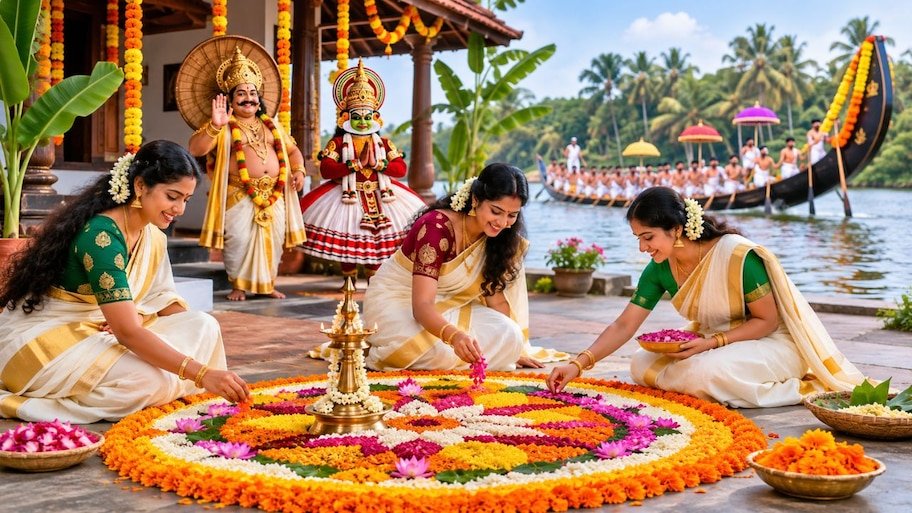
India is a country of diversity, beliefs and vibrant festivals, where every festival has its own deep historical, mythological and cultural background. But in recent years, a wide ideological and cultural debate has erupted regarding ‘Onam’, one of the most important festivals of South India. The question being raised is that when the distinct religious identity of big festivals like Eid and Christmas and their religious rules are completely accepted across the world, then why are efforts being made to limit an ancient festival like Onam as only a ‘secular’ or ‘cultural harvest festival’?
A section of cultural thinkers, historians and religious organizations are arguing that in the name of modernity and secular narrative, the original religious and mythological soul of Indian festivals is being ignored. While the other side sees it as a symbol of social harmony, shared culture and linguistic unity of Kerala, where every section of the society, irrespective of caste and religion, participates in this festival.
Mythology vs Cultural Narrative: What is the basic premise of Onam?
According to the mythological traditions of Sanatan Dharma and Srimad Bhagwat Mahapuran, Onam is associated with the fifth incarnation of Lord Vishnu. Lord Vaman and the just king King Mahabali (Maveli) Is connected to the sacred story of.
Mythological belief is that pleased with King Mahabali’s sacrifice, charity and love for his people, Lord Vaman made him the king of the underworld and gave him the boon of meeting his subjects once a year. In Kerala, on the day of Thiruvonam, lamps are lit in every house, flower rangoli (Pookalam) is made and a traditional feast (Onam Sadya) is organized to commemorate the arrival of King Mahabali.
Along with this, Lord Vaman is mainly worshiped during Onam in the famous ‘Thrikkakara Temple’ of Kerala. This is why a large section of people believe that the basis of Onam lies entirely in the Vedic and Hindu mythological contexts, and calling it just a seasonal event is like diluting its original history.
Why are questions raised on Onam compared to Eid and Christmas?
The biggest point in this entire discussion comes from the comparison with the festivals of other global religions. Critics say that:
-
Distinct Religious Identity: Just as Christmas is associated with the birth anniversary of Jesus Christ and Eid-ul-Fitr and Eid-ul-Azha are purely related to Islamic tradition and the teachings of the Prophet, they are never separated from their religious identity and reduced to mere ‘food festivals’.
-
Demand for uniform standards: Advocates of Indian tradition say that when the sanctity of festivals of other religions and their religious rituals is accepted globally, why is there a growing trend to present festivals with Hindu context—such as Onam, Pongal or Diwali—as only secular events?
-
Fragmentation of History: Many thinkers allege that as part of a political and ideological agenda, an attempt is made to present a false picture of a class struggle between King Mahabali and Lord Vamana, which increases polarization in the society.
Social perspective of Kerala: symbol of shared culture and inter-religion equality
On the other hand, there is also a strong view among sociologists, intellectuals and local citizens of Kerala that Onam has been a part of Kerala’s history for centuries. ‘Malayali identity’ Has been an integral part of.
Kerala has a history where people of different religions—be it Hindu, Christian or Muslim—celebrate Onam together as a celebration of their soil, farming and the new harvest. This party believes that by keeping Onam all-inclusive, its importance does not decrease but increases, because it embodies India’s Ganga-Jamuni culture and the basic spirit of ‘Vasudhaiva Kutumbakam’ on the ground. According to him, instead of limiting Onam to any one category, it should be considered as a platform which unites the entire society in the thread of mutual harmony.
The need for a balance between cultural heritage and faith
The conclusion of this entire debate is that the real strength of any ancient festival lies in the truth of its roots and its message. The popularity of Onam and its cultural expansion is definitely going to take everyone along, but it is equally important to respect the spiritual, mythological and historical context behind it.
To preserve the spirit of festivals, it is necessary that their historical traditions be passed on to the coming generations without disturbing them, so that social harmony is maintained and the identity of cultural heritage also remains intact.