 look news india

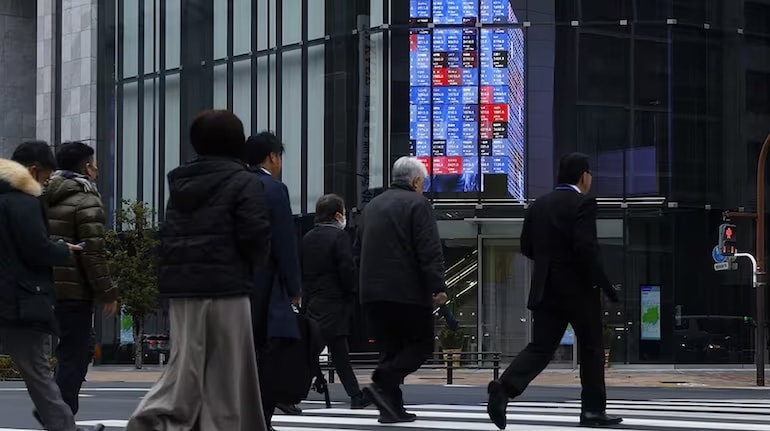
Asian markets are seeing good growth in Thursday’s trading session. However, the mood in the US equity and bond markets deteriorated after the US Federal Reserve’s comments, due to which the US 10-year bond yield once again reached the level of 4.7%. Despite this, Asian markets have made a strong comeback.
Japan’s main index Nikkei 225 is trading up by 1.38%, while South Korea’s Kospi has registered a spectacular rise of 2.95% after a big fall in the previous session. Apart from this, Taiwan’s stock market has gained 1.50% to reach the level of 40,639.43 and Hong Kong’s Hang Seng is trading 0.14% stronger at 25,826.00. However, Singapore’s Straits Times Index is showing slight weakness of 0.64%.
Recession shock in Wall Street, but greenery seen in futures
In the last regular trading session, the US stock markets closed with a heavy fall. The Dow Jones Industrial Average closed down 1,153.18 points (2.19%), its biggest one-day decline since April 2025. With this, S&P 500 declined by 1.52% and Nasdaq Composite declined by 1.74%. The fall has left the Nasdaq down more than 10% from its all-time intraday high.
However, US stock futures saw an improvement on Wednesday night. Following the quarterly results of big tech companies and the Fed’s decision, Dow futures rose 158 points (0.3%), S&P 500 futures are trading up 0.4% and Nasdaq 100 futures are up 0.7%.
US Fed’s decision: No change in interest rates for the 5th consecutive time
In line with market expectations, the US Federal Reserve has announced to keep interest rates unchanged after a two-day policy meeting led by Chairman Kevin Wersh. This is the fifth consecutive policy meeting when the US Central Bank did not make any change in interest rates.
The Fed raised its key benchmark interest rate 3.50% – 3.75% Has been maintained within the scope of. Central bank officials say they want to take a more in-depth assessment of inflation and macroeconomic conditions before making changes to monetary policy. Also, the Fed has kept its estimates of inflation, unemployment and economic growth rates stable at the level of the June meeting.
New tension in America-Iran war: attacks spread in Middle East
The military conflict between America and Iran that has been going on in the Middle East for the last five months now seems to be taking a more frightening form. On Wednesday, the US military carried out fresh air strikes on Iran. According to the US Central Command, this action has been taken in response to attacks by Iran-backed groups on US troops deployed in the Middle East.
Tension has increased significantly on the regional front. A US-owned gas storage tanker located at Egypt’s Damietta port was attacked by drones. Additionally, US and Saudi forces conducted joint airstrikes on Iran-backed groups in eastern Iraq. On the other hand, Iran fired missiles at American military bases located in Jordan.
Crude oil softens: Brent crude near $89
Despite increasing military conflict in the Middle East, there was a slight softening in crude oil prices on Thursday, as the movement of oil tankers from the ports of the Middle East continues.
-
Brent Crude: It fell $1.29 (1.42%) to $89.45 a barrel.
-
WTI Crude: Trading down 56 cents (0.66%) at $83.90 a barrel.
This fall comes after the strong rise of the previous session, when there was a huge jump of 7.91% in Brent and 6.56% in WTI.
Slight rise in gold prices
Gold prices registered a slight rise after Fed Chairman Kevin Wersh’s comments on inflation and interest rates remaining stable.
-
Spot Gold: rose 0.4% to $4,080.38 an ounce.
-
US Gold Futures (August Delivery): rose 1.1% to $4,078 an ounce.
It is noteworthy that since the start of the US-Iran conflict 5 months ago, gold prices have fallen by about 25%, as the fears of rates remaining high for a long time have strengthened due to inflation caused by the energy crisis.