 look news india

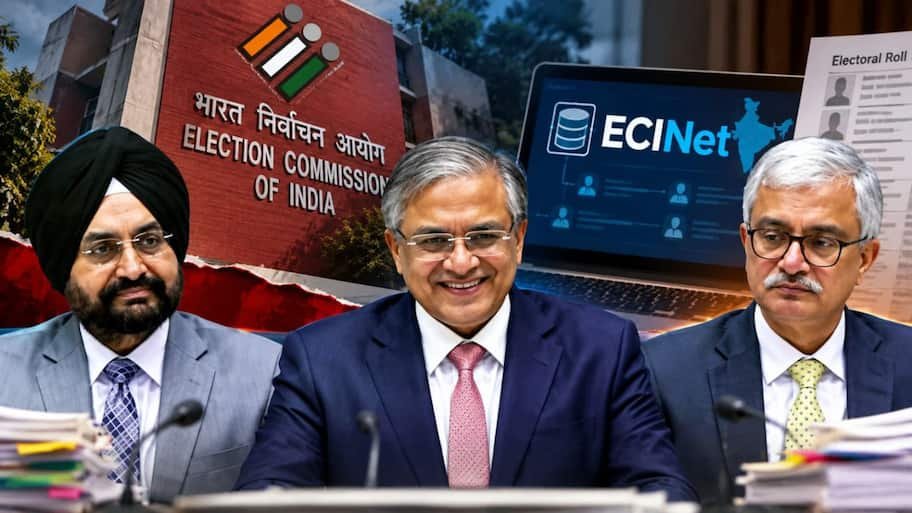
New Delhi. After the news surfaced regarding the internal functioning within the Election Commission of India (ECI), Special Intensive Revision (SIR) and the central IT portal ‘ECINet’, the Election Commission has clarified its official stand. After the letters and notes written by Election Commissioners Dr. Sukhbir Singh Sandhu and Vivek Joshi to Chief Election Commissioner (CEC) Gyanesh Kumar became public, the Commission has issued a detailed clarification. The Commission bluntly said that different viewpoints and disagreements during the decision-making process are proof of the healthy and vibrant functioning of any multi-member body, and not a constitutional deadlock. Along with this, the Commission has ordered to constitute a high-level committee of top experts from IITs and Triple IT (IIIT) for the legal and technical review of the ‘ECINet’ system and IT infrastructure which has been at the center of controversies.
Recent media reports had claimed that both the Election Commissioners had lodged serious objections on the centralized process of Voter List Revision (SIR), Voter ID card management and IT decisions on at least 14 separate occasions in the last few months. After this revelation, opposition parties had raised sharp questions on the impartiality and autonomy of the Election Commission.
The clarification issued by the Election Commission states that the distinction between internal deliberations and final decisions of the Commission is being misrepresented:
-
Tradition of Multi-Member Commission: The Commission said that the Election Commission of India is a multi-member constitutional body, where all three commissioners—the Chief Election Commissioner and both the Election Commissioners—have equal statutory powers. Raising questions on various aspects of files, asking for detailed information and putting forth alternative views is a natural part of democratic deliberations.
-
Unanimous verdict on SIR: The Commission emphatically clarified that the decision to conduct Special Intensive Revision (SIR) across the country on June 24, 2025 was taken unanimously in the full bench meeting. Later, this process was also considered constitutionally valid and flawless by the Supreme Court in its historic decision of 27 May 2026.
-
Clarification on correspondence related to Cabinet Secretary: The Commission clarified that the letter written to the Cabinet Secretary was not related to any IT policy or general functioning of the Commission, but was only a personal reference to the administrative responsibilities of a particular officer posted on deputation.
The Election Commission has taken concrete steps to ensure the functioning, data security and strict compliance of election rules of ‘ECINet’, the main technology platform of the Election Commission, which has been a bone of contention:
-
Committee headed by Senior Deputy Election Commissioner: A special independent technical evaluation committee has been constituted under the leadership of a Senior Deputy Election Commissioner (DEC).
-
Experts from reputed institutions include: Well-known computer science and cyber security experts from Indian Institute of Technology (IIT) and Indian Institute of Information Technology (IIIT) have been included in this committee.
-
Main scope of audit: This committee will examine whether the process of adding, deleting and transferring names of voters on ECINet is working in accordance with the stringent legal provisions of the Representation of the People Act, 1950 and Voters Registration Rules, 1960.
-
Strict process on new IT projects: The Commission has decided that no new technical modules or software updates will be implemented directly in future. First it will be technically tested in the Committee of Officers (COO) and then activated only after getting the formal approval of the full bench of the Commission.
The Commission has also announced systemic reforms to make its internal functioning fully transparent:
-
Agenda of meetings already decided: Before any meeting of the Commission, its written agenda will be circulated in advance so that all the members can participate in the deliberations with full preparation.
-
Minutes of the meetings will be issued: Official minutes of the discussions and decisions taken in the meetings will be prepared and kept on record.
-
Prior approval for foreign travel: Any level officer of the Election Commission must obtain prior permission from the Commission before going on an official foreign tour.
-
Monitoring of Commissioners’ instructions: Compliance with the administrative instructions issued by the Commissioners will be regularly reviewed.
-
Timeline for Performance Appraisal: The last date for mandatory completion of Officers’ Annual Confidential Report (APAR) has been fixed as 31st December every year.
The Election Commission believes that with these independent reviews and administrative reforms, while the efficiency of the technical systems will increase manifold, the unwavering faith of the citizens of the country in the purity, fairness and transparency of the electoral process will be further strengthened.