 look news india

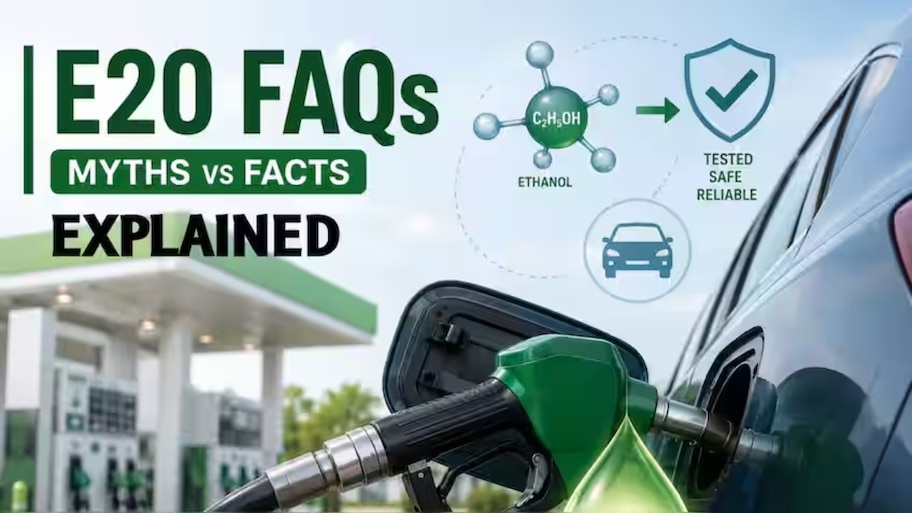
For some time now, various concerns, rumors and misconceptions have been going viral on social media among common consumers regarding mixing of ethanol in petrol used in vehicles across the country. To put an end to all these apprehensions and misleading news, the Central Government has issued a very detailed Frequently Asked Questions (FAQs) regarding the Ethanol Blended Petrol (EBP) programme.
This official document issued by the Ministry of Petroleum and Natural Gas provides direct and logical answers to all the pressing questions related to vehicle compatibility, real fuel price, consumer preferences and most importantly – engine safety. The Ministry clarified that despite an earlier detailed press note on 23 June 2026 and a press conference held by automobile companies on 4 July, some concerns remained, which were extremely important to be addressed.
Let us know the 4 biggest and important revelations made regarding ethanol blended petrol in the FAQs issued by the government:
1. Confusion: India increased ethanol blending very suddenly and rapidly?
Truth: The Ministry has taken a strong stand on the criticism regarding ethanol blended petrol in India that the country has increased blending much faster than countries like Brazil. The government clarified that this change has not happened overnight or suddenly, rather this entire program has evolved gradually and in a phased manner over the last two decades (20 years).
The first pilot program of ethanol blending in India was started in the year 2001 itself. After this, by 2006, 5 percent (E5) ethanol blended petrol was commercially launched in many states of the country. Its formal policy framework was prepared in the year 2013 and major reforms were made under the ‘National Policy on Biofuels’ implemented in 2018. Only after many years of long planning, infrastructure development, huge investment and detailed discussions with automobile companies and testing agencies, it has been successfully brought to the level of about 20 percent (E20) in the current financial year.
2. Confusion: Why is there no separate option of 100% pure petrol, E10 and E20 available at petrol pumps?
Truth: The question of many drivers is that why do they not get the freedom to choose pure petrol or low ethanol oil as per their choice? In response to this, the Ministry has cited huge logistical and practical challenges.
According to the government, India has a highly complex and vast network of refineries, huge oil depots, thousands of kilometers of pipelines and more than 1 lakh petrol pumps spread across the country. Maintaining a parallel supply chain of three different grades of petrol (pure petrol, E10 and E20) simultaneously on such a large scale would be extremely complex and almost impossible for the country’s infrastructure. That is why uniform standard fuel is being supplied throughout the country.
3. Confusion: Why is E20 petrol not cheaper even after adding ethanol?
Truth: Consumers believe that since ethanol is cheaper to produce, gasoline prices should be lower. On this, the government clarified that the ethanol mixed in petrol is purchased from the Annadata farmers of the country at very profitable and attractive prices so that the rural economy can be strengthened.
This is the reason why when crude oil prices fall significantly in the international market, the purchase cost of ethanol is slightly higher than that of pure petrol. However, the biggest advantage of this blending is that it reduces India’s dependence on foreign crude oil and domestic prices are not affected by geopolitical fluctuations in the international market. In the last four years, the stability of petrol and diesel prices in India compared to major economies of the world and neighboring countries has been due to this policy.
4. Confusion: Are E20 petrol damaging vehicle engines and rubber parts?
Truth: The government has completely rejected the claims circulating on social media that E20 petrol is damaging the engines, rubber components or fuel lines of older E10 vehicles. The ministry bluntly said that these claims have no scientific or technical basis.
The nationwide rollout of E20 fuel has taken years of intensive research using state-of-the-art laboratories, rigorous field trials and collaboration with top technical bodies like the Automotive Research Association of India (ARAI) and the Society of Indian Automobile Manufacturers (SIAM). All vehicle manufacturing companies continue their warranty on old vehicles also.
Government report on mileage and performance: The Ministry has honestly admitted that some very old vehicles may see a marginal reduction of 3 to 5 percent in mileage due to the low calorific value of ethanol. But on the contrary, E20 fuel provides higher octane number to the vehicle engine, which improves combustion (burning of fuel), improves pickup and performance of the engine and most importantly – dangerous carbon emissions from vehicles are greatly reduced, which is lifesaving for the environment.