 look news india

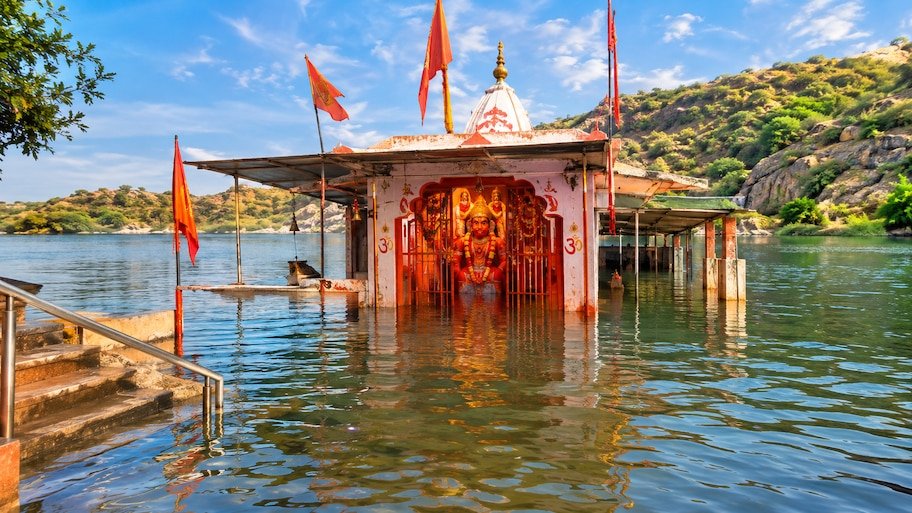
Rajasthan is famous all over the world for its historical heritage, forts, palaces and miraculous pilgrimage sites. There are many such mysterious temples present on the holy land of this Marudhara, whose faith and the science of architecture still astonishes people. One such unique and awe-inspiring pilgrimage site is located in Karauli district of Rajasthan. This temple remains immersed in a vast body of water for most of the year. During monsoon and winter, this place looks like a huge lake or ocean, where only water is visible. But as soon as the scorching summer season arrives and the water level decreases due to the strong sunlight, this ancient temple comes out of the water in all its glory and starts giving a live darshan to the devotees.
Panchna Dam, located at a short distance from Karauli district headquarters, is not only the lifeline of this region, but is also counted among the largest clay/earth-fill dams of Asia. Built at the confluence of five major rivers—Bhadravati, Barkheda, Ata, Manchi and Bhainsavat, this huge reservoir is home to many ancient settlements and temples. The most prominent among these submerged temples and the center of reverence is this mythological temple associated with Lord Shiva and local folk beliefs.
When Panchna Dam was constructed, many nearby old villages and ancient religious places came under waterlogging area. Despite rehabilitation by the government, the faith of the local people and devotees in these ancient temples never diminished. During the rainy season, when the inflow of water from the five rivers increases, the entire temple complex gets submerged. At that time only the upper shikhara or flag pole of the temple is visible floating on the surface of the water from a distance. The rest of the sanctum sanctorum, assembly hall and circumambulation path remain submerged in several feet deep water.
As the months of Chaitra and Vaishakh pass and the scorching heat of Jeth-Ashadha scorches the land of Rajasthan, the water level of Panchna Dam gradually starts decreasing. As the water dries up and the water level reaches its minimum level, this submerged temple slowly starts coming out of the water. In the months of May and June, when the water level goes down completely, the entire structure of the temple becomes clearly visible on the surface.
This is the special time when devotees, historians and tourists coming from far off places can directly reach the sanctum sanctorum of the temple on foot without any boat or risk of deep water. Despite the scorching sun and scorching heat, there is a huge influx of devotees here during this time. Devotees consider it no less than a miracle that even after being under immense water pressure and humidity for months, the stone structure of the temple and the Shivalinga remain completely intact and safe.
The biggest feature of this temple is its amazing architecture and architecture. Built using local stones, lime and traditional ancient techniques, the foundation and walls of this temple are so strong that despite being continuously submerged under water for decades, there have been neither cracks nor erosion of the stones.
When the water recedes in summer, moss and water marks are visible on the walls of the temple, but the beautiful carvings and sculptures carved on the pillars of the temple are still seen spreading their old shine. As soon as the water recedes, the local villagers gather and clean the temple premises, worship is started and the ritual of Aarti and Jalabhishek begins. Devotees believe that Varun Dev (God of Water) himself performs Jalabhishek of this holy temple and Shivling continuously for eight to nine months of the year, and only for some time gives the opportunity of service and darshan to the human society.
This temple has become a major center of faith for the people of Karauli and surrounding districts – Sawai Madhopur, Bharatpur, Dausa and Dholpur. In summer, whenever the temple completely comes out of the water, a kind of religious fair is organized at the local level. People come here to perform the Mundan Sanskar of their children, ask for special vows and perform Jalabhishek.
Along with religious sight, this place has also become a center of attraction for photographers and adventure tourism lovers. The panoramic view of dry and moist soil spread all around, the water body of Panchna Dam spread in the background and the ancient temple standing with its head raised in the middle is worth seeing. In the evening, when the rays of the setting sun fall on the dome of the temple, its beauty appears even more divine. As soon as the first heavy monsoon rains fall in July–August, the water level of the dam starts rising again and the temple once again takes a jalsamadhi, to wait again till the summer of next year.