 look news india

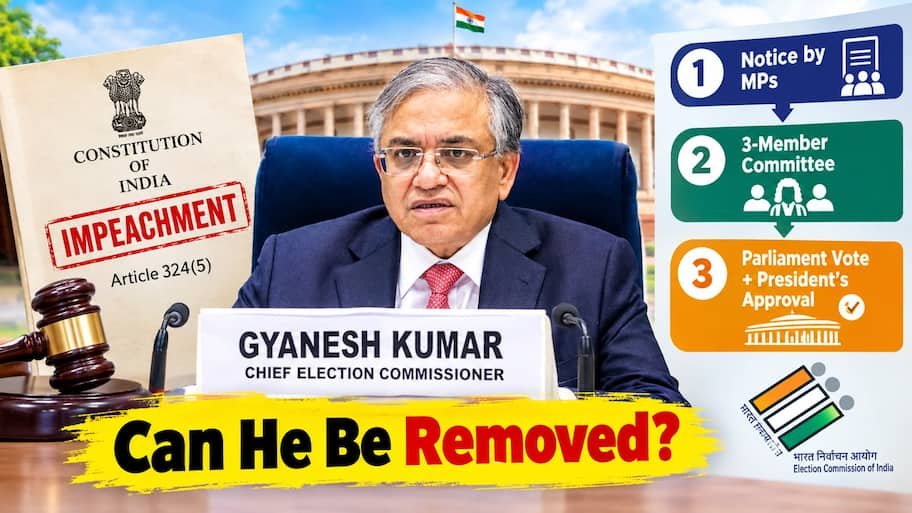
New Delhi. Following the Special Intensive Revision (SIR), internal disagreements and recent political controversies within the Election Commission of India (ECI), the discussion has intensified with demands for the removal of Chief Election Commissioner (CEC) Gyanesh Kumar. There are calls in the opposition camp to adopt a tougher process like parliamentary impeachment, but due to the protective provisions of the Indian Constitution, removing a Chief Election Commissioner is one of the most complex and difficult legal processes in the country.
The framers of the Indian Constitution have provided extraordinary constitutional protection to the Chief Election Commissioner to keep the Election Commission completely free from any pressure from the executive (government), political bias or shocks of change of power.
Article 324(5) of the Constitution clearly provides that:
“The Chief Election Commissioner shall be removed from his office in the same manner and on the same grounds as a Judge of the Supreme Court is removed; and not otherwise.””
This means that:
-
Direct intervention of Cabinet or President impossible: The President or the Central Government cannot remove the Chief Election Commissioner by any administrative or executive order.
-
Different status from other commissioners: While Election Commissioners (EC) can be removed by the President on the recommendation of the Chief Election Commissioner, the statutory power to remove the Chief Election Commissioner rests only with both Houses of Parliament.
-
The only two grounds for removal: They can be removed only on two grounds –‘Proved Misbehaviour’ That means corruption and disregard for the Constitution, or ‘Inability’ That is, mental/physical inability to perform work.
The legal process for removing the Chief Election Commissioner is governed under the ‘Judges Inquiry Act, 1968’ of Parliament, which is divided into three stringent stages:
Step 1: Parliamentary notice and approval of the Presiding Officer
To start the process, MPs have to move a formal removal motion:
-
Condition of numerical strength: on this notice Minimum 100 MPs in Lok Sabha signature of or Minimum 50 MPs in Rajya Sabha Signature is mandatory.
-
Prerogative of the Presiding Officer: After receiving the notice, the Speaker of the Lok Sabha or the Chairman of the Rajya Sabha examines the preliminary validity of the allegations. If the allegations appear to be baseless or politically motivated, they have every right to reject it at first sight.
Step 2: 3-member high-level judicial inquiry committee
If the Presiding Officer accepts the proposal, a three-member judicial panel is constituted to conduct a factual and impartial investigation into the allegations:
-
Chief Justice of India (CJI) or any sitting senior judge of the Supreme Court.
-
Chief Justice of any High Court of the country.
-
A distinguished jurist.
This committee examines the witnesses and documents on the allegations and gives full opportunity to the concerned Chief Election Commissioner to present his case and defence. If the committee does not find the Chief Election Commissioner guilty of misconduct or incompetence, the process ends there. If the committee finds them guilty, only then is the report sent to Parliament for discussion and voting.
Step 3: Special Majority in Parliament and President’s approval
After the report of the inquiry committee is presented in Parliament, there is extensive debate on the proposal in both the Houses:
-
Double special majority required: To pass a motion in each House of Parliament, two conditions have to be fulfilled:
-
of the house Clear majority of total members (more than 50%).
-
present and At least two-thirds (2/3) majority of the members voting.
-
-
To be passed in the same session: The motion must be passed separately by both the Lok Sabha and the Rajya Sabha within the same parliamentary session.
-
Signature of the President: After being passed by a special majority in both the Houses, the resolution is sent to the President, after which resignation is effected by a formal order of the President.
The strength of the constitutional provisions can be gauged from the fact that till date in the history of independent India, no Chief Election Commissioner has been removed through this process:
-
Example of history: Former Chief Election Commissioner T.N. Even during Seshan’s tenure, discussions of impeachment attempt were raised due to political discontent, but they could never reach a decisive level.
-
Challenge of existing numerical strength: To pass any proposal in Parliament with a two-thirds special majority, broad support from the ruling party and the opposition is required. In the current parliamentary mathematics, it is practically impossible for the opposition to garner a two-thirds majority in both the houses without the consent of the government.
Therefore, the political demands and rhetoric of removing Chief Election Commissioner Gyanesh Kumar may be in the headlines, but the constitutional rigor of this process and the current strength of parliamentary numbers make it almost impossible on a practical level.