 look news india

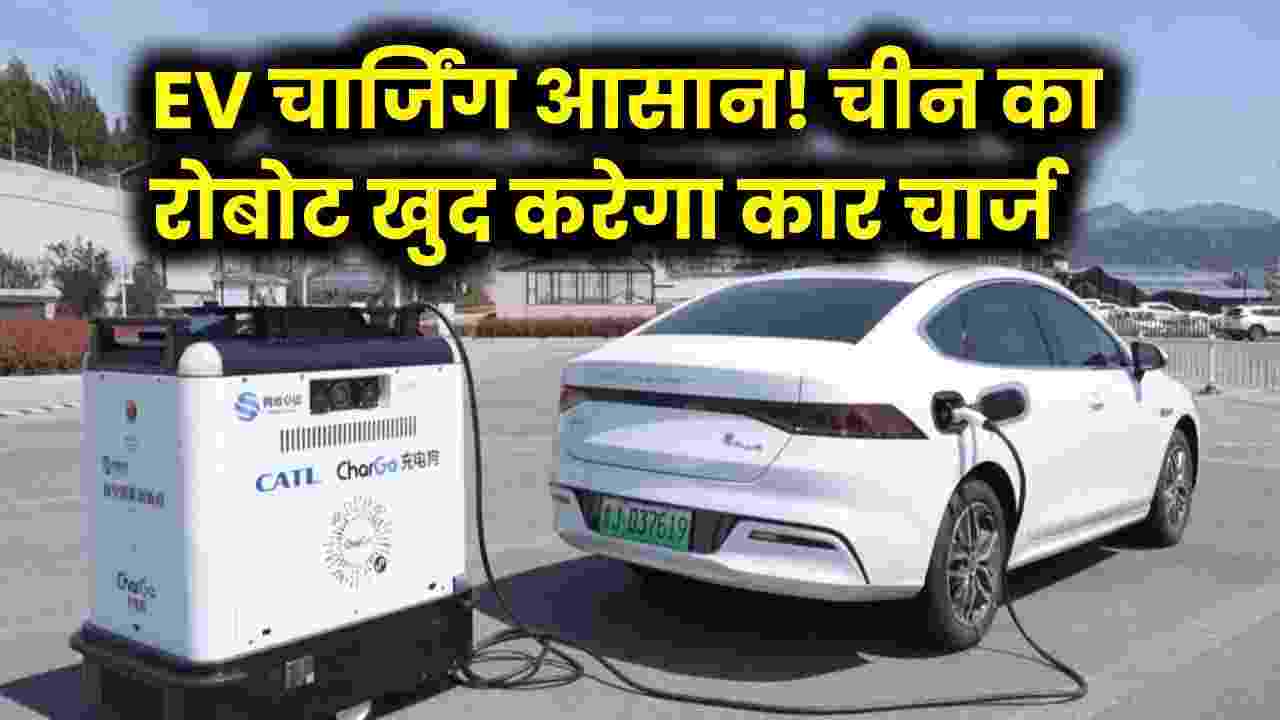
The biggest challenge faced by every person buying an electric car is to find an empty charging point in a public parking, mall or old apartment and wait in the queue for hours. Many times, EV owners have to face a lot of trouble due to petrol-diesel vehicles parked at charging spots. But, now Chinese engineers and tech companies have created a revolutionary solution to eliminate this problem from its roots. Such smart ‘Autonomous EV Charging Robots’ are being rapidly deployed in China, which work on the principle of ‘the charger will itself come to the car’, replacing the old rule of ‘the car will find the charger’. By simply sending a request on your smartphone app, this mobile high-tech robot automatically reaches your car parked in the parking lot and charges the battery.
‘CharGo’, a subsidiary of China’s leading battery manufacturing company CATL, and other major tech companies have developed mobile charging robots like ‘Energy Tank’. These robots are actually like a giant, running on wheels and equipped with Artificial Intelligence (AI) power banks. These robots are equipped with high-capacity lithium-iron-phosphate (LFP) batteries ranging from 30 kilowatt-hours (kWh) to 200 kWh and are capable of providing fast DC charging of up to 120 kW.
As soon as an EV owner parks his car at any common parking space in a mall, office or residential society, he can call the charging robot through the mobile app. The LiDAR, cameras and ultrasonic sensors installed in the robot approach your car directly, avoiding pedestrians and other vehicles in the parking lot. In some advanced models, a robotic arm is also installed, which automatically identifies the charging port of the car and connects the plug, while in some, the attendant connects the plug. Within just 40 to 60 minutes, this robot charges your electric car’s battery from 10 percent to 80-100 percent and returns back to its base station.
Along with robots walking on the ground, charging robots running on overhead ceiling rails in the underground parking lots of many Chinese cities are also surprising people. In this system, an electrically conducting track is laid on the roof of the parking lot, on which a compact charging robot is hung. As soon as a charging order is received for a car parked in a parking slot, this robot slides on the roof rail and reaches right above that car and starts charging the car by taking down the charging cable. This does not occupy any space on the parking floor and the robot installed on the same track can charge dozens of vehicles one by one.
According to automobile experts, this technology is proving to be a boon especially for those old apartments, hotels and dense urban areas where there is neither the space nor the power grid capacity to install separate charging pillars at every parking space. Mobile charging robots charge themselves at affordable rates during the night and provide fast charging to vehicles parked throughout the day without any heavy civil work or network of wires.
According to data from China’s National Energy Administration, the number of EV charging connectors in the country has crossed 2.53 crore (25.39 million), and now the entire emphasis is on smart and automatic charging. Plans are underway to deploy more than 1,000 mobile charging robots at 150 parking spots in the city of Beijing alone. Industry experts estimate that by the year 2030, about 20 percent of the total electric vehicles will be charged through these robots. This technology could also prove to be extremely useful in the future for fast-growing EV markets like India, where charging infrastructure remains a major challenge in densely populated societies.