 look news india

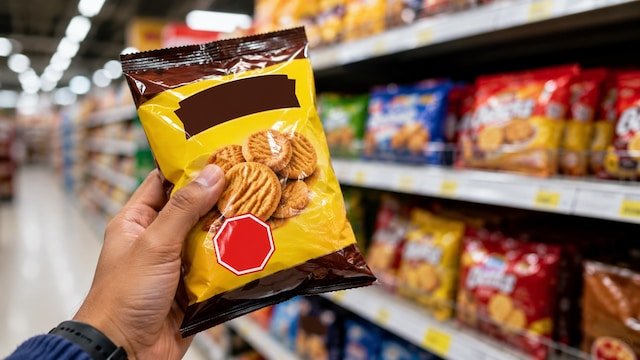
The Food Safety and Standards Authority of India (FSSAI) has taken a historic and tough step regarding the health of crores of consumers across the country, especially children and youth. It is now going to be mandatory to put a red hexagonal warning mark in front of the packets of ultra-processed foods like chips, namkeen, cookies, noodles and packaged drinks sold in the market. This red mark will be visible in the same way as a ‘STOP’ sign in traffic, so that as soon as the buyer picks up the packet, they can understand at a glance whether the amount of salt, sugar or saturated fat in the food they are purchasing exceeds the prescribed limit.
This major policy change has come after the Supreme Court issued a strong rebuke to the Central Government and the Food Safety Regulator. Hearing a PIL filed by NGO ‘3S and Our Health Society’, Justice J.B. Pardiwala and Justice K. Vinod Chandran’s bench had bluntly asked whether the regulator is not serious about the health of the people. After the tough stance of the court, FSSAI has filed a compliance affidavit in the Supreme Court and presented the complete outline for implementing the red warning symbol under Front-of-Pack Nutrition Labeling (FoPNL).
Till now, nutritional information on packaged goods sold in India was printed on the back of the packet in the form of a complex table in very fine print. Common consumers, elders or children could neither understand nor read this detailed chart. Companies took advantage of this to attract customers by making big claims on the front of the packets (such as ‘natural’, ‘healthy’, ‘rich in vitamins’).
According to the new proposal of FSSAI, now a red colored hexagonal box will be printed on the front of the packet. It will contain bold text based on the ingredients of the product in clear English and local languages:
-
HIGH FAT: If the product contains unhealthy or added saturated fat more than the prescribed limit.
-
HIGH SUGAR: If excessive amount of added sugar has been used in the product.
-
HIGH SALT: If the amount of sodium or salt exceeds the safe limit of daily requirement of the body.
-
HIGHLY SWEETENED BEVERAGE: Special warnings for highly sweetened carbonated drinks, packaged juices and energy drinks.
Along with this, FSSAI has also decided that the font size of the warning should be at least one point larger than the font of the nutrition table printed on the back of the packet, so that it can be easily seen from a distance.
The regulator plans to implement this warning system in a two-phased manner, taking into account industry preparedness and consumer understanding:
-
Phase I: In the first phase, this red hexagonal warning will be mandatorily imposed only on those food products which contain at least ‘two or more’ of the three major harmful ingredients—fat, sugar and salt—in excess of the prescribed limits. For example, if a chips packet is high in both fat and salt, it will have the combined red symbol ‘HIGH FAT – HIGH SALT’ printed on it.
-
Phase II: Under the second phase, the scope of this rule will be further tightened. Then it will be mandatory to put a red mark on any product in which only ‘one’ ingredient (be it only sugar, only fat or only salt) is found to exceed the standard limit.
The main objective of the phased system is that big food companies should reformulate their products by reducing the amount of salt, oil and sugar in their products so that they can avoid getting the red danger mark on their packets.
The biggest impact of this new rule will be on those ultra-processed snacks and drinks sold in the Indian market, which have become a part of the daily routine of youth and children:
-
Potato Chips, Bhujia and Namkeen: These use palm oil, deep frying fat and excessive salt, making them fall directly into the ‘High Fat – High Salt’ category.
-
Chocolate, Cream Biscuits and Wafers: They contain trans fat, refined palm fat and excessive amounts of flour and sugar, due to which they will come under the warning ‘High Sugar – High Fat’.
-
Cold Drinks, Carbonated Beverages and Bottled Juices: On an average, a can of soda contains 7 to 10 teaspoons of sugar dissolved in it, which will now have the red mark ‘Highly Sweetened Beverage’ prominently printed on it.
-
Instant Noodles, Frozen Food and Ready-to-Eat Meals: These contain heavy amounts of sodium and preservatives to maintain longer shelf life.
FSSAI has clarified that this red warning rule will not be blindly applied to all types of food items. Single ingredient products and conventional ingredients naturally rich in fat or sweeteners are excluded from this warning label:
-
Desi Ghee, Butter and Raw Milk: Natural single products containing dairy will be excluded from this rule.
-
Pure Edible Oils: Mustard oil, sesame oil, groundnut oil etc. will be exempted.
-
Jaggery, honey, table sugar and plain salt: Since these are simply basic kitchen ingredients (raw ingredients), this warning will not apply to them.
To set the standards, the nutrient thresholds prescribed in the ‘Dietary Guidelines for Indians 2024’ issued by the Indian Council of Medical Research and the National Institute of Nutrition (ICMR-NIN) have been made the basis.
India is currently facing the challenge of serious non-communicable diseases (NCDs) such as type-2 diabetes, high blood pressure, fatty liver, heart attacks at an early age and increasing childhood obesity.
Global studies and medical research have proven that when people buy goods from a supermarket or grocery store, the red warning symbol helps them stay away from unhealthy options and choose healthy options more than 60% effectively. When similar black and red warning labels were implemented in countries such as Chile, Mexico and Brazil, consumption of packaged sugary drinks and junk food declined by 20% to 30%.
Public health experts and nutrition advocacy groups have welcomed this decision of FSSAI, but have also demanded some reforms. Experts say that due to the requirement of ‘two or more’ ingredients in Phase-1, only extremely sweet drinks or products with high salt content should be left out, hence Phase-2 should be implemented soon without any delay. Also, given the linguistic diversity of India, the warning should be printed in large size in English as well as in Hindi and regional languages.
FSSAI will very soon notify this proposal in the official gazette as an amendment to the Food Safety and Standards (Labeling and Display) Regulations. In the coming days, when you buy any packet from the market, this red mark on the front of the packet will prove to be a powerful shield to protect you and your family from unknowingly consuming poison like excess sugar and fat.