 look news india

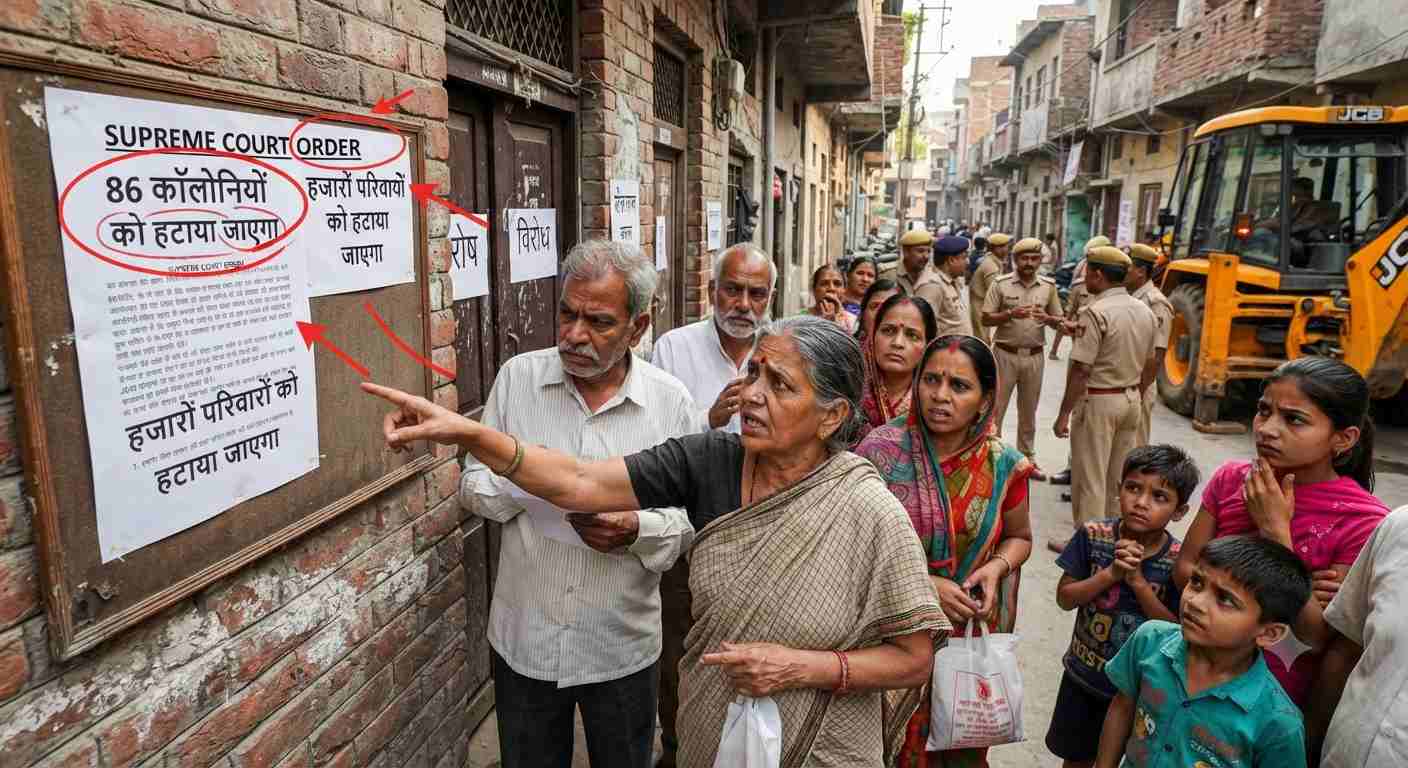
The Supreme Court has given a very strict and historic decision regarding environmental protection, protection of forest land and planned urban development. The apex court has issued clear instructions to vacate with immediate effect 86 illegal colonies established for years on protected forest areas, green belts and government land and demolish the unauthorized constructions made there.
The special bench of the court has made it clear that environmental balance and public safety cannot be compromised under any circumstances. The court has ordered the state government, concerned municipal corporations, development authorities and district administration to free the entire land from encroachment and submit a compliance report within a stipulated time frame. As soon as this order came out, thousands of families living in the concerned areas were facing a deep crisis of saving their homes.
The backdrop of the court’s stringent order includes long-running public interest litigations (PILs) and legal appeals filed by environmentalists. Through investigation reports and satellite mapping, the fact came before the court that the 86 colonies identified were illegally settled on natural drainage channels, eco-sensitive zones, ridges or reserved forest lands.
Land mafia and illegal colonizers prepared fake documents of agricultural and forest land and sold plots to poor and middle class families at cheap prices. With the passage of time, permanent houses, multi-storey buildings and even commercial shops came up there. In its strict comment, the court said that giving protection to illegal constructions is like inviting floods, landslides, waterlogging and serious environmental disasters in future. Therefore, restoring the original condition of natural water sources and forest area is the top priority.
After this instruction of the Supreme Court, an atmosphere of fear and uncertainty has been created in the affected 86 colonies. Most of the people living in these areas belong to the lower and middle income group, who had built houses brick by brick by investing their entire life’s savings.
Local residents say that they have been living in these areas for the last 15 to 25 years. They have documents including valid electricity connections, water bills, municipality house tax receipts, Aadhaar card, voter ID and registry. People argue that when the construction work was going on, why did the local administration and police not stop it. Now the sudden decision to demolish the roofs without any concrete arrangement has left the future of the elderly, women and school children hanging in the balance.
To avoid contempt of the apex court, the local administration and police department have become fully active. District Magistrates and Municipal Commissioners held a joint high-level meeting and prepared a phased outline of action:
-
Public Notices and Announcements: First of all, the administration is making public announcements under Section 144 in the identified colonies and eviction notices are being pasted on every house, so that people can safely remove their household items.
-
Appointment of Zonal Magistrates: To carry out this large-scale operation peacefully, the entire area is being divided into different sectors and zones and special duties of administrative and police officers are being imposed.
-
Drone Surveillance and Videography: To deal with any untoward incident, disturbance or law and order situation during the demolition operation, the entire area will be monitored with drone cameras and the entire process will be videographed.
-
Instructions for disconnecting electricity and water connections: As soon as the official deadline ends, orders have been issued to the concerned discoms and water bodies to disconnect electricity and water connections of illegal structures.
While the Supreme Court has said that there should be no laxity in removing illegal constructions, it has also given guidelines for rehabilitation keeping in mind the human rights of genuine and eligible citizens. The Court has clarified that only those families will get the benefit of the rehabilitation scheme who meet the strict eligibility standards:
-
Determination of cut-off date: Only those families will be considered eligible for rehabilitation who are already residing there before the cut-off date fixed by the government and who have strong legal proof of the same.
-
Link to Pradhan Mantri Awas Yojana (PMAY): A proposal is being prepared to allot flats on minimum installments or lease basis under the Affordable Housing Schemes of the government to the eligible and poor families facing homelessness.
-
Identification and Scrutiny Process: The District Social Welfare Department and Revenue Team will check the ration cards, names in the voter list and annual family income certificate of the affected people, so that the scheme is not misused by any ineligible person or tenant.
Legal options become quite limited after the Supreme Court’s final order, but affected parties can still use certain constitutional avenues under the Indian judicial process:
-
Review Petition: The affected citizens or their joint welfare societies (RWAs) can file a review petition in the Supreme Court against the order, seeking an interim stay on the demolition until humanitarian grounds and the rehabilitation process is completed.
-
Curative Petition: If the review petition is also rejected, then curative petition can be resorted to as a last legal resort, although the rate of relief in this is extremely limited.
-
Appeal to the state government: Through local public representatives and social organizations, the state government is being demanded to take policy decisions at the cabinet level and arrange for a special rehabilitation package or land in satellite townships for the affected population.
This whole incident reflects a complex conflict between urban planning, environmental balance and the housing of citizens. In the coming days, the eyes of the entire country will be on the action taken by the administration and the rehabilitation steps of the government.