 look news india

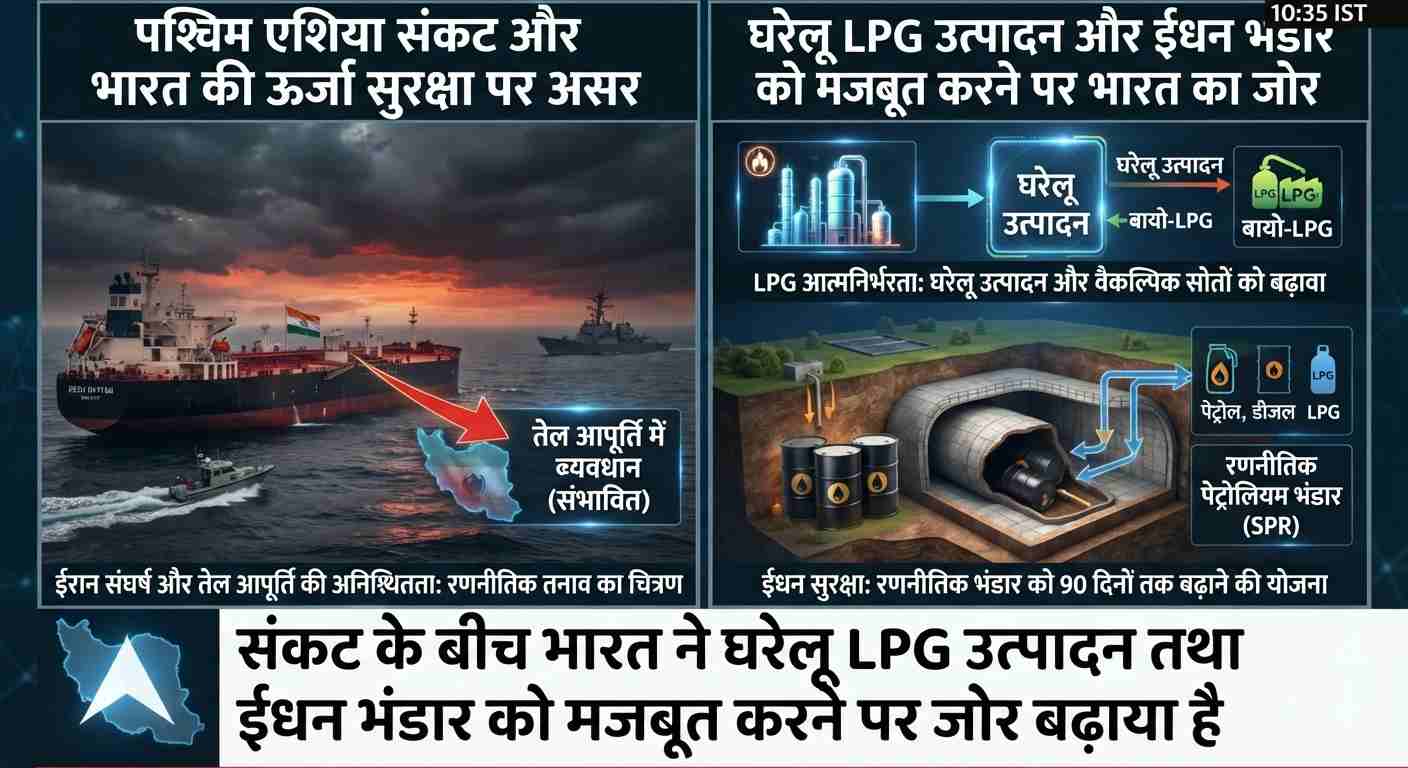
The ongoing military conflict between Iran and allied powers in the Middle East (West Asia) and the disruption in the Strait of Hormuz, the narrow sea route of the Persian Gulf, have caused severe instability in energy markets around the world. For India, this geopolitical turmoil is directly linked to national energy security, because under normal circumstances, the country imports more than 85 percent of its crude oil, more than 50 percent of natural gas (LNG) and about 60 to 64 percent of LPG through the sea routes of these Gulf countries.
With the movement of ships in the Hormuz corridor affected and the crude oil prices in the international market reaching the sensitive range of $100 to $120 per barrel, the Government of India and the Ministry of Petroleum and Natural Gas (MoPNG) have started implementing a multi-layered and aggressive ‘Energy Security Strategy’ to deal with any possible fuel crisis. The main focus of this strategy of the government is to double domestic LPG production, rapidly expand Strategic Petroleum Reserves (SPR), increase oil-gas imports from geographies other than Gulf countries and provide uninterrupted fuel to domestic consumers.
Historic surge in domestic LPG production: Production quota fixed for 21 refineries
To prevent any possible shortage of LPG, the Ministry of Petroleum and Natural Gas, in a historic and unprecedented step, has set maximum LPG production targets for all 21 major refineries and upstream producing companies in the country’s public and private sector.
Under this order, by increasing the total daily domestic LPG production capacity of the country 63,810 tonnes per day has been fixed. This figure is almost double the average daily production of the last financial year (about 35,900 tonnes per day) and is capable of meeting 70 per cent of the country’s total daily consumption (about 91,000 tonnes) from domestic sources alone.
In this new allocation of refineries, the biggest responsibility lies with the private sector giant. Reliance Industries Limited (RIL) Has been assigned to. Reliance’s Jamnagar refinery has been instructed to produce up to 18,000 tonnes of LPG per day during the crisis. Along with this, emergency powers have been invoked to Indian Oil (IOCL), Bharat Petroleum (BPCL), Hindustan Petroleum (HPCL), Mangalore Refinery (MRPL) and ONGC to completely divert their propane and butane stocks to LPG manufacturing. With this step, India’s dependence on imports will immediately reduce to less than half.
Strategic diversification of supplies: increased contracts from US, Latin America and Russia
To reduce the risk of over-dependence on Gulf countries, India has undertaken wide geographical diversification of its oil and gas purchases (Supply Diversification):
-
LPG and Crude from America and Latin America: India has aggressively increased purchases of crude oil from the United States (US), Brazil and Guyana. Additionally, LPG imports from Argentina and Algeria have been doubled to meet the shortage of Liquefied Petroleum Gas (LPG) following the disruption in the Middle East.
-
Continuation of discounted oil from Russia: Despite Western sanctions and complexities of payment mechanisms, India has maintained inflows of Russian crude through its traditional and non-traditional sea routes (Chennai-Vladivostok corridor), providing steady supply of crude to domestic refineries.
-
Long Term Contracts: Public sector oil companies (OMCs) have been directed to sign long-term fixed supply agreements with West African and Latin American producers to avoid spot market fluctuations.
Expansion of Strategic Petroleum Reserves (SPR): Strengthening the Emergency Buffer
In case of any war or maritime blockade, the number of days of oil available to the country is the most sensitive measure of national security. India currently has underground strategic petroleum reserves with a total capacity of 5.33 million metric tonnes (MMT) in Visakhapatnam (Andhra Pradesh), Mangaluru (Karnataka) and Padur (Karnataka).
According to the Union Petroleum Minister, India, including refinery inventory, pipeline stock, depots and strategic reserves, has approximately Safe buffer of 69 days of crude oil and LNG consumption While present, the stock of LPG is sufficient to meet the demand for about 45 days.
Along with this, in view of the crisis, the government SPR Phase-2 (SPR Phase II) The project has been fast-tracked. Under this, budgetary allocation has been released to rapidly complete the construction work of additional commercial and strategic underground caves of 4.0 MMT in Chandikhol, Odisha and 2.5 MMT in Padur, Karnataka.
Operation Sankalp: Indian Navy’s security cover in the Strait of Hormuz
To ensure the safety of maritime merchant vessels, the Indian Navy has launched its special missions in the Persian Gulf and Gulf of Oman. ‘Operation Sankalp’ Under this, the deployment of warships has been greatly intensified.
Guided-missile destroyers and frigates of the Indian Navy are providing escort to Indian-flagged merchant ships, especially large crude tankers and LPG carriers, for their safe passage through the troubled waters of Hormuz. The Navy’s ‘Information Fusion Center – Indian Ocean Region’ (IFC-IOR) is sharing 24×7 real-time maritime domain awareness, enabling Indian ships to be alerted well in advance of any drone, missile or sea-mine threat.
PNG and rapid transition to alternative energy: domestic demand management
To permanently reduce the pressure on imported LPG, the Central Government has transformed the expansion of ‘Piped Natural Gas’ (PNG) network in urban and town areas into a national campaign:
-
Conversion of millions of houses to PNG: Within the last few weeks alone, more than 4 lakh new customers have been directly connected to the PNG network and more than four lakh new registrations have been made. This has reduced the demand for LPG cylinders and cylinders are being reserved for rural and remote areas where there is no pipeline network.
-
Priority Management of Commercial Supply: Domestic consumers, hospitals, pharmaceutical units, cold storage and food processing industries are being given top priority in LPG allocation compared to industrial and non-essential commercial sectors.
-
Contribution of Ethanol and Bio-CNG: The successful implementation of 20% ethanol blending (E20) in petrol and the increasing number of Compressed Bio-Gas (CBG) plants have led to annual savings of thousands of crores of rupees in the crude oil import bill, thereby boosting both foreign exchange reserves and energy independence.