 look news india

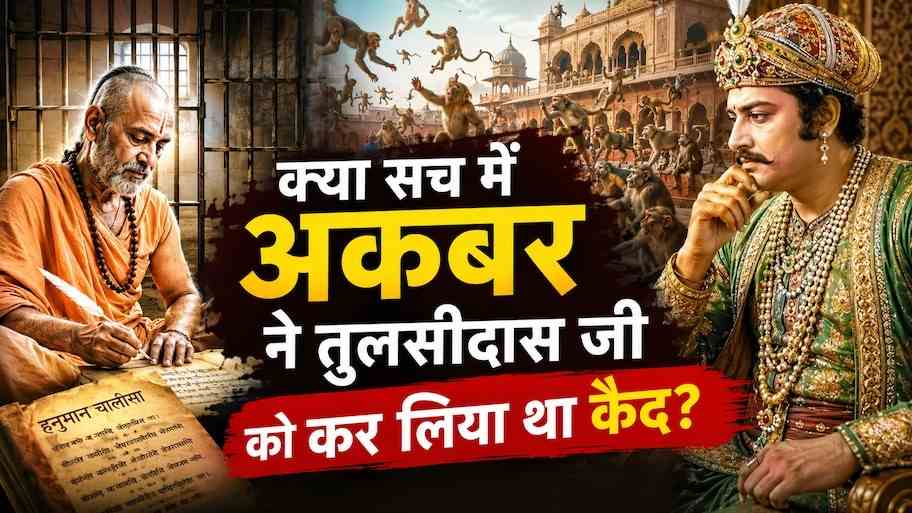
Many interesting stories and legends have been prevalent for centuries about the greatest saint-poet of medieval India, Goswami Tulsidas and the Mughal emperor Jalaluddin Mohammad Akbar. The most famous folk tale is that when the echo of Tulsidas ji’s devotion, miracles and his popularity among the people reached the Mughal court, Akbar called him to Fatehpur Sikri.
According to folklore, the king asked Saint Tulsidas to perform a miracle or see Lord Shri Ram. To this Tulsidas ji humbly replied that he was only an ardent devotee and servant of Lord Rama and not a magician or a juggler who could perform miracles. It is said that Angered by his blunt answer, Akbar captured him and put him in prison.
Composition of ‘Hanuman Chalisa’ in jail and attack of monkey army
According to popular religious narratives, while in jail, Goswami Tulsidas wrote an immortal text consisting of 40 quatrains in praise of the trouble-shooting Lord Hanuman. ‘Hanuman Chalisa’ Composed.
The story says that as soon as the forty days of sadhana was completed, the palace and fort of Fatehpur Sikri was suddenly attacked by a huge army of lakhs of monkeys. The monkeys created a rampage in the royal palace, driving away the guards and destroying the entire fort’s security system. When astrologers and advisors warned Akbar that this was God’s punishment for imprisoning the great devotee of Ram, the frightened emperor apologized to Tulsidas ji and freed him from prison with full honours.
96 bigha land and the truth of the royal decree
After this incident, it is often claimed that Akbar had offered to gift 96 bighas of land or jagir to Tulsidas ji as an atonement.
But, according to the experts of saint tradition and Tulsi literature, Tulsidas ji was a detached and renunciant saint. He rejected this property and material wealth of the king saying that whose Lord is Shri Ram himself, the lord of all the three worlds, he has no need of the land or wealth of any worldly king. However, folk traditions also state that some of his followers or local ashrams later received patronage through the courtiers of King Mansingh or Akbar, which was later added to such legends.
What do historical documents and literary evidence say?
When we examine this narrative on historical and literary criteria, some interesting aspects emerge:
-
Ain-e-Akbari and silence of Abul Fazal: Akbar’s court historian Abul Fazal has made detailed mention of many saints, philosophers and poets of contemporary India in his book ‘Ain-e-Akbari’, but there is no historical record of any major event like the imprisonment of Tulsidas ji or the attack of the monkey army.
-
Tulsidas ji’s own literature: Tulsidas ji has described in detail the epidemic of Kashi, the then social turmoil and the horrors of Kalikal in his works like ‘Kavitavali’ and ‘Vinay Patrika’, but he himself did not directly mention his imprisonment by Akbar anywhere.
-
Nabhadas’s ‘Bhaktamal’: The seventeenth century text ‘Bhaktamal’ and its commentary later written by Priyadas, describe the miracles of Tulsidas ji and incidents of communication with the then rulers, which made these legends immortal in the public mind.
Relationship of contemporaneity and mutual respect
Historians agree that Tulsidas (1532–1623) and Akbar (1542–1605) were contemporaries. There is clear evidence of Tulsidas ji’s deep relationship and correspondence with poet Abdul Rahim Khan-e-Khana (Rahim), who was among Akbar’s Navratnas, and Raja Mansingh of Amer. Rahim and Tulsidas used to exchange each other’s literary couplets and there was deep respect between the two.
Hence, from the historical point of view, the attack of the prison and the monkey army is considered to be a symbolic legend arising out of folk faith and devotion, which is a symbol of the fact that the spiritual power of a saint is much stronger than the ego of any imperialist power.