 look news india

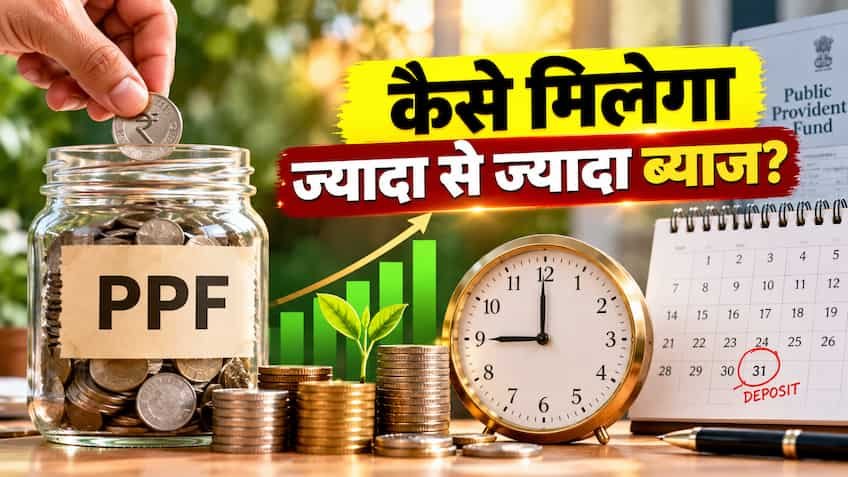
Public Provident Fund (PPF) is one of the most secure and popular tax-saving investment vehicles supported by the Government of India. This scheme comes with ‘EEE’ (Exempt-Exempt-Exempt) tax status, meaning the deposit amount, interest earned and maturity fund all three are completely tax-free. However, what most investors do not know is that merely depositing money in PPF is not enough, but the date and when the money is deposited has a direct impact on your ultimate returns.
As per rules of Post Office and Ministry of Finance:
-
Rule of interest calculation: Interest in PPF account is calculated on the minimum balance between the end of the 5th of every month and the last day of the month.
-
Credit to account: Although interest is calculated every month, it is credited to the account on an annual basis at the end of the financial year i.e. 31st March Is credited.
-
Disadvantages of depositing after 5th: If you deposit money after the 5th of the month (e.g. 6th or 10th), the ‘minimum balance’ of your account for the entire month will be counted as the old one. This means that on your new deposit in that current month Zero interest Will be received and interest will start accruing from 1st of next month.
Under Section 80C of Income Tax, there is a maximum limit of deposit of ₹1,50,000 in a PPF account in a financial year. There are three ways to deposit this money:
1. Strategy 1 (Golden Strategy): Lump Sum Deposit between 1st to 5th April
This is the most effective way to get maximum returns in PPF. If you deposit the entire ₹ 1.5 lakh together between the beginning of the financial year i.e. from April 1 to April 5, you get compound interest on the entire amount for 12 months.
2. Strategy 2 (Salaried Category): Installment of ₹12,500 every month (before 5th)
If you do not have ₹1.5 lakh in lump sum at the beginning of the financial year, you can deposit ₹12,500 per month from your monthly salary. But it has to be ensured that auto-debit or net banking transfer Between 1st and 5th of every month Yes it is. With this, you will get full month’s interest on the new installment of every month.
3. Strategy 3 (worst way): Deposit after the 5th or at the end of the year (March)
Often people deposit ₹ 1.5 lakh in the last days of January, February or March in a hurry to save tax. If you deposited ₹1.5 lakh on March 25, you will not get any interest for 11 months of that financial year. Your capital of ₹1.5 lakh will earn only 6-7 days of negligible interest in that year or it will be counted in the next financial year only.
If you deposit ₹1.5 lakh continuously every year for the entire lock-in period of 15 years, the difference in final corpus due to timing can be understood from the table given below:
| Parameters/Investment Method | Lumpsum deposit before 5th April | ₹12,500 every month (before 5th) | difference / net additional gain |
| annual total investment | ₹1,50,000 | ₹1,50,000 (₹12,500 $\times$ 12) | ₹0 (equal principal) |
| Total Principal Deposit in 15 Years | ₹22,50,000 | ₹22,50,000 | ₹0 |
| Total Estimated Interest Earned | ₹18,18,209 | ₹17,04,500 | +₹1,13,709 more interest |
| Total maturity amount after 15 years | ₹40,68,209 (approximately ₹40.68 lakh) | ₹39,54,500 (approximately ₹39.54 lakh) | Direct benefit of more than ₹1.14 lakh |
(Note: If the PPF account is extended after 15 years in two blocks of 5 years each (total 25 years), then this additional interest received from the timing of April 5 will be due to compounding. ₹3.5 lakh to ₹4 lakh reaches.)
-
Set Auto-Debit as soon as salary arrives: If you choose monthly instalment, set the Standing Instruction (SI) date in your net banking to 2nd or 3rd, so that the money gets credited to PPF before 5th despite technical delays.
-
When paying by cheque, enter 3 days in advance: If you deposit money in post office/bank through check or DD, keep in mind that it takes 2 to 3 working days for the check to clear. Therefore, to avail the benefit on 5th, drop the check in the drop box on 1st or 2nd.
-
Benefits of extension in 5 year block: After 15 years of maturity, if there is no immediate need of money, then extend the account in a block of 5 years by filling Form 16-H. The entire interest received during this period will be completely tax-free.
-
Correct use of loan and partial withdrawal: Loan against PPF is available at very affordable rates between the third to sixth financial year, and partial withdrawal facility is also available after the seventh year. Take advantage of these facilities instead of closing your account in case of emergency.