 look news india

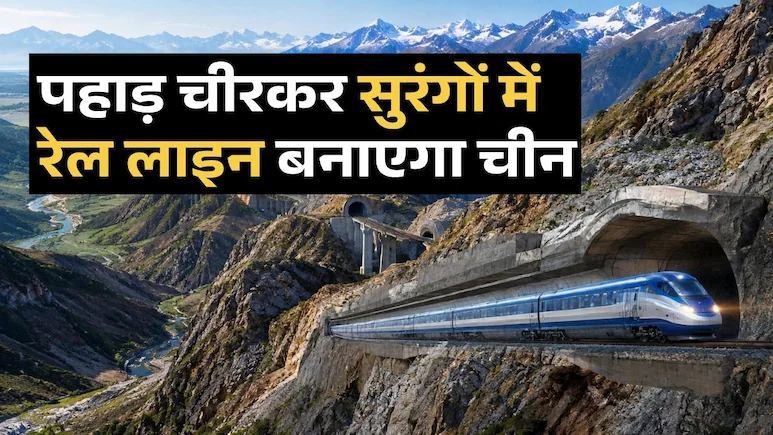
As part of a major infrastructure project in terms of international transport and geopolitical connectivity routes, the construction of a 532 km long railway line connecting China, Kyrgyzstan and Uzbekistan is progressing with the help of tunnels and bridges in the mountainous terrain. The estimated cost of this China-Kyrgyzstan-Uzbekistan (CKU) railway project, which is being prepared under the ‘Belt and Road Initiative’ (BRI), is said to be around 4.7 billion dollars i.e. around Rs 44 thousand crores. A large part of the entire route—about 120 kilometres—is being built through tunnels and bridges, including dozens of tunnels and bridges, to cross inaccessible mountain passes, high peaks and valleys.
According to reports, the total length of the China-Kyrgyzstan-Uzbekistan Railway is said to be about 532 kilometers (some estimates range between 500 to 530 kilometers), starting from Kashgar in China, passing through Jalalabad region of Kyrgyzstan and connecting to Andijan in Uzbekistan. In this route, China’s share is about 158 kilometers, Kyrgyzstan’s share is about 305 kilometers and the remaining part is considered to be connected to Uzbekistan’s existing rail network. A large number of tunnels and bridges are being built to cross the difficult terrain of Kyrgyzstan’s Tian Shan mountain range, including major tunnels over 12 kilometers long such as Naryn No. 1, Kosh-Dobo and Fergana. Under the financial structure, China’s stake in the joint project company is stated to be 51 percent and Kyrgyzstan and Uzbekistan’s stake is 24.5-24.5 percent.
Building a railway route through the mountains is counted among the most complex challenges of modern civil engineering. It is not easy to carry forward the work amidst altitude, seismic and geological sensitivity, rock pressure and inaccessible access roads. According to reports, tunneling and construction work has gained momentum in the Kyrgyzstan section, where the 209.6 meter long Kosh Dobo North No. 2 tunnel has been achieved and work is underway on dozens of tunnels, bridges, roadbed sections and 20 proposed stations. Various reports have revealed different estimates regarding the timeline for completion of the project, with some technical assessments suggesting commencement of operations by June 2031, while some parties wish to complete it earlier.
The biggest strategic and commercial objective of this rail link is to create an alternative land corridor for freight movement from East Asia and China via Central Asia to the markets of the Middle East and Southern Europe. Through existing rail lines beyond Andijan, this route could connect to routes to Europe via Turkmenistan, Iran and Türkiye. According to initial estimates, this could reduce the distance on some routes by about 900 kilometers and save several days in transit time, and is expected to develop the capacity to transport millions of tonnes of freight annually. Geo-strategic analysts believe that the project provides an opportunity for Central Asian countries to overcome the geographical limitation of being away from the sea and increase regional trade and connectivity, although aspects such as debt, operating costs and regional balance remain under discussion.
News about major international infrastructure projects, trade corridors and neighboring and regional connectivity is always important for readers in Uttar Pradesh and across India, including Lucknow, Kanpur, Varanasi, Gorakhpur and Prayagraj. India itself is continuously working on strengthening its border and regional connectivity routes, ports and logistics networks. In such a situation, the progress, engineering challenges and business impact of this mountain railway line being built in Central Asia will be especially seen in the coming times from the point of view of global logistics and regional equations.