 look news india

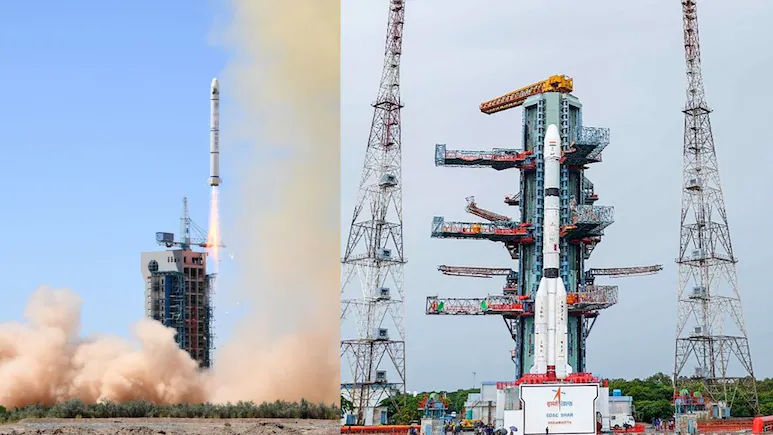
Whenever there is talk of the achievements of India’s Indian Space Research Organization (ISRO) in the world of space science and satellite launch, many people are surprised to know that Pakistan’s space agency SUPARCO (Space and Upper Atmosphere Research Commission) was established before ISRO and had also launched its first rocket before India. SUPARCO, formed in 1961, entered the field of space research through the initial sounding rocket in 1962, while ISRO was formally formed in 1969. Despite this, decades later, today there is a huge difference in the capabilities, indigenous technology, budget and global space missions of both the agencies, where ISRO has moved forward in the direction of human space flight by reaching the Moon and Mars and the Indian Space Station.
The foundation of Pakistan’s space program was laid in the early 1960s with the efforts of physicist Dr. Abdus Salam and the support of the then leadership. SUPARCO was formed in 1961 and initially with the cooperation of America and NASA, the sounding rocket program was carried forward by training scientists. As a result, ‘Rehbar-I’ rocket was launched from near the coast of Karachi in 1962, the main objective of which was to collect data related to the upper atmosphere and meteorology. Due to international cooperation and scientific initiatives in the early years, Pakistan was considered to be an early step in formally beginning space exploration in South Asia.
According to history and space analysts, despite early gains, Pakistan’s space program could not maintain the same pace and stability for long. In the 1970s and beyond, civilian space research slowed due to frequently changing political circumstances, military conflicts, budget cuts, and the diversion of resources to other areas—particularly defense and missile technology. Additionally, the agency’s leadership was held back by military officers instead of scientists and lack of consistency in building indigenous launch vehicles and large scientific infrastructure. As a result, dependence on external partnerships for satellite launch and technological development increased, while even today, cooperation with China and other foreign agencies figures prominently in many steps related to satellite launch and human space flight.
On the other hand, even though India formally took the form of space agency after SUPARCO, the visionary thinking of Dr. Vikram Sarabhai and other scientists linked it to self-reliance and public utility science. Linking the needs of national development to communications, weather forecasting, agriculture, disaster management and remote sensing, ISRO developed its own rockets and satellites in a phased manner. Over time, historic missions like Chandrayaan and Mangalyaan, capacity of heavy launch vehicles, commercial launch services and now ambitious plans like Gaganyaan and Indian Space Station (BAS) have placed ISRO in the league of premier space agencies of the world.
There is special pride and curiosity about ISRO’s missions among students, youth and common citizens in Uttar Pradesh and across India including Lucknow, Kanpur, Varanasi, Prayagraj and Gorakhpur. Whenever any new achievement or future mission related to the Indian space program is discussed, this topic occupies a prominent place in schools and colleges and in general conversations. This comparative journey of SUPARCO and ISRO gives a clear message that in any scientific field, an early start is not enough, but a long-term policy, stable budget, scientific leadership and indigenous capacity makes the difference.