 look news india

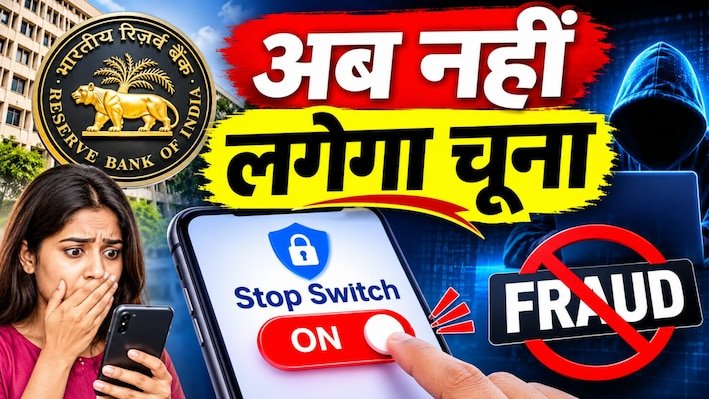
New Delhi/Mumbai (Business Desk): With the rapidly increasing digital payments in the country, cases of online banking fraud like cyber fraud, phishing and ‘digital arrest’ have also become a matter of serious concern. The Reserve Bank of India (RBI) has made a big and historic ‘masterstroke’ to keep the hard-earned money of common citizens safe from cyber criminals. RBI has released the draft of ‘Reserve Bank of India (Commercial Banks – Responsible Business Conduct) Fifth Amendment Directions, 2026’ on Monday, November 23, 2026. The biggest feature of this new safety feature is an emergency feature called ‘Stop Switch’. After its implementation, if any customer has even the slightest suspicion that his mobile phone, bank account or UPI has been hacked, he will not need to wander to different helplines, rather he will be able to immediately freeze all the outgoing payments from his account by just pressing a button.
According to the proposed RBI rules, the ‘stop switch’ will be a kind of emergency kill-switch, which will be mandatory for all commercial banks to make available through their mobile banking apps, internet banking, ATMs, bank branches and through IVR calls. As soon as a customer activates this button, all outgoing debit transactions initiated by the customer from his bank account will stop with immediate effect. This means that no fraudster will be able to withdraw even a single rupee from the account through UPI, Net Banking, Debit Card, Credit Card, IMPS, NEFT or RTGS. Apart from this, as soon as the stop switch is on, no new payment mandate or standing instruction will be set, nor will UPI registration be done on any new third-party app. The saving grace is that this will not close the entire bank account – incoming credits, already running EMIs or auto-debit mandates will continue to flow normally. To turn off this switch again, it will have to go through a strict authentication and cooling-off period process, so that fraudsters cannot turn it off easily.
To prevent major frauds through digital arrest and social engineering, RBI has also proposed ‘Trusted Person Mechanism’ (TPM). Under this, any bank account holder aged 18 years or above will be able to nominate any member of his family or a trusted person as a ‘trusted person’. The customer himself will be able to set a limit for transactions above which amount will require the approval of another person. Whenever a large fund transfer exceeding that limit is initiated, the nominee will immediately receive an alert and will have a full hour to approve or reject the transaction. If the trusted person does not approve or reject it within an hour, the transaction will be automatically canceled. In this arrangement, the nominated person will not get any ownership rights of the account nor will he have any financial liability.
The new draft calls for giving customers complete control over their digital channels. Now, instead of heavy limits set by the bank, customers will be able to set the maximum transaction limit and daily limit for each payment channel (like UPI, card or net banking). Not only this, customers will also be able to set a limit on the daily amount to be sent to a particular beneficiary and can also choose to keep digital channels closed for a particular time window of the day or night. Additionally, all digital payment channels will be closed by default at the time of opening a new bank account and will be activated only after explicit consent and authentication of the customer.
Along with protecting customers, RBI has also made the definition of negligence on the part of banks quite broad. If a fraud occurs with the customer due to technical fault in the bank’s own system, security breach, not sending alert on time or collusion between any bank employee and third-party vendor, then the bank will be held directly responsible for it. The Reserve Bank has invited suggestions on this draft from the general public and stakeholders till December 14, 2026. According to the proposal, rules related to enhanced bank accountability will be effective from January 1, 2027, while security features like ‘stop switch’ and ‘trusted person’ will be implemented across the country by July 1, 2027 (or earlier at the discretion of banks).