 look news india

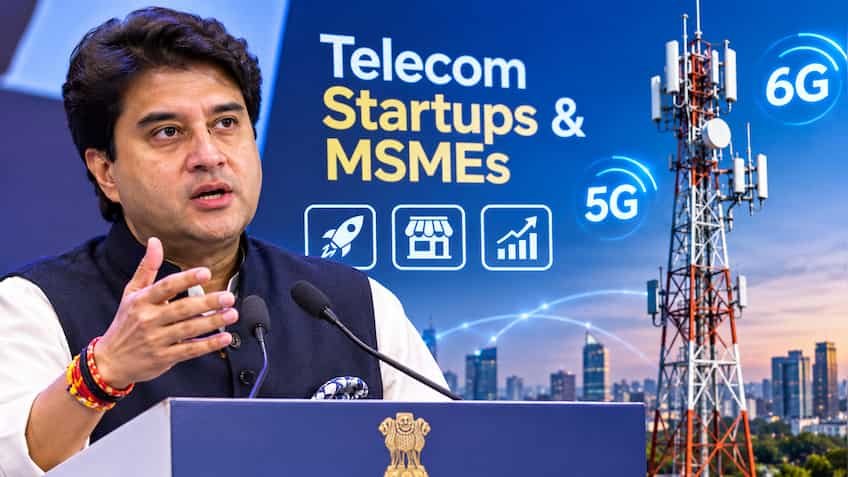
New Delhi (Business/Tech Desk): The Central Government has taken a very important step towards making India a manufacturer and exporter of cutting-edge technology rather than just a major consumer market on the global telecom map. Union Communications Minister Jyotiraditya M. Scindia has made a big announcement to set up a dedicated ‘Advisory Group’ for the country’s telecom startups and Micro, Small and Medium Enterprises (MSMEs) during the ‘Telecom Startups and MSME Conclave 2026’ organized at the Leaders Lounge in Bharat Mandapam, New Delhi on Tuesday, 24 November 2026. Innovators, investors, academicians and industry leaders from across the country participated in this high-level conference organized by the Department of Telecommunications (DoT). The main objective of this new advisory group is to quickly address the ground challenges of domestic telecom entrepreneurs, facilitate commercialization of indigenous products and take India’s indigenous technological capabilities to new heights in line with the vision of ‘Developed India @2047’.
Addressing the conference, Union Minister Jyotiraditya Scindia clarified that India has today become a global center for innovation, research and development (R&D) and the emergence of new technologies. He informed that during the conclave, the startups and MSME representatives have put forward their clear expectations and challenges to the government through individual presentations. This special advisory group will meet regularly to maintain continuous dialogue on these issues and to remove policy obstacles. This group will especially act as a bridge for live field trials of new technologies, availability of testing facilities, priority in government procurement and taking indigenous products to the mass market. Scindia stressed that the government will play the role of a ‘facilitator’ so that Indian entrepreneurs can completely focus on their product development and innovation without worrying about red tape.
The conclave witnessed intensive brainstorming and exhibitions on the five most important areas of the telecom technology stack—Radio Access Network (RAN) and Core Network, Applications, Indigenous Chipsets, Cyber Security and Global Standards. The Communications Minister said that India is playing a leading role in setting global standards for next generation 6G technology through ‘Bharat 6G Alliance’. While in the past the country was dependent on foreign companies for technologies like 2G, 3G and 4G, after the rapid expansion of 5G, now in the era of 6G, India’s own startups and engineers are creating world-class solutions. With the activation of the new advisory group, research related to 6G, indigenous semiconductor chipset design and secure network architecture is expected to get a big boost at the policy and financial level.
Sharing data on the success of the indigenous telecom ecosystem, it was said that seed funding has been provided to more than 200 innovation initiatives so far under the flagship schemes of the Department of Telecommunications—such as Digital Communication Innovation Square (DCIS), Telecom Technology Development Fund (TTDF) and Technology Development and Investment Promotion (TDIP). The most encouraging thing is that with the encouragement received from these schemes, more than 96 indigenous products of Indian startups have reached the level of full commercialization and entered the market. Additionally, provisions like ‘Captive Non-Public Networks’ (CNPNs) and ‘Regulatory Sandbox’ brought under the Telecommunications Act, 2023 have provided a highly conducive regulatory environment for enterprises to live test new technologies.
In this conference organized at Bharat Mandapam, global giants like Ericsson also shared their international experiences related to Regulatory Sandbox and Private Enterprise Networks. Experts believe that when startups, MSMEs, academic institutions (like 5G use case labs), venture capital investors and policy makers come together on a single platform, the import dependence in India’s telecom sector will reduce rapidly. In the coming days, the formal roadmap of the members of this Advisory Group and its functioning will be released by the Department of Telecommunications, which may prove to be the beginning of a new golden era for Indian telecom startups.