 look news india

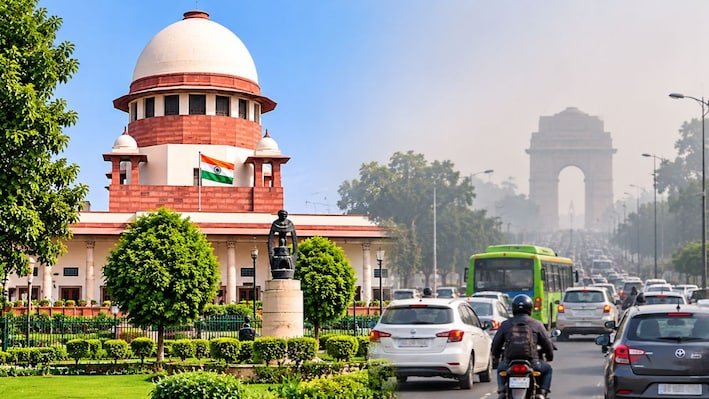
The country’s Supreme Court now seems to be in a mood to take long-term and strict measures instead of temporary measures to provide permanent relief from the deadly air pollution that engulfs the national capital Delhi and the entire NCR region every winter. While hearing the Delhi air pollution case on Monday, 23 November 2026, the Supreme Court clearly indicated that in future, it is considering allowing only ‘Bharat Stage-6’ (BS-VI) standard vehicles to ply on the roads of the capital. A three-member bench comprising Chief Justice (CJI) Surya Kant, Justice Joymalya Bagchi and Justice V. Mohana has also suggested a unique roadmap to completely stop the entry of all commercial vehicles in Delhi within the next five years.
Reviewing pollution control measures during the hearing, Justice Joymalya Bagchi took a tough stance on vehicular emissions. “We are very clear that we will allow only BS-VI vehicles in Delhi, if not in the entire NCR,” he said in a verbal comment. The court believes that lakhs of old and polluting vehicles traveling daily from Ghaziabad, Greater Noida, Gurugram and Faridabad, bordering Delhi, play a big role in making the air of the capital poisonous. If movement is limited to BS-6 vehicles complying with strict emission standards, a permanent improvement in air quality can be achieved.
During the hearing, Chief Justice Surya Kant put forward a visionary solution to reduce the congestion of commercial trucks and goods trains in Delhi. The CJI raised the question as to why such a mechanism could not be developed so that no commercial vehicle would enter within the limits of Delhi. He also clarified that this does not at all mean that the citizens of Delhi should be deprived of essential goods.
CJI Surya Kant said that the population of Delhi needs vegetables, fruits, ration and other essential commodities daily, so the supply chain should not be disrupted. As an alternative, he suggested that big warehouses should be built on the borders of Delhi. Big commercial trucks coming from outside should unload their goods in these warehouses located on the border, and from there the goods should be transported to the markets and colonies of Delhi through small battery operated (electric) or non-polluting vehicles. The CJI admitted that it may not be possible to implement this system this year or next year, but it can be implemented by setting a target for the next five years so that not a single polluting commercial vehicle enters Delhi.
After this comment of the Supreme Court, concern had arisen among millions of vehicle owners who have BS-IV standard vehicles. During the hearing, a lawyer drew the attention of the bench that the authorities have stopped issuing Pollution Control Certificate (PUC) of BS-4 vehicles, due to which vehicle owners are facing a lot of trouble in getting fuel at petrol pumps. On this, Chief Justice Surya Kant clarified that the court is not imposing any immediate restrictions or changes right now. The CJI ordered that status quo should be maintained in the existing system for at least one month and the court will not interfere in it right now. However, under the Delhi government’s Winter Action Plan, the existing restrictions on entry of non-BS-6 petrol and diesel vehicles registered outside Delhi will continue at the borders from November 1.
During the hearing, the court refused to give credit to government agencies alone for the slight improvement seen in Delhi’s air this winter compared to previous years. CJI Surya Kant said in a light but strict tone that some credit for this improvement in air should also be given to nature and favorable weather, because the people of Delhi have been a little lucky this winter.
Along with this, the Supreme Court has expressed displeasure over the slow participation of the neighboring states of NCR – Haryana, Punjab and Uttar Pradesh – and has summoned a detailed compliance report on pollution control measures from all the concerned states and the Commission for Air Quality Management (CAQM). The court also identified flaws in the functioning of the Municipal Corporation of Delhi (MCD) and said that the civic body will have to answer for its negligence. In the next hearing of the case, the court will issue further strict guidelines after reviewing the affidavits of the state governments and the recommendations of the expert committee of CAQM.