 look news india

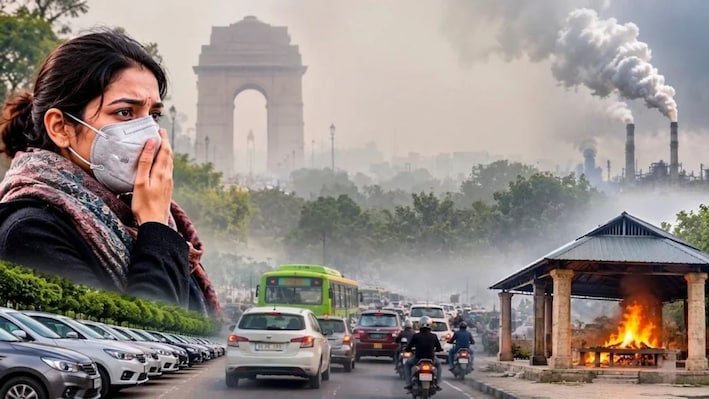
With the onset of winter, the air of Delhi-NCR has once again become extremely poisonous and the Air Quality Index (AQI) continues to remain in the severe category. Every year, big claims and winter action plans are prepared to deal with pollution, but the ground reality seems to be completely opposite to these claims. The latest review report of the Commission for Air Quality Management (CAQM) has exposed the sluggish functioning of government agencies and municipal bodies of the four NCR states including Delhi—Delhi, Uttar Pradesh, Haryana and Rajasthan. According to the report, the agencies have lagged badly in meeting key infrastructure targets set to reduce pollution, such as building green crematoriums, expanding organized parking facilities, paving roadsides and strengthening public transport.
The Air Quality Management Commission, as part of its long-term directives, had given clear targets for setting up eco-friendly ‘green crematoriums’ (CNG and electric crematoriums) to reduce smoke from traditional wood-based cremation in NCR cities. But CAQM’s assessment has revealed that the pace of setting up green crematoriums in most cities, including Delhi, Noida, Ghaziabad, Gurugram and Faridabad, has been extremely slow and many projects are still stuck only on paper or in the tender process.
Similarly, instructions were given to increase multi-level and systematic parking facilities to prevent congestion caused by haphazard parking on roads and toxic emissions from vehicles. The report shows that there has been no concrete progress in expanding parking infrastructure, due to which the problem of illegal parking on the streets of major markets and residential areas continues to persist.
Talking about the performance of the capital Delhi, the CAQM review has shown mixed results. The performance of Delhi government on the front of increasing the fleet of electric buses (E-Buses) and electrification of public transport has been better than other states and Delhi has got positive marks in this category. However, the Municipal Corporation of Delhi and the Public Works Department have failed to meet the targets in terms of effective use of mechanical road sweeping machines to control road dust, deployment of anti-smog guns, repair of broken roads and disposal of construction and demolition (C&D) debris. The agencies have also failed to completely stop the incidents of open burning of garbage.
The NCR districts of Uttar Pradesh—especially Noida, Greater Noida, Ghaziabad, Meerut and Bulandshahr—have achieved partial success in shifting industrial units to clean fuel (PNG) and implementing the rules of DG Sets, but UP seems to be lagging behind in dust control, greening of roadsides and procurement of e-buses for public transport.
At the same time, the report card of districts like Gurugram, Faridabad, Sonipat and Jhajjar of Haryana was also not satisfactory. There has been a decline in incidents of stubble burning in Haryana compared to previous years, but local bodies have lagged far behind the target in terms of dust control at construction sites in urban areas, disposal of mountains of garbage and developing green cremation grounds.
The performance of Alwar and Bharatpur regions of Rajasthan falling under NCR has been found to be the weakest in the CAQM report. According to the Commission, the pace of pollution monitoring system, charging infrastructure for electric vehicles, availability of mechanical sweeping machines and adoption of clean fuel is extremely slow in the NCR districts of Rajasthan. The agencies of Rajasthan have not been able to achieve even the minimum targets set on many key parameters.
After the review meeting, the Air Quality Management Commission has warned the Chief Secretaries of the four states and the heads of the concerned departments in clear words that the pollution control instructions should not be considered a mere formality. The Commission has said that if the incomplete works related to green cremation, parking, dust control and clean fuel are not completed within the stipulated time frame, strict punitive action will be taken against the responsible officials and municipal bodies under Section 14 of the CAQM Act. Experts also believe that unless all the states of NCR coordinate and improve the infrastructure, the people of Delhi-NCR will have to bear the brunt of poisonous air every winter.