 look news india

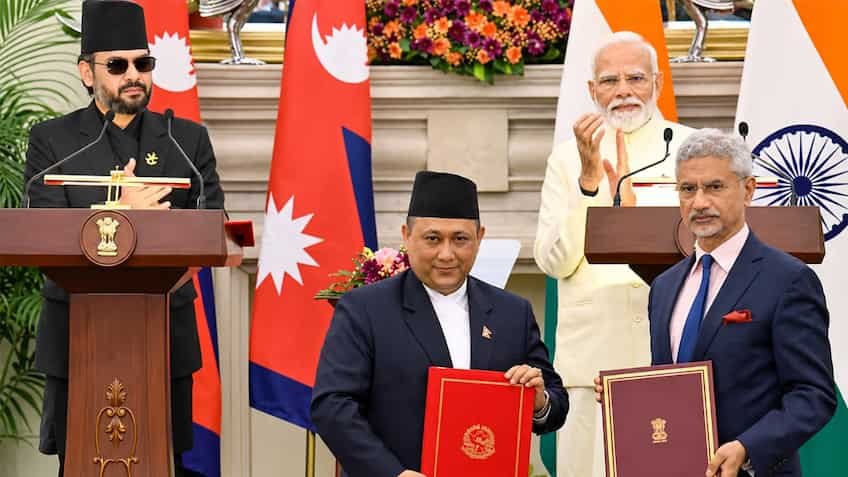
A new and historic chapter has begun in the centuries-old cultural, economic and strategic relations between India and Nepal. Nepal’s Prime Minister Balen Shah reached New Delhi on his first bilateral foreign visit after assuming office in March 2026, visiting India from 22 to 23 November 2026. After the high-level bilateral talks between Prime Minister Narendra Modi and Nepali Prime Minister Balendra Shah at Hyderabad House on Monday 23 November, both the countries released a joint vision document named ‘Viksit Bharat and Samunnat Nepal’. During the meeting, India announced a major economic package of Rs 15,000 crore (24,000 crore Nepali rupees) for the reconstruction and long-term development of flood-hit Nepal, announced the setting up of an offshore campus of the Indian Institute of Technology (IIT) in Nepal and flagged off a new train connecting Ayodhya to Janakpur Dham.
Prime Minister Narendra Modi, during a joint press conference, expressed deep condolences on the huge loss of life and destruction of infrastructure caused by the devastating Bhotekoshi flood in Nepal in August 2026. To recover from this disaster and bring the lives of the affected families back on track, PM Modi announced a ‘Development Cooperation Package’ worth more than 24,000 crore Nepali rupees i.e. 15,000 crore Indian rupees. The funds will be used to rebuild damaged roads, bridges, housing and the Rasuwa-Bhotekoshi corridor, as well as strengthen Nepal’s capacity to deal with future natural disasters. Apart from this, both the countries have also agreed to share real-time data for monitoring of glacier lakes and early warning of floods.
To give flight to the aspirations of the youth of Nepal, Prime Minister Modi made a big announcement to establish an offshore campus of India’s prestigious institute IIT in Nepal. Along with this, a ‘Startup Incubator’ and ‘Innovation Hub’ will also be created in Nepal, so that the young entrepreneurs there can get technical guidance and investment. India has also announced to increase the number of scholarships for Nepali students in the field of law and technology in India and to develop an agro-industrial park to promote food processing in Nepal. Stepping up cooperation in the field of sports, India has promised to help in the development of sports infrastructure in Nepal and especially in the training of Nepalese cricket players.
To give new heights to religious and cultural tourism, both the Prime Ministers jointly inaugurated the virtual ‘Saryu-Kamala Express’ connecting Lord Shri Ram’s city Ayodhya (Uttar Pradesh) to Mata Sita’s birthplace Janakpur Dham (Nepal). Regular operation of this approximately 604 kilometer long rail service will start from 28 November 2026, which will provide very easy travel to the devotees of both the countries.
In the energy and infrastructure sectors, the two leaders laid the foundation stone of the 669 MW Lower Arun Hydroelectric Project and reiterated their commitment to timely complete the Arun-3 project. Along with this, the second phase of Motihari-Amlekhganj petroleum pipeline was inaugurated and the foundation stone of the new petroleum terminal in Jhapa was laid. To facilitate trade, India has also agreed to give Nepal access to the ports of Kandla in Gujarat and Paradip in Odisha and develop a modern Integrated Check Post (ICP) at Banbasa.
Following the bilateral talks, a total of 8 Memorandums of Understanding (MoUs) were exchanged between India and Nepal to institutionalize cooperation in various fields. Following are the major agreements:
-
Space and Communications: Establishment of satellite communication network in Nepal through South Asia Satellite.
-
Security and Forensic Science: Collaboration between the National Defense University (RRU) and the National Police Academy of Nepal, and academic and research partnership between the National Forensic Sciences University (NFSU) and Nepal Police.
-
Administrative Capacity Building: Special program for training and capacity building of Nepalese civil servants (officers).
-
Health and Ayurveda: Bilateral cooperation in modern medical systems as well as Ayurveda and traditional medical systems.
-
Urban Development and Agriculture: Technical cooperation in sustainable urban development and partnership in the development of animal husbandry and fisheries.
Apart from this, both the countries also agreed to ensure easy availability of banking, digital payments and telecom services to the citizens living across the border. At the end of the talks, Nepali Prime Minister Balendra Shah expressed his gratitude for India’s warm hospitality and extended an official invitation to Prime Minister Narendra Modi to visit Nepal, which PM Modi gladly accepted.