 look news india

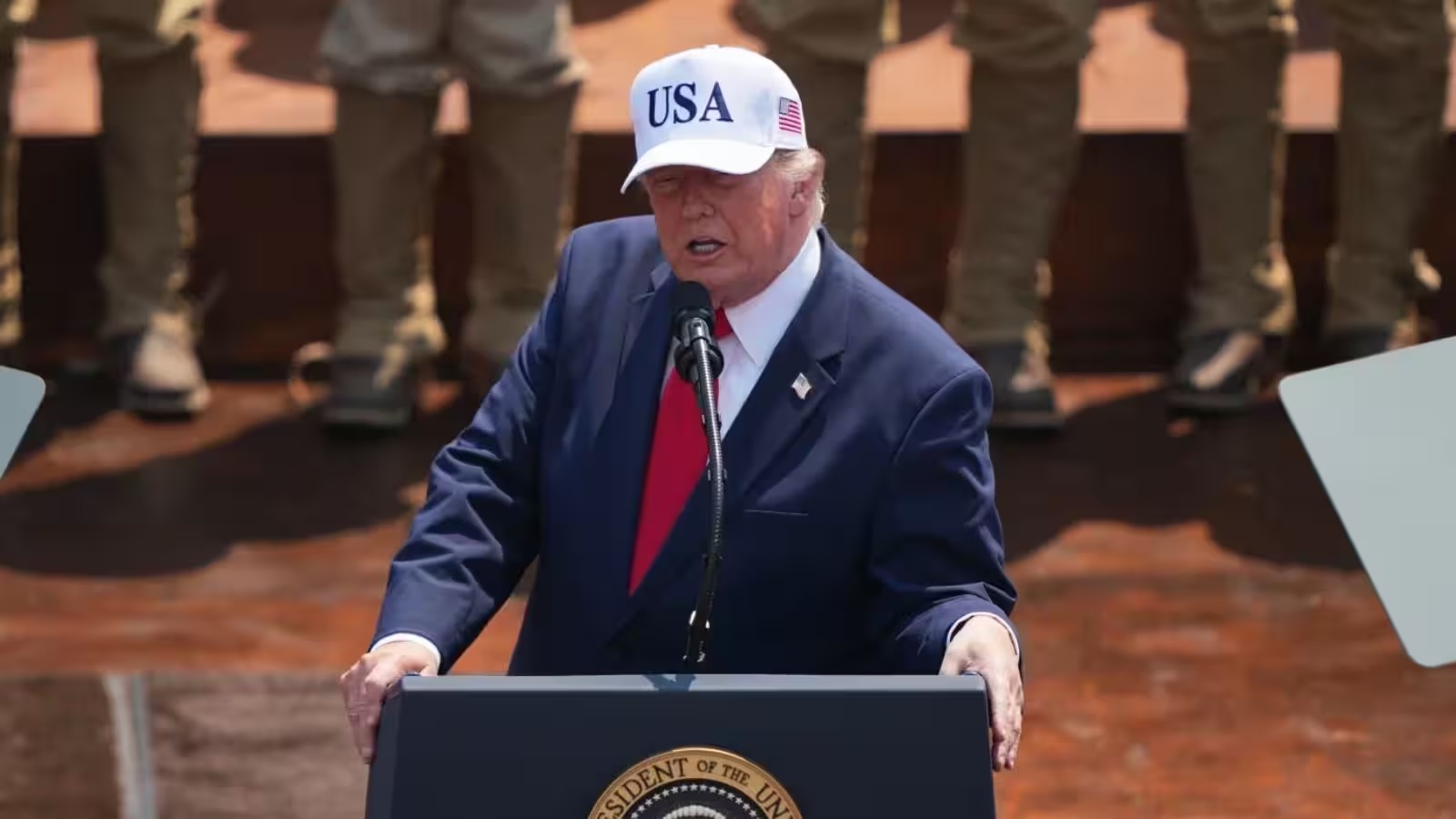
US President Donald Trump has issued a stern warning to Iran amid ongoing tension around the Persian Gulf and the Strait of Hormuz. When he was questioned about Iranian media reports that Iran might try to test or break the US naval blockade, Trump said in a very strong tone that he expected Iran to do so and if they tried to break the blockade, Iranian ships would be at the bottom of the sea like the rest of their navy. This statement has come at a time when there is concern around the world about attacks on oil tankers and maritime traffic near the Strait of Hormuz.
According to reports, for some time, discussions have intensified within Iran regarding resuming oil exports and challenging the American blockade. Incidents involving activities of tankers near Kharg Island and entry of ships into restricted areas have further sensitized the situation. On the other hand, statements by Iran’s Revolutionary Guards (IRGC) and military leadership indicate that Tehran is preparing to show a tough stance instead of bowing to pressure. In such a situation, any conflict situation can push the entire region towards a major military conflict.
The importance of Trump’s statement also increases because America has maintained its heavy military presence in the region. US aircraft carrier strike groups are deployed in the Arabian Sea and vigilance has been increased regarding regional security. Diplomatic analysts believe that on one hand, efforts for negotiation and mediation are going on behind the scenes, while on the other hand, pressure is being put on Tehran through strict military warnings to move forward on any agreement or conditions.
The Strait of Hormuz is one of the most important sea routes for global energy supplies, carrying the majority of the world’s seaborne oil and liquefied natural gas (LNG) trade under normal circumstances. The military conflict, which began on February 28 this year, has had a profound impact on ship movements, insurance costs and energy supply security on the route. Global fuel markets and supply chains are witnessing instability due to tensions and blockades that have been ongoing for several months.
If there is a direct confrontation between the US Navy and Iranian ships, its impact will not be limited to only the two countries. Gulf countries have already expressed concern about new attacks and retaliation, as the Gulf region’s energy and industrial infrastructure has also faced threats during the conflict. Attacks on oil tankers or disruption of sea routes could have immediate downward pressure on crude oil prices, freight rates and the global economy.
Apart from this, the Gulf region is also important in terms of fertilizer and petrochemical products. Therefore, the international community and energy agencies are keeping an eye on whether the blockade and military tension in the Strait of Hormuz prolongs or a way out is found through diplomatic means.
Despite strict military warnings, efforts for dialogue on the diplomatic front have not stopped completely. Donald Trump has indicated that if no agreement is reached with Iran even after the New Year i.e. January 1, then large-scale military action may resume. He also said that the objective of any agreement should be to ensure that Iran cannot acquire nuclear weapons.
On the other hand, Iran’s Foreign Minister Abbas Araghchi has said that the reopening of the Strait of Hormuz could be facilitated if the US accepts Tehran’s fair conditions under international law, acknowledges past mistakes and respects prior commitments. Several regional countries, including Qatar, are playing the role of mediator in reducing tensions and exchanging messages, while high-level meetings are also being held in Washington with the Gulf leadership.
Trump also expressed dissatisfaction with Iran’s way of negotiating, saying that during the talks, only things were being discussed without any concrete progress. Along with this, he encouraged the protesters by mentioning the ongoing protests and domestic challenges in Iran. It is clear from this that America is simultaneously pursuing a strategy on all three fronts – military pressure, economic and maritime blockade and diplomatic messages.
Any development taking place in West Asia and the Persian Gulf is naturally very sensitive for India. India’s energy security, trade relations with the Gulf countries and the security of millions of Indian expatriates living there—all these issues are directly linked to the stability of the region. People in various cities of the country, including Lucknow, the capital of Uttar Pradesh, not only see international news as global politics, but also want to understand what effect such tension can have on fuel, inflation and global trade.
Geographically, the Strait of Hormuz is a narrow but highly strategic waterway located between Iran and Oman, connecting the Persian Gulf with the Gulf of Oman and the Arabian Sea. News of any military confrontation or blockade passing through this route immediately makes global headlines, as its impact is felt from Asia to Europe and America.