 look news india

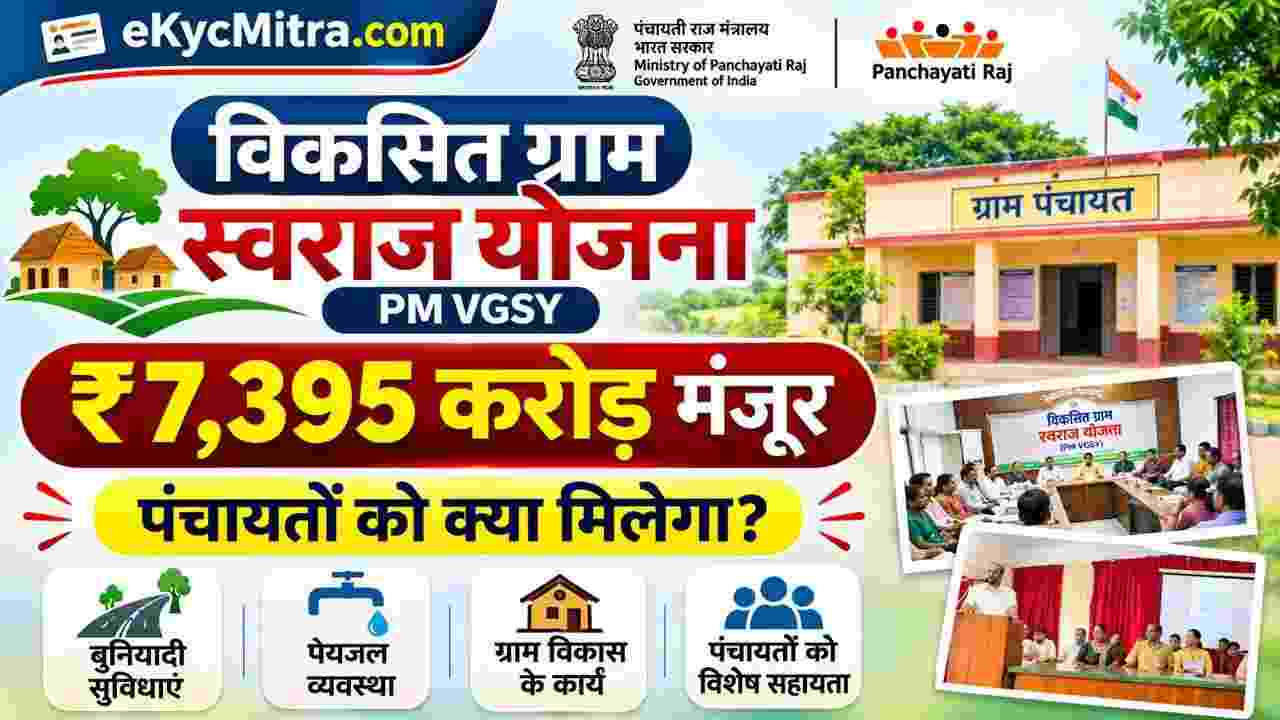
The Central Government has taken a historic step to link the infrastructure, local governance and Panchayati Raj system of rural India with the resolve of ‘Developed India’. The Union Cabinet chaired by Prime Minister Narendra Modi has approved ‘Pradhan Mantri Viksit Gram Swaraj Yojana – PM VGSY’. The government has allocated a huge budget of ₹ 7,395.55 crore for this ambitious Centrally Sponsored Scheme, which will be implemented from the financial year 2026-27 to 2030-31 i.e. during the entire period of the Sixteenth Finance Commission. The central government’s share in this budget will be ₹4,869.48 crore, while the state governments’ contribution has been fixed at ₹2,526.07 crore. More than 2.55 lakh gram panchayats and traditional local bodies of all the states and union territories of the country including Uttar Pradesh, Bihar, Madhya Pradesh, Rajasthan and Maharashtra are going to get the direct benefit of this scheme.
The biggest objective of PM Vikas Gram Swaraj Yojana is to make Gram Panchayats the real axis of local development instead of just an agency implementing government orders. Under this scheme, each Gram Panchayat will be given technical, digital and financial assistance to prepare a ‘Gram Panchayat Development Plan’ (GPDP) based on the ground needs and priorities of its village. Further, Panchayats will be specifically encouraged and trained to develop ‘Own Source Revenue’ (OSR) instead of relying solely on grants from the Central and State Governments. This will enable Panchayats to increase their own income through local taxes, fees and community assets and spend freely on works like village roads, drinking water, sanitation and solar street lights.
Under the scheme, every year high level capacity building and training will be provided to about 32 lakh elected public representatives (village heads, sarpanches, ward members, block and district panchayat members) and panchayat secretaries and officers of panchayats across the country. They will be taught the ins and outs of modern financial management, resource allocation, budgeting and achieving the Sustainable Development Goals (SDGs) at the local level. To promote digital governance, 2.55 lakh holistic development plans will be prepared every year through the eGramSwaraj portal and 100% online financial audit will be ensured through the AuditOnline platform. Besides, state-of-the-art AI-based multilingual digital platforms in 17 Indian languages like ‘Pancham’ will also be used to provide information about government schemes to rural citizens in their own mother tongue.
Under the scheme, the role of Gram Sabhas in villages will be made more effective so that there is complete transparency in the selection of development works and expenditure of funds. Complete data of various public welfare schemes of the government, list of beneficiaries and community assets will be available on a common digital dashboard, making it much easier to identify and monitor development gaps. Apart from this, a target has been set to establish direct communication with at least 1 crore rural citizens through each awareness episode run under the scheme, so that common villagers can also become aware of their rights and the budget of the Panchayat.
The scope of this scheme is not limited only to the general Panchayati Raj areas, but also includes the rural local bodies of those tribal and traditional areas (Non-Part IX Areas) falling outside Part-IX of the Constitution, where the traditional Panchayat system is not in force. On the administrative front, the government has clarified that no new permanent government posts will be created under the scheme, but contractual technical personnel can be appointed as per requirement at the state, district and block levels to provide technical support to the Panchayats at the grassroots level and help in the smooth implementation of the scheme. The scheme, worth a total of ₹7,395.55 crore, will prove to be a milestone in making India’s villages administratively strong, digitally transparent and economically self-reliant over the next five years.