 look news india

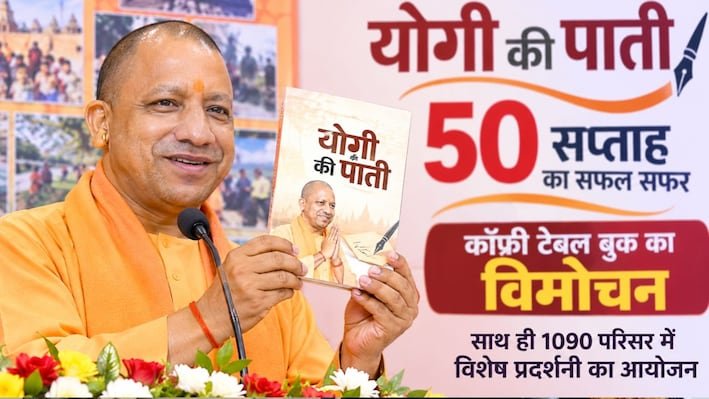
The weekly writing and dialogue series ‘Yogi Ki Paati’, started by Uttar Pradesh Chief Minister Yogi Adityanath with the aim of establishing direct communication with the people of the state, has successfully completed its 50 weeks. According to the information received from the Information and Public Relations Department of the State Government and official sources, on this special occasion, a formal program is being organized in the capital Lucknow, in which Chief Minister Yogi Adityanath will release a special ‘Coffee Table Book’ based on selected letters and messages of these 50 weeks. According to government spokespersons, the purpose of this compilation is to preserve in the form of a document the views written by the Chief Minister to the public on the major policies, public welfare schemes, cultural initiatives and contemporary issues of the state government during the last one year.
According to the official releases of the state government, ‘Yogi Ki Paati’ was started by Chief Minister Yogi Adityanath with the idea of maintaining direct, simple and intimate communication with the citizens of the state. Under this initiative, a letter is issued by the Chief Minister every week, which is distributed to the general public through print media, digital platforms and social media. Government officials say that unlike traditional government press notes or formal announcements, the language of this paper has been kept conversational so that even ordinary citizens of villages, towns and cities can directly understand the priorities and social concerns of the government. In the last 50 weeks, the series has covered diverse topics like good governance, law and order, women empowerment, youth employment, agricultural reforms, infrastructure development and social significance of festivals.
In this program to be organized in Lucknow, the presence of state cabinet members, senior administrative officials, litterateurs, journalists and enlightened citizens from various fields is proposed. According to the information received from the organisers, the coffee table book to be released includes key excerpts from 50 editions of ‘Yogi Ki Paati’ as well as archival photographs related to related schemes and events. This book has been designed in such a way that it can become a compiled reference book of the governance system, policy decisions and public communication style of Uttar Pradesh during the last one year. During the programme, it is also planned to share the experiences of those citizens and readers who regularly read these papers and send their suggestions to the government.
Different viewpoints are seen among political and administrative analysts regarding this communication style of the government. The ruling party and its supporters believe that regular writing like ‘Yogi Ki Paati’ reduces the distance between the government and the public and the information about government schemes reaches the beneficiaries directly without any middleman. According to him, this method of written communication in the digital age has been helpful in clarifying the thinking behind policies. On the other hand, leaders of opposition parties and some political commentators say that the government should focus more on solving inflation, unemployment and local administrative problems at the ground level rather than in papers and publications. The opposition argues that such publications, produced with government resources, are primarily a part of government image building and publicity.
Amidst the criticism and discussions, Uttar Pradesh government officials say that ‘Yogi Ki Paati’ is not just a one-sided message, but through it, common citizens have also been inspired to send their suggestions and feedback. According to the Information Department, awareness programs were also conducted across the state on social issues raised in several papers—such as water conservation, cleanliness campaigns, road safety and de-addiction. Along with the release of the coffee table book in Lucknow, a plan to make the next phase of this dialogue series more digital and interactive is also being considered, so that the participation of the youth of the state and the citizens of rural areas can be further increased.