 look news india

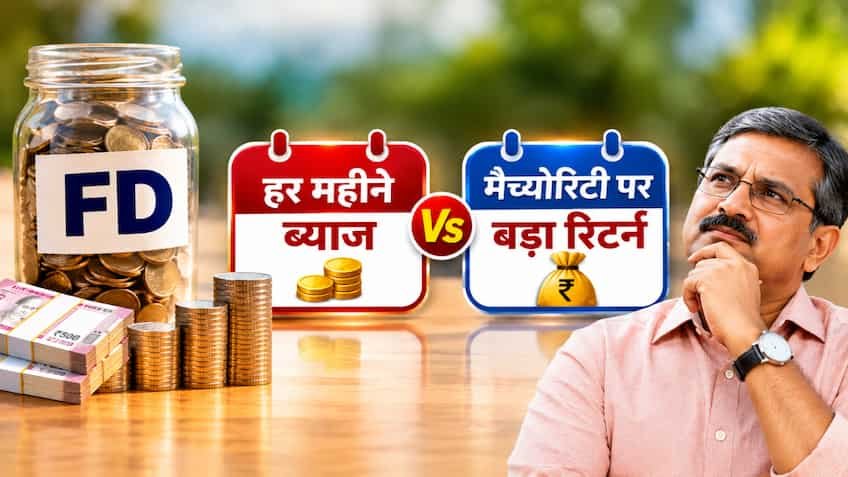
Whenever a person deposits his hard-earned money in a bank fixed deposit (FD), the first option the bank asks while filling the form is how the interest is to be paid – every month (Non-Cumulative/Monthly Payout) or in lump sum on completion of the FD tenure (Cumulative/At Maturity). At first glance it may seem like just a choice of timing of payment, but financially this decision has a profound impact on your overall profits. Both the options have their own importance and mathematics. On one hand, monthly interest provides liquidity for regular household expenses, pensioners and medical bills, on the other hand, by taking interest on maturity, one gets the full benefit of Albert Einstein’s ‘Eighth Wonder’ i.e. Power of Compounding. On a lump sum amount like Rs 5 lakh, this difference translates into profits worth thousands of rupees, which should be understood only after choosing the right option.
It is important to understand the system of interest calculation in banks. When you choose the cumulative option, the bank calculates interest on your deposit on a quarterly basis. The first quarter’s interest gets added to your principal, and in the next quarter you get interest on the principal as well as the previous interest. This is called Quarterly Compounding. On the contrary, when you choose non-cumulative or monthly payout, the bank transfers the interest earned to your savings account every month. Since the bank is giving you money every month even before the end of the quarter, as per RBI rules the bank calculates the monthly interest at the discounted rate so that the effective rate remains equal to the quarter. The result is that your principal always remains at Rs 5 lakh and no compound interest is added on it.
Let us make a direct comparison of both the options by taking a real example of an FD of Rs 5 lakh with a tenure of 5 years and an interest rate of 7.00% per annum. If you deposit Rs 5 lakh in a cumulative FD at 7.00% for 5 years, you will get a total of around Rs 7,07,389 on maturity based on quarterly compounding. That means you will get a total net interest of Rs 2,07,389 in 5 years. Whereas if you choose the option of monthly payout on this same Rs 5 lakh, then under the discounted monthly formula, interest of about Rs 2,897 will be sent to your savings account every month. In 5 years (60 months) you will get total interest of around Rs 1,73,820 and finally your principal amount of Rs 5 lakh will be returned. Thus, in the cumulative option of the same Rs 5 lakh and the same interest rate, you get a direct additional profit of approximately Rs 33,569.
Even though the total returns in cumulative FDs may look higher, the monthly payouts prove to be a boon for those who need regular cash-flow. For retired employees, senior citizens or families who do not have a fixed monthly income, the interest of Rs 2,800 to Rs 3,000 per month makes them self-reliant in meeting the expenses of medicines, electricity-water bills or daily ration. If you leave the interest for maturity, for 5 years you will have to depend on someone else for your daily expenses or withdraw money from the savings account. Apart from this, if a person transfers the monthly interest in the form of SIP every month in a good mutual fund instead of keeping it directly in the savings account, then he can create more wealth in the long run than the cumulative returns of the bank.
It is also very important to know the income tax rules regarding interest on FD. Many people think that in cumulative FD, since the money is received on maturity after 5 years, tax will also be charged at the end, but it is not so at all. As per income tax rules, banks deduct TDS on the interest accrued in your account every financial year, whether the interest is transferred to your account or added to the principal. 10% TDS is deducted if the interest exceeds Rs 40,000 in a financial year for general citizens and Rs 50,000 for senior citizens under Section 80TTB. So if you have no immediate need of money for the next 3 to 5 years and your main goal is to maximize capital, always choose the option of ‘Interest on Maturity’ (Cumulative). If you need a regular pension-like income to run your household, then choose ‘Monthly Payout’ without hesitation.