 look news india

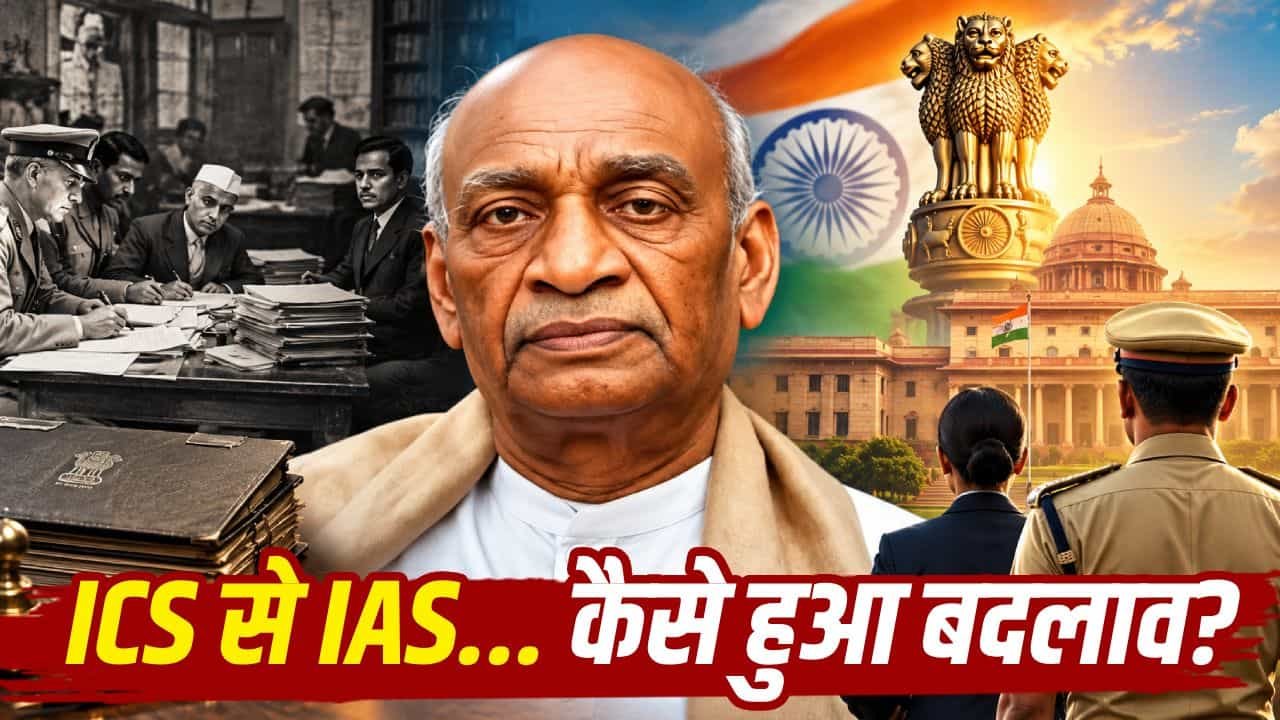
When India became independent on 15 August 1947, the country was not only faced with the challenge of uniting more than 560 princely states, but also faced the difficult situation of saving a nascent nation from disintegrating due to communal riots, the horrors of partition, rehabilitation of millions of refugees and administrative vacuum. If India’s administrative structure broke down at that critical juncture, the unity and integrity of the country could collapse like a house of cards. At the time of such a historic crisis, the country’s first Deputy Prime Minister and Home Minister, the ‘Iron Man’ Sardar Vallabhbhai Patel, played the role of a visionary administrator. He ended the colonial system of the British Raj and laid a strong foundation of an independent, impartial and All India Administrative Service (All India Services – IAS and IPS) in its place. This determination of Sardar Patel transformed the Indian bureaucracy into the ‘Steel Frame of India’, which has played the most decisive role in keeping the country united since independence till today.
During the British rule, the backbone of Indian administration was ‘Indian Civil Service’ (ICS) and the police system was ‘Indian Police’ (IP). The British considered it the steel frame of the British Empire, but its basic character was to protect colonial interests, collect revenue and crush freedom struggle movements. At the time of independence, many prominent leaders and chief ministers within the Constituent Assembly and the Congress Party were completely against this old bureaucracy. His argument was that the officers who lathicharged the freedom fighters and followed the orders of the British could never fulfill the democratic values and aspirations of socialist development of independent India. Many provincial leaders wanted that there should be no All India Service under the Center and that each state should have its own separate administrative system. If this demand were accepted, India would be divided into countless regional administrative camps and it would become impossible to implement a common national policy in the country.
Sardar Patel was the only national leader who saw with a far-sighted vision that this vast and diverse country cannot run smoothly even for a day without a permanent bureaucracy with an efficient, trained and all-India character. During the vigorous debate on this issue in the Constituent Assembly on 10 October 1949, Sardar Patel took a strong stand in his historic speech and clearly said:
“If you do not have an efficient and satisfied All India Service, which can express its views openly and which is not subject to political pressure, then you will not have an organized India. You will not be able to follow this Constitution. The bureaucracy has to be protected from political interference, because it is the real lifeline of the country.”
The opponents had to bow down to this unwavering commitment of Sardar Patel. As a result of this the Indian Constitution Article 311 and 312 Under the Constitution, all India services—the Indian Administrative Service (IAS) and the Indian Police Service (IPS)—were provided constitutional protection and recognition. This provision ensures that no civil servant can be arbitrarily removed from office without a fair investigation and the permission of the President or the Governor.
On 21 April 1947, Sardar Patel addressed the probationers of the first batch of the Administrative Service (IAS) of independent India at the historic Metcalfe House in Delhi. This is why the Government of India every year ‘National Civil Services Day’ on 21st April Celebrates as. In this address, Patel taught the officers to come out of the British mentality and become not ‘rulers’ but ‘public servants’ of independent India. He gave three basic principles to young officers:
-
Political Neutrality: Governments will keep changing, parties with different ideologies will come to power, but the civil service will have to work with complete impartiality within the framework of the Constitution and laws rather than having allegiance to any political party.
-
Fear-free and clear advice: A true civil servant must have the courage to put forth the hard facts and policy truth before his political ministers without any fear or favour.
-
Sense of national unity: Being an officer of an All India Service, his first loyalty should not be towards any narrow caste, religion or province, but towards the entire nation of India.
This unwavering faith of Sardar Patel was not limited to speeches only; He used the administrative machinery to redraw the political map of the country. His most trusted aide and senior civil servant V.P. Menon (VP Menon) He worked shoulder to shoulder with Sardar Patel in drafting the Instrument of Accession of more than 560 princely states and concluding confidential and complex negotiations with the kings and emperors. Patel showed that if the political leadership had the will and the administrative authorities were given complete confidence and independence, the world’s largest political unification could be achieved without shedding a single drop of blood.
Along with the administrative service, Sardar Patel also completely redesigned the structure of the Indian Police Service (IPS) for the internal security of the country. The purpose of the British-era police system was to create fear among the public, while Patel reorganized it as a protector of the fundamental rights of citizens and a sentinel of internal peace in independent India. The newly formed police machinery played an unprecedented role in quelling the partition riots, maintaining order in refugee camps and maintaining law and order in the border states. The country’s highest police training institute established in Hyderabad to provide professional, modern and constitutional values training to the country’s police officers has been named in honor of Sardar Patel’s contribution. ‘Sardar Vallabhbhai Patel National Police Academy’ (SVPNPA) to be done.
Today, even after many decades of independence, if India stands stable as a vibrant democracy, fair elections are held, relief operations during natural disasters (floods, cyclones, earthquakes) are carried out on a war footing and despite conflicts between different states, common policies (such as GST, digital public infrastructure, health and food grains schemes) are implemented across the country, then the credit for this goes to this pan-India administrative structure created by Sardar Patel. He ensured that India’s bureaucracy, instead of being bound to the boundaries of any one region or state, kept the entire country under one administrative thread from Kashmir to Kanyakumari. This is the reason why Sardar Vallabhbhai Patel is called the Father of Modern Indian Civil Services.