 look news india

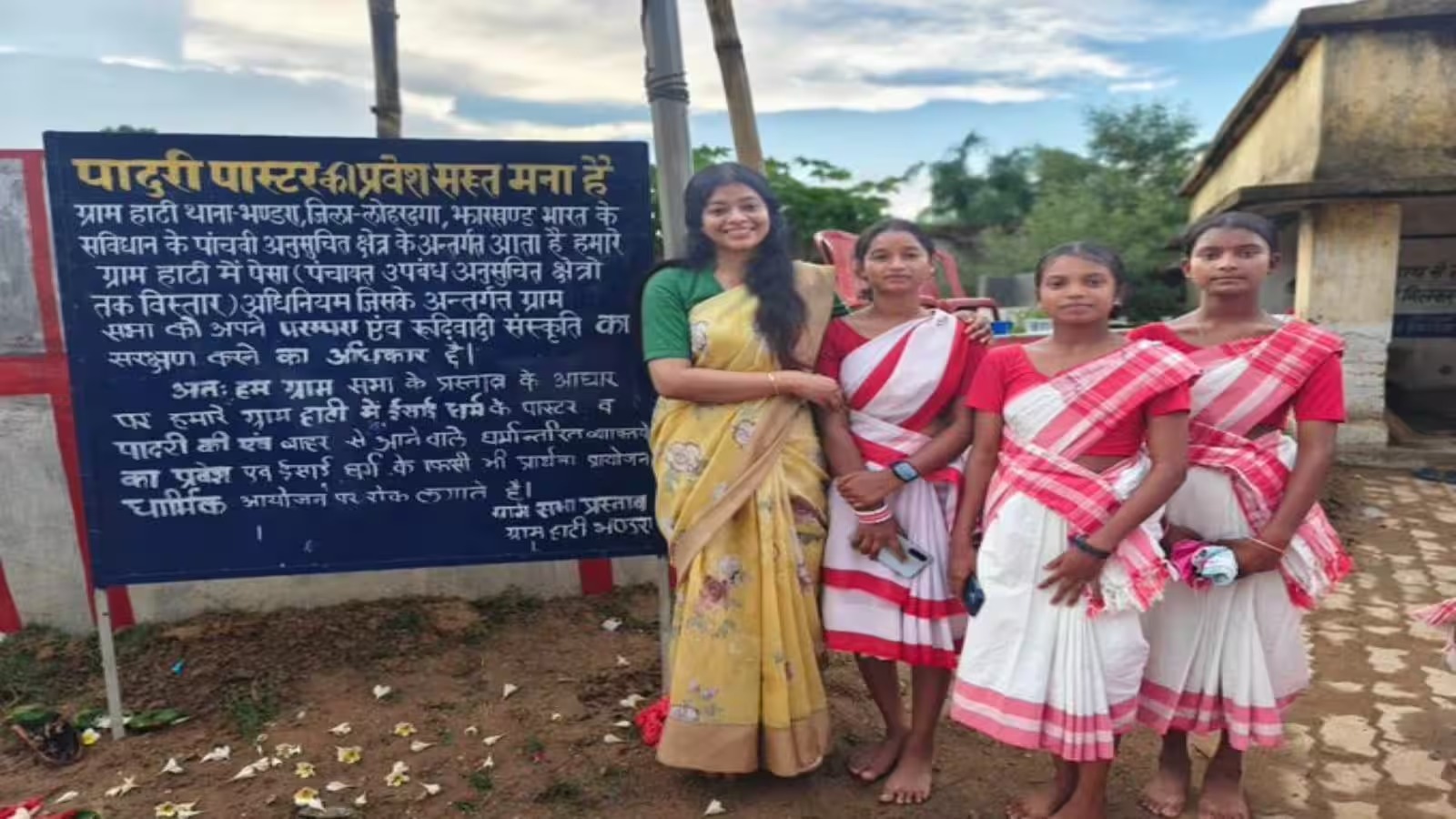
A voice rising from the land of Jharkhand has sparked a new debate in the social and administrative corridors of the entire country. Senior IRS officer and former Panchayati Raj Director Nisha Oraon has made a direct attack on the issue of illegal conversion and warned that if the tribal society does not raise its voice now to protect its traditional identity and culture, then in the coming time its very existence will cease to exist.
Nisha Oraon clearly said that under the Indian Constitution and PESA law, the Gram Sabha has the statutory right to stop any kind of immoral or illegal conversion within the limits of its village.
Highlighting the constitutional powers of Gram Sabhas in tribal dominated areas, Nisha Oraon said that Section 4(d) of the ‘PESA Act 1996’ and Section 23 of the state’s PESA rules give the Gram Sabha full legal right to preserve its traditions, customs and socio-cultural fabric.
He particularly emphasized that if Gram Sabhas put up notice boards or warning boards at the entrances to their villages prohibiting religious conversion or dubious religious activities (such as illegal healing meetings), then this step is completely constitutional and legally justified. He also mentioned that the Supreme Court and various High Courts have also upheld the validity of such steps taken by the Gram Sabha to save its socio-religious system.
Nisha Oraon took a sharp dig at those foreign and colonial minded forces who view India’s soil, its eternal traditions and the ancient nature-worshipping Sarna culture as separate from each other. He said that “describing Hindus and Hindutva as foreigners or outsiders in our own country is a very insidious and well-planned narrative by Vatican-inspired forces”.
He believes that the basic roots of Indian culture and civilization are deeply rooted in Hindutva and nature worship. The forces which are creating distrust in the society and cutting off the tribals from their roots cannot be secular from any point of view. Such disruptive ideologies pose a direct threat to the unity, integrity and sovereignty of the country.
Revealing this bitter truth, Nisha Oraon said that illegal conversion is no longer just a matter of change in faith or method of worship. There is a huge agenda of political, economic and cultural control hidden behind this. Through conversion, planned efforts are being made to capture the tribal lands like ‘Bhuihari’ and ‘Pahanai’, their reserved employment, political representation and benefits of constitutional reservation.
He said that when a tribal leaves his original religion and converts to another religion (baptism), his cultural stream completely changes. People who have abandoned their original traditions, worship practices (e.g. worship of Mahadev, Dharmesh and Singbonga) and ancestral customs should have no right to hold religiously and culturally important traditional tribal positions such as village head, Pahan, Mahato or Padha Raja.
Supporting the restrictions being imposed by Gram Sabhas on the entry of priests or outside preachers in various areas, Nisha Oraon clarified that this is not a restriction on the movement of any common citizen, but a ban on conversions done through superstition and fraud.
Questioning the so-called miraculous cure campaigns being run in the name of ‘healing meetings’, he said that in these meetings, Sarna faith and Gods and Goddesses are insulted, which disturbs the peace of the villages. Gram Sabhas have the right to ban such superstitions, miraculous claims and temptations in their villages.
In her detailed message, Nisha Oraon said that the Constitution makers had created the PESA law so that the age-old lifestyle and practices of the tribals could be saved as ‘living heritage’. Many ancient cultures of the world are now confined to the showcases of museums, but the culture of Indian tribals is still clearly visible in their lives.
He has appealed to all the intellectuals, social workers and citizens of the society who believe in the protection of religion to recognize their constitutional rights without coming under any kind of fear or influence. If Gram Sabhas do not take empowered decisions to save their traditional system, then the coming generations will lose both their identity and rights.